
 Worksheets
Unit 8 Test Review
Total questions: 73
Worksheet time: 43mins
Congress granted LBJ power to go to war with North Vietnam by passing the __________.
Great Society
War Powers Act
26th Amendment
Gulf of Tonkin Resolution
LBJ feared a full-scale invasion of North Vietnam might cause ______ to enter the war.
the USSR
China
Japan
North Korea

What was one result of the Great Society?
Poverty was eliminated in the United States.
the lives of many underprivileged Americans improved.
President Johnson's popularity plummeted.
The federal government shrank considerably.
The Great Society could be most compared to which previous government program?
The Square Deal
Laissez-Faire
The New Deal
The New Frontier
After WWII the United States implemented what was known as the Marshall Plan. The purpose of
this plan was to (SSUSH20a)
Provide returning US soldiers with jobs, homes, and educational opportunities
Supply West Berlin with much needed supplies despite the Soviets’ decision to block access
Provide European nations with the money they needed to rebuild after WWII in order toprevent the spread of communist ideas
Prevent communists from taking over countries in Southeast Asia
“A shadow has fallen upon the scenes so lately lighted by Allied victory…an iron curtain has descended
across the continent.” What was Churchill referring to?
The division that now existed in Europe between the pro-democratic western and Communist controlled eastern nations
The Berlin Wall
JFK’s actions when he learned there were Soviet missiles in Cuba
Truman’s response to the success of China’s communist revolution
A similarity between the Red Scare of the 1920s and McCarthyism in the 1950s was that during each
period (SSUSH20b)
Thousands of American citizens were expelled from the US
The Communist Party gained many members in the US
Many government employees were convicted of giving secrets to the USSR
The civil liberties of American citizens were threatened
Mao Zedong concerned leaders in the United States because he was
A militaristic leader who led Japan down an aggressive path
A communist revolutionary who ultimately took over China
A communist leader who allowed the USSR to place missiles ninety miles off the coast of Florida
The communist leader of North Korea who was intent on conquering the South
What is the Eisenhower Doctrine?
It used Containment to stop communism from spreading to the Middle East
It focused US's attention away from Communism and more towards economy
It attempted to solve segregation in U.S
It declared war between U.S. and Russia


Where was Korea divided?
18 parallel
34 parallel
38 parallel
15 parallel

Who led the Nationalists in a civil war in China and was forced to retreat to Taiwan?
Chiang Kai-shek
Mao Tse-tung


Where was Korea divided?
18 parallel
34 parallel
38 parallel
15 parallel
Who led the Nationalists in a civil war in China and was forced to retreat to Taiwan?
Chiang Kai-shek
Mao Tse-tung
What led to the creation of first suburban housing developments?
Truman Doctrine
Marshall Plan
Brown v. Board of Education
G.I. Bill of Rights
What was a govt. sponsored creation of infrastructure and US military moved more efficiently?
GI Bill of Rights
National Interstate and Defense Highways Act
Marshall Plan
Truman Doctrine
Who made sweeping claims against people with no evidence to back charges?
Sputnik
McCarthy
Truman
Eisenhower
Because racial tension in the military needed to be reduced and Korean War need for more troops
Truman signed GI Bill of Rights
Truman signed executive order integrating military
Eisenhower ordered National Interstate and Defense Act
McCarthy enacted the Marshall Plan
The creation of a national space program (NASA) was a main effect of
McCarthyism
the Korean War
the launch of Sputnik
The Marshall Plan

What was the GI Bill?
Helped Veterans afford houses
Helped people named Bill buy a house
Discrimination bill against African Americans
The Great Society legislation enacted under President Lyndon B. Johnson is an example of
the increased power of the states to deal with economic problems
a growth of conservatism in the United States
direct Federal involvement in the U.S. economy to address the problems of poverty
decreased support for the Vietnam War in the late 1960s
18. The assassinations of Martin Luther King, Jr. and Robert Kennedy in 1968 led to
Stricter gun control laws
The decision of president Johnson not to run for reelection
Increased involvement in the Vietnam conflict
Increased social turmoil around the country
Which is NOT a result of the 1968 Democratic National Convention?
Ruins Democratic Party
Leads to the election of Richard Nixon
Rise of conservatism
Robert Kennedy is assassinated
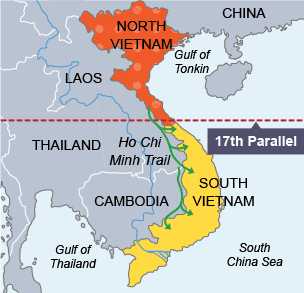
The Gulf of Tonkin Resolution (1964) provided congressional support for
withdrawing from the United Nations
expanding the Alliance for Progress
escalating military action in Vietnam
reestablishing trade with Cuba
President Nixon’s policy of reducing the number of American troops in Vietnam allowing South Vietnam to assume more the fighting was known as…
Vietnamization
Detente
Watergate
Brinkmanship
The War Powers Act of 1973 was intended to affect the balance of power between the President and Congress by
allowing troops to be sent overseas without the president’s consent
requiring the president to remove all United States troops from Southeast Asia
permitting the president to enter treaties without Senate approval
placing limitations on the president’s ability to keep troops in hostile situations
The secret documents detailing the history of American involvement in Vietnam, which were obtained by Daniel Ellsberg and later printed by the new York Times, were known as the
Watergate tapes
Nixon memoranda
Pentagon Papers
Warren Report
The role of government in the economy has grown significantly since...
We adopted the Constitution.
We started the space program.
The Great Depression.
World War II.
A federal program whose purpose is to provide health care for those disabled or over the age of 65 ?
Medicare
Medicaid
Social Security
FICA
After WWII the United States implemented what was known as the Marshall Plan. The purpose of
this plan was to
Provide returning US soldiers with jobs, homes, and educational opportunities
Supply West Berlin with much needed supplies despite the Soviets’ decision to block access
Provide European nations with the money they needed to rebuild after WWII in order to prevent the spread of communist ideas
Prevent communists from taking over countries in Southeast Asia
The Tet offensive of 1968 during the Vietnam War demonstrated that
the army of South Vietnam was in control of the North
the Vietcong were losing hope
America was nowhere near winning the war
a negotiated settlement was in the near future
What is the correct sequence of the following events?
1) Gulf of Tonkin Resolution
2)Geneva Accords
3)Vietnamization
4)Tet-Offensive
1,2,4,3
2,1,4,3
4,1,3, 2
1,4,2,3
Kennedy approved an invasion plan called
Destroy Castro
Operation Cuba's Biggest Regret
The Bay of Pigs Invasion
The U-2Coastal Operation
The Soviet Nuclear Crisis
Which of the following statements is true about the Bay of Pigs?
Castro was alert and prepared for a rebel attack because the first rebel soldiers had missed their target.
Soviet ships carrying medical supplies and food were refused entrance to the Bay of Pigs and had to turn back.
Castro made an alliance with Gorbachev, who placed missiles in Cuba which were directed at the US.
A US spy plane observed the Cubans placing Soviet submarines in the Bay of Pigs, which prompted the US to attack Cuba.
The Bay of Pigs is a small farming community that was being used to disguise the Soviet missiles being set up on the coast of Cuba.
"Within the past week, unmistakable evidence has established the fact that a series of offensive missile sites is now in preparation on that imprisoned island."
Which 1962 leader said this?
Nikita Khrushchev
John F. Kennedy
Harry Truman
Wang Chung
Hideki Tojo
Shutting off of a port to keep people or supplies from moving in or out.
blockade
containment
perestroika
satellites
An attempt by the Soviet Union in 1962 to place nuclear missiles in Cuba directed toward the United States.
Cuban Missile Crisis
Iron Curtain
Berlin Airlift
Detente

