
NEW
Font size
S
M
L
XL
 Worksheets
Air Test Review #4- Ecology
Total questions: 54
Worksheet time: 2hrs 39mins
Name
Class
Date
1.

All of the living and nonliving things in an area that interact with each other are called a/an ______.
a)
community
b)
habitat
c)
population
d)
ecosystem
2.

An area where an organism finds food, shelter and water in a specific arrangement
a)
niche
b)
biosphere
c)
biome
d)
habitat
3.

The non-living part of an ecosystem
a)
Ocean
b)
Lava Flow
c)
Birds
d)
Abiotic
4.
The living part of an ecosystem
a)
Biotic
b)
Abiotic
c)
Mother Earth
d)
Flowers
5.

Organisms that look similar and can produce fertile offspring
a)
Species
b)
Fish
c)
Community
d)
Trees
6.
Two or more members of a particular species living and interacting in the same area
a)
Community
b)
Population
c)
Organisms
d)
Biosphere
7.

Different populations living and interacting with each other in the same area
a)
Biome
b)
Ecosystem
c)
Community
d)
Niche
8.

The area between the highest mountain and the deepest ocean where life can be found
a)
Biosphere
b)
Biome
c)
Farm
d)
Ecosystem
9.

The diagram below shows the cycling of nutrients in an ecosystem.
The removal of which of the following groups would cause an immediate decrease in the amount of energy flowing through the system?
The removal of which of the following groups would cause an immediate decrease in the amount of energy flowing through the system?
a)
Producers
b)
Consumers
c)
Decomposers
d)
Inorganic nutrients
10.
What is the term for each step in the transfer of energy and matter within a biological community?
a)
energy path
b)
food web
c)
trophic level
d)
food pyramid
11.

which symbiosis is this
a)
parasitism
b)
mutualism
c)
commensalism
d)
nonalism
12.

symbiotic relationship in which both organisms benefit
a)
competition
b)
Mutualism
c)
nitrogen fixation
d)
energy pyramid
13.
The energy at each trophic level in the pryamid of energy decreases by a factor of ____.
a)
10
b)
1
c)
100
d)
2
14.

What does a food web represent?
a)
All connections of energy flow throughout all organisms in a habitat.
b)
The specific ways that mutualism is carried out.
c)
A single pathway or energy flow between organisms.
d)
How carnivores get their food.
15.

symbiotic relationship in which one organisms benefits and the other organism is not affected
a)
invasive (non-native) species
b)
mutualism
c)
nitrogen fixation
d)
commensalism
16.

A pond ecosystem is shown in the diagram below. Which statement describes an interaction that helps maintain the dynamic equilibrium of this ecosystem?
Which statement describes an interaction that helps maintain the dynamic equilibrium of this ecosystem?
Which statement describes an interaction that helps maintain the dynamic equilibrium of this ecosystem?
a)
The frogs make energy available to this ecosystem through the process of photosynthesis.
b)
The algae directly provide food for both the rotifers and the catfish.
c)
The green-backed heron provides energy for the mosquito larvae.
d)
The catfish population helps control the populations of water boatman and waterfleas.
17.

A food chain is illustrated below:
The arrows represented most likely indicate
The arrows represented most likely indicate
a)
A. Energy released from metabolism into the environment as heat.
b)
B. Oxygen released from metabolism produced by cellular respiration.
c)
C. The absorption of energy from the environment that has been created.
d)
D. The transport of glucose away from the organism through photosynthesis.
18.
When an environment has reached its carrying capacity for a certain population, which of the following is true?
a)
Growth and immigration rate is equal to death and emigration rate.
b)
Growth and immigration rate is greater than death and emigration rate.
c)
Growth and immigration rate is less than death and emigration rate.
d)
Growth rate is exponential.
19.
Angel was trying to explain carrying capacity to her mother. Which of the following descriptions is accurate? Carrying capacity is :
a)
the maximum number of individuals that an ecosystem can sustain.
b)
the ability of an environment to accommodate a growing population.
c)
the greatest number of individuals that an area can sustain over the long term.
d)
the maximum number of species that can co-exist in an area.
20.
Jenn is studying a population of fish found in a pond that has a decreasing carrying capacity. Which of the following factors would not decrease the carrying capacity of her fish?
a)
drought
b)
flooding
c)
food shortages
d)
a freeze
21.
An animal population decreases from 800 individuals to 600 individuals. Which of the following could explain this change in population size?
a)
The population size of the animal’s predator increased.
b)
The emigration rate of the animals from the population decreased.
c)
The number of breeding pairs in the animal’s population increased.
d)
The number of species competing with the animal for food decreased.
22.

Mullet are local estuarine fish that move in schools and feed on plankton and plant matter. Natural predators of the mullet include spotted sea trout, sharks, pelicans and dolphins. The graph below shows how the number of mullet in an area has changed over time.
Based on the data, one student concludes that a new predator was introduced into the area during this time period. Which of the following is a likely alternate explanation for the change in the mullet population?
Based on the data, one student concludes that a new predator was introduced into the area during this time period. Which of the following is a likely alternate explanation for the change in the mullet population?
a)
mullet prey increased in the area
b)
mullet parasites decreased in the area
c)
the temperature of the area increased
d)
the amount of aquatic plants in the area decreased
23.
The pH of the water in several lakes in Norway and Sweden had decreased to below 5.0 due to an increase in acid rain. Which of the following is most likely to happen in these lakes?
a)
the decline of several fish populations.
b)
an increase in numbers of fish
c)
an increase in the amount of primary producers
d)
increased predator-prey relationships
24.
Which of the following is a limiting factor in a population of organisms
a)
reproductive replacement
b)
life spans of the members
c)
fluctuations in atmospheric temperature
d)
availability of food
25.
The common brushtail possum is a marsupial native to Australia. This possum was introduced to New Zealand where it had no natural predators and had an abundant food supply. Which of these likely occurred a few years after the introduction of this possum to New Zealand?
a)
The possums became extinct.
b)
The possums developed shorter life spans.
c)
The possum population grew to a larger size.
d)
The possum population evolved into a different species.
26.
The number of pythons found throughout Everglades National Park hasincreased in recent years. These huge snakes are not native to Florida and are believed to have been released into the wild by pet owners. Wildlife biologists have initiated attempts to capture and remove these pythons. Which statement best explains the biologists' reasons for removing these pythons from the Everglades?
a)
The pythons could upset the territorial boundaries of native organisms.
b)
The pythons could adapt to overcome diseases common to native snakes.
c)
The pythons could prey on native organisms and cause native population to decline.
d)
The pythons could begin to interbreed with native snakes and produce a more successful species.
27.
Why are there so few aquatic plants and phytoplankton that live at the bottom zones in the ocean?
a)
The ocean floor contains many decomposers.
b)
Most sunlight is absorbed before reaching these levels.
c)
Water is a limiting factor.
d)
The temperature in these zones is extremely low.
28.
Which kind of growth does the human population follow? It is described as a J-shaped curve.
a)
Exponential Growth
b)
Logistic Growth
c)
Outstanding Growth
d)
Minimal Growth
29.

What point on the graph represents the carrying capacity?
a)
A
b)
B
c)
C
d)
D
30.

What is the carrying capacity of the following graph?
a)
1000
b)
8000
c)
800
d)
600
31.
As a population of a species increases within a territory, which of the following most likely also increases?
a)
Immigration
b)
Food supply
c)
Carrying capacity
d)
Competition
32.
No two species can occupy the same niche
a)
Competitive Exclusion Principle
b)
Limiting Exclusion Theory
c)
Competitive Limiting Principle
d)
Limiting Competitive Theory
33.
Logistic growth has 3 phases. In Phase 1, the population grows rapidly. In Phase 2, population grows slowly. In Phase 3, growth stops. What causes growth to stop in the 3rd phase of logistic growth?
a)
Emigration
b)
Immigration
c)
Exponential Growth
d)
Carrying Capacity
34.
If the number of births in a population is the same as the number of deaths in a population, what will happen to the growth of the population?
a)
It will increase.
b)
It will decrease.
c)
It will stay the same.
d)
It will fluctuate.
35.

What type of growth curve is pictured?
a)
exponential
b)
logistic
c)
predator-prey
d)
invasive
36.
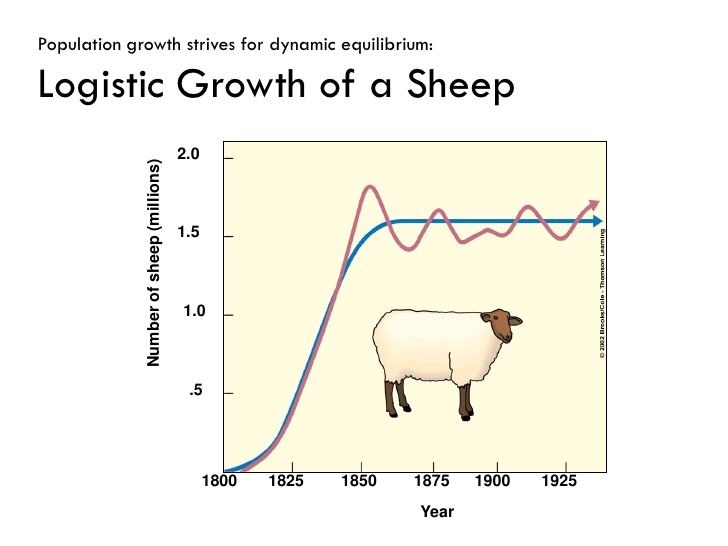
What is the carrying capacity for this sheep population?
a)
1.8 million
b)
1.25 million
c)
1.6 million
d)
1.o million
37.

What is the approximate carrying capacity of Paramecium aurelia cultured alone?
a)
150
b)
400
c)
450
d)
500
38.

Will competition increase/decrease the carrying capacity of an ecosystem for the animal in competition?
a)
Decrease
b)
Increase
39.

Which of the following statements best supports the graph?
a)
Infant mortality rate has increased in most countries.
b)
Access to modern medicine has increased in many areas.
c)
War and disease have increased death rates in many countries.
40.

When creating a exponential or logistic growth graph which axis would be labeled "# of penguins" if you are making a graph about population growth?
a)
X axis
b)
Y axis
c)
J-shaped
d)
S-shaped
41.
When creating a exponential or logistic growth graph which axis would be labeled "time" if you are making a graph about population growth?
a)
X axis
b)
Y axis
42.
Suppose that a species of toads is introduced into a new environment in an attempt to reduce the population of insects. The toad has no natural predators in the new environment. The toad population would most likely
a)
Increase exponentially at first, but then regulate based on carrying capacity.
b)
Increase logistically at first and then increase exponentially.
c)
Decrease
d)
No Change
43.
Which of the following is TRUE of predator/prey relationships?
a)
The amount of prey does not affect the number of predators.
b)
Herbivores are limited by the number of prey in an ecosystem.
c)
Humans are not considered predators.
d)
The number of predators is determined by available prey.
44.
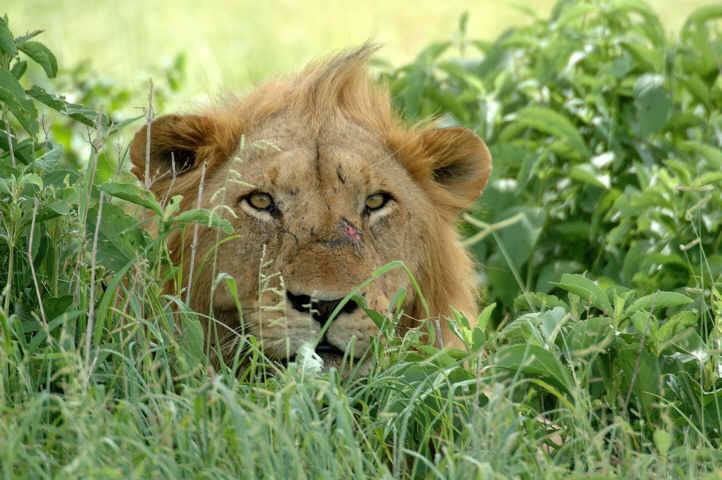
How does the carbon in grass become part of a lion?
a)
The lion eats the grass
b)
Carbon from grass doesn't end up in a lion.
c)
The carbon ends up in the lion's food chain.
d)
The lion breathes in carbon given out by the plant
45.
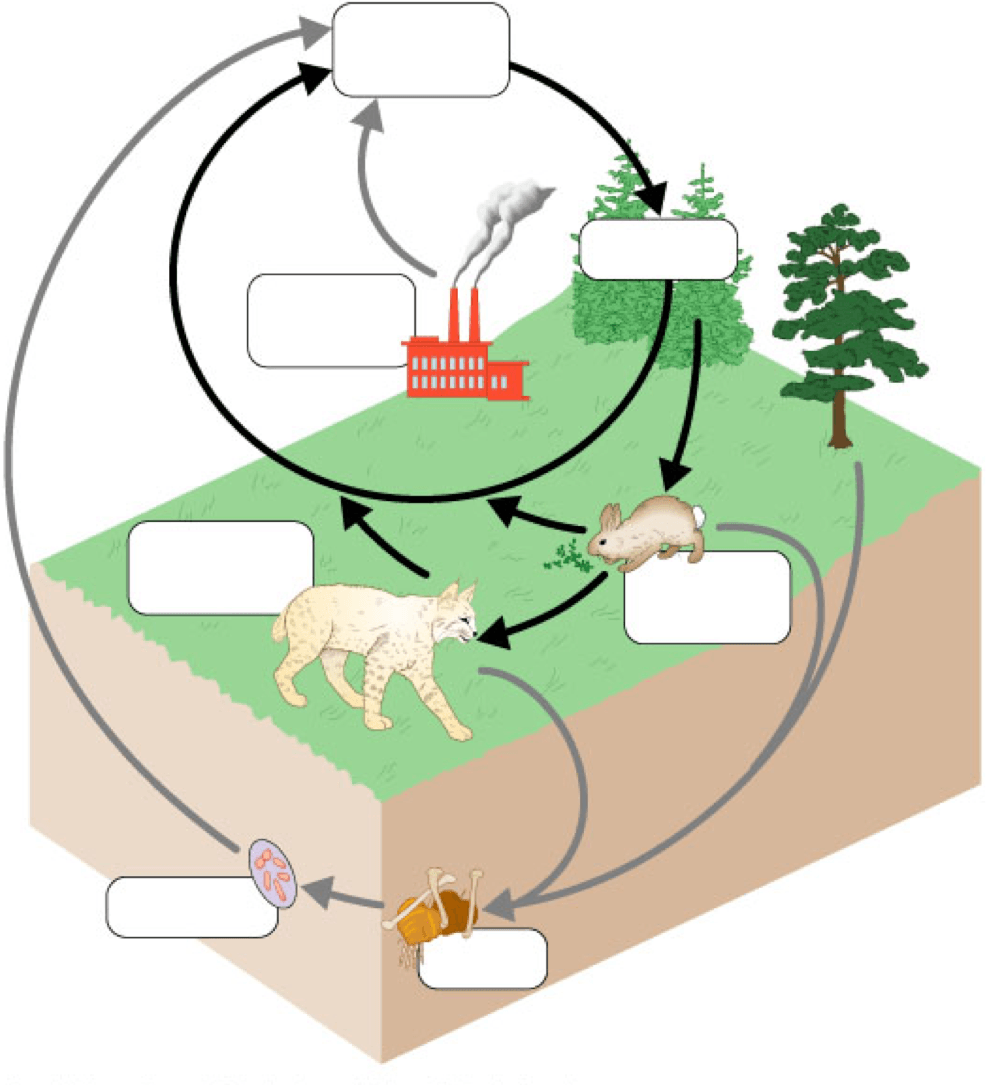
In what process is Carbon transformed into chemical energy?
a)
Photosynthesis
b)
Respiration
c)
Primary Production
d)
Secondary Production
46.
How animals get the nitrogen they need
a)
from the air they breathe
b)
from the water they drink
c)
from the food they eat
d)
from the Sun
47.
Organisms that play a role in the nitrogen cycle
a)
only plants
b)
only animals
c)
only bacteria
d)
plants, animals, & bacteria
48.

The process where excess nutrients enter a body of water causing overgrowth of aquatic plants and algae...
a)
Eutrophication
b)
Acid Precipitation
c)
Nitrogen Fixation
d)
Decomposition
49.
What is the role of decomposers in an Ecosystem?
a)
They recycle matter and nutrients to form fossil fuels
b)
They are burn and release as carbon dioxide
c)
Decomposers are responsible to turn oxygen into carbon dioxide
d)
They recycle energy back to the sun
50.
Building proteins and DNA is the reason organisms need what substance?
a)
Water
b)
Carbon
c)
Nitrogen
d)
Calcium
51.

Identify the cycle pictured.
a)
The Water cycle
b)
The Carbon cycle
c)
The Nitrogen cycle
d)
The Phosphorus cycle.
52.

Identify the cycle pictured.
a)
The Water cycle
b)
The Carbon cycle
c)
The Nitrogen cycle
d)
The Phosphorus cycle
53.
Which nutrient is not cycled through the atmosphere?
a)
carbon
b)
nitrogen
c)
phosphorous
d)
water
54.
What role do decomposers play in the phosphorous cycle?
a)
absorb phosphorous
b)
release phosphorous into atmosphere
c)
return phosphorous into the soil
d)
combustion
Reset

