
 Worksheets
Chap. 11 Test Review
Total questions: 48
Worksheet time: 38mins

Name the Genetic Disorder: A dominant genetic disorder; affects the nervous system; first symptoms do not appear until between the ages of 30 - 50 years old, some symptoms include paranoia, hallucinations, and uncontrollable movements.
Achondroplasia
Albinism
Huntington's Disease
Tay-Sachs Disease

Name the Genetic Disorder: Autosomal dominant genetic condition; affects height and body size; adult height is about 4 ft.
Huntington's Disease
Tay-Sach's Disease
Turner Syndrome
Achondroplasia

Name the Genetic Disorder: recessive genetic disorder; gene found on chromosome 15; characterized by lack of enzyme that breaks down fatty acids; predominant among Jews of eastern European descent
Huntington's Disease
Tay-Sach's Disease
Sickle Cell Anemia
Parkinson's Disease

Which describes the 23 pairs of human chromosomes?
1 autosome pair; 22 sex chromosome pairs
2 sex chromosome pairs; 21 autosome pairs
2 autosome pairs; 21 sex chromosome pairs
1 sex chromosome pair; 22 autosome pairs

TRUE or FALSE: There are four alleles for blood type, making blood type a good example of multiple alleles.
True
False

Name the Genetic Disorder: caused by altered genes; results in lack of skin pigment
Albinism
Cystic Fibrosis
Hemophilia
Achondrolasia

When both alleles are expressed in the heterozygous condition
Incomplete dominance
Codominance
Complete dominance
Intolerance

The following picture represents what pattern of inheritance?
Complete dominance
Incomplete dominance
Co-dominance
Sex-linked inheritance

Name the Genetic Disorder: recessive genetic disorder; characterized by the body's inability to tolerate galactose
Sickle Cell Anemia
Parkinson's Disease
Cystic Fibrosis
Galactosemia
Name the Genetic Disorder: recessive genetic disorder; affects mucus-producing glands, digestive enzymes, sweat glands, and is most common among Caucasians
Cystic Fibrosis
Parkinson's Disease
Achondroplasia
Huntington's Disease

Blood type and Coat Color of Rabbits are examples of:
Incomplete Dominance
Multiple Alleles
Codominance
Mendel's Laws
Name the Genetic Disorder: affects the red blood cell and their ability to transport oxygen; red blood cell is crescent shaped; symptoms can include abdominal pain, ulcers, fatigue, fever, and stroke
Tay-Sachs Disease
Sickle Cell Anemia
Achondroplasia
Huntington's Disease
If a gene is found only on the X chromosome and not the Y chromosome, it is said to be what?
sex-linked trait
polygenic trait
codominant trait
incomplete dominance trait
What is NOT a possible genotype for someone with type B blood?
BB
AB
BO

What pattern of inheritance is shown in this image?
Codominance
Incomplete dominance
Polygenic traits

How many kids did the mother and father from the first generation have?
2
4
5
6

In the second generation-how many people have the disease or display the physical trait?
2
4
5
6

What do half colored symbols represent?
The individual is a carrier (heterozygous).
The individual expresses the trait.
The individual has both recessive alleles.
The individual has both dominant alleles.
Which of the following is homozygous dominant?
Yy
Y
yy
YY
Which of the following genotypes is heterozygous?
Bb
BB
bb
B

How are individuals I-2 and III-5 related?
Grandpa and grandson
Mom and son
Uncle and nephew
Grandma and grandson

Looking at this pedigree, how many female family members are carriers?
1
3
10
7

Looking at this pedigree, how many family members have the disease?
4
7
All
None

Based on the data on human height, it is reasonable to conclude that height is an example of a(n) ________ trait.
polygenic
codominant
x-linked
multallelic
One form of a gene is called_______________
a DNA
a Phenotype
a trait
an allele
How many PAIRS of sex chromosomes do humans have?
23
46
1
2
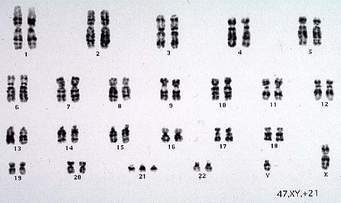
Based on the Karyotype shown, at which chromosome pair can we identify a genetic disorder?
Chromosome pair 5
sex chromosomes
Chromosome pair 21
There are no chromosomal disorders
Testing the amniotic fluid for birth defects.
Chorionic Villi Sampling
Ultrasound
Amniocentesis
Embryo Test
Cell division during which sister chromatids fail to separate properly
Epistasis
Incomplete Dominance
Nondisjunction
Telomere
Codominance

For the following Karyotype, please answer the following question...
What is the sex of the person in the Karyotype?
Male
Female
For the following Karyotype, please answer the following question...
As far as you can tell, according to the karyotype graph, does the person have a "normal" karyotype (meaning no deletions or additions of chromosomes) or does the person show an abnormality, such a deletion or addition of a chromosome?
The karyotype appears normal. There are no visible deletions or additions of chromosomes.
The karyotype appears to have abnormalities. There are visible deletions or additions of chromosomes.

Alleles that are on an X or Y chromosome
sex-linked trait
heredity
genes
alleles
chromosome

inheritance pattern in which an offspring's phenotype is a combination of its parents' phenotypes
dominance
sex-linked traits
incomplete dominance
mutation

The visual representation of an individual's chromosomes is a
phenotype
genotype
karyotype
stereotype
Someone who has one recessive allele for a trait but doesn’t show it.
Dominant
Recessive
Mutant
Carrier
The passing of traits from parent to offspring
Genetics
Heredity
Biology
Zoology
Human chromosomes that determine gender
C and D
O and P
X and Y
A and B
When you cross two parents, each parent is responsible for passing _______ of their two alleles for each individual trait.
1
2
3
4
A rare genetic disorder where in the blood does not clot in a typical way that it should due to insufficient blood-clotting factors.
Sickle Cell Anemia
Hemophilia
Phenylketonuria
Rett Syndrome
In autosomal dominant inheritance, only one copy of a defective gene (from either parent) is necessary to cause the condition.
TRUE
FALSE

The karyotype diagram below represents a human female with the genetic disorder known as Turner syndrome. Chromosomal analysis of this karyotype reveals the mutation is a result of
a missing X chromosome
a missing Y chromosome
an extra 21 chromosome
missing chromosome #9

The karyotype diagram below represents a human male. Chromosomal analysis of this karyotype reveals the abnormality in this karyotype is:
a missing X chromosome
a missing Y chromosome
an extra 21 chromosome
missing chromosome #9

True or False. Pictured above is a karyotype of a male human being.
True
False
What process occurs during meiosis that can result in chromosomal disorders?
crossing over
non-disjunction
anaphase I
prophase II

Colorblindness is more common in males than in females because......
fathers pass the allele for colorblindness to their sons only
the allele for colorblindness is located on the Y chromosome
the allele for colorblindness is recessive and located on the X chromosome
males who are colorblind have two copies of the allele for colorblindness

What are the possible genotypes for this cross?
(Click the picture to see it without the text)
TT = 25% Tt= 50% tt=25%
all tall
TT= 75% tt = 25%
Tt = 100%

Why are there no white rabbit babies?
The white gene is not present in any of the babies.
It takes two recessive genes to show the trait.
Grey is a better color.
Baby five will be white.
Incomplete dominance means that the traits are
expressed equally
dominant
recessive
blended

