
 Worksheets
Force & Motion Review Game
Total questions: 65
Worksheet time: 1hrs 2mins

What will the net force on the soccer ball be?
50 N to the left
50 N to the right
200 N to the left
200 N to the right

What is the net force on the car?
400 N forward (left)
0 N (balanced forces)
200 N forward (left)
200 N backward (right)
What effect does friction have on a moving object?
it causes the moving object to slow and eventually stop
it causes the moving object to speed up
it keeps the moving object moving in the same direction forever
it causes the moving object to turn around and move in the opposite direction
A change in an object's position, direction or location
Position
Force
Motion
Inertia
An object at rest stay at rest and an object in motion stays in motion until acted upon by an unbalanced force.
Newton's 3rd Law
Force
Newton's 2nd Law
Newton's 1st Law
Which one is the best example of oscillatory motion?
Swinging on a swing
Running down the street in a marathon
Standing in the same position and doing jump jacks
Running around in circles in the yard
Which one is the best example of circulatory motion?
Swinging on a swing
Running down the street in a marathon
Standing in the same position and doing jump jacks
Running around in circles in the yard
Which one is the best example of linear motion?
Swinging on a swing
Running down the street in a marathon
Standing in the same position and doing jump jacks
Running around in circles in the yard
It took 2 hours for a car to drive 140 miles. How fast was the car traveling?
240 mph
75 mph
70 mph
50 mph

At what speed would a car have to move in order to travel 20 kilometers in 2 hours.
5 km/hr
10 km/hr
20 km/hr
40 km/hr

A very fast zombie was chasing after Bob to eat him. What was the zombie's speed if he traveled 36 meters in 6 seconds?
216 meters/second
36 meters
What unit is force measured in?
kilograms
meters per second squared
Newtons
kilometers
An object with a large mass has ____________ inertia and is ______________ to move and stop.
more, easier
more, harder
less, easier
less, harder

Pushing a child on a swing is easier than pushing an adult on the same swing, because the adult has more mass.
Newton's 1st Law
Newton's 2nd Law
Newton's 3rd Law
None of them
According to Newton's first law of motion, a moving object that is not acted on by an unbalanced force will
remain in motion
eventually come to a stop
accelerate in the absence of friction

According to Newton's Second Law, if you increase the force applied to an object:
It accelerates more
It doesn't move
It decelerates

What happens to the coffee mug when the car stops?
a. the mug moves forward
b. the mug moves backward
c. the mug moves from side to side
d. the mug stays in the same position
If a moving object stops, it means that
A force must have acted on it
No forces acted on it
Two equal opposing forces acted on it
A force was acting on it, but it stopped acting
A moving object will continue to move in the same direction at the same speed unless acted on by
Inertia
a force
momentum
a vector
If no force acts on a moving object, ______
it will stop
it will slow down
it will change direction
It will keep moving in the same direction
If a force acts on a stationary object, it will…
Accelerate in the same direction that the force acts
Accelerate in the opposite direction that the force acts
Accelerate at right angles to the direction of the force
Move at a constant speed in the direction that the force acts
Which of the following principles is NOT a principle that is explained by Sir Isaac Newton’s three laws of motion?
Every object with mass attracts every other object with mass
For every action, there is an equal and opposite reaction
Force = mass x acceleration
An object at rest will stay at rest, and an object in motion will stay in motion until acted upon by an unbalanced force
A man steps on a ladder with 750 Newtons of downward force. The ladder supports his weight with an upward force of 750 Newtons. This is an example of…
A fixed reference point
a balanced force
an unbalanced force
remain stationary
A stationary object pushed by two equal forces in opposite directions will…
Remain stationary
Move toward one of the forces
Move at right angles to the two forces
Accelerate
A change in the position of an object is it
acceleration
Motion
speed
inertia

A block kept on a frictionless horizontal surface is acted upon by a force of 100 N, as shown in the figure. What magnitude of force must be applied on the block from the opposite direction to stop its motion?
50 N
75 N
100 N
200 N
Why does it take more force to move a heavy box up a ramp than to move the same box down the ramp?
There is more friction on the bottom of the box when going up a ramp
Gravity is pushing the box up the ramp at the same time you are pushing the box up the ramp
When you push an object up a ramp, you are working against atmospheric pressure, which is pushing down
When you push an object up a ramp, you are working against gravity, which pulls the box downward

A block is pushed from four sides with forces of different magnitude, as shown in the picture. In which direction will the block move?
north
south
east
west
One force pushes a stationary object east about 10 Newtons, and another force pushes west at 5 Newtons. Which way will the object move?
north
south
east
west
If you are wearing roller skates and you push against a wall, you roll backwards. Why?
The wall is bigger than you are, so it pushes you with a greater force than you push it.
Every action has an equal and opposite reaction
There is no friction between your roller skates and the floor
You and the wall have opposite charges, so the wall repels you
Forces that are equal in magnitude, but opposite in direction are…
universal forces
unbalanced forces
unstoppable forces
balanced forces
An object is accelerating when
It is changing speed or direction
It is not moving
It is spinning around
It continues at the same speed
Suppose an astronaut floating in space throws a rock. What will happen to the rock?
It will continue to move in the same direction but will eventually slow down and stop.
It will continue to move in the same direction, speeding up as it moves
It will continue to move at constant speed in the same direction until it is acted on by another force
It will go into orbit around the astronaut
A rock is sitting on a table. Which statement best describes the forces involved?
No forces are acting on the rock or table because neither is moving
The rock is exerting a downward forces on the table, and the table is exerting an upward force on the rock.
The rock is exerting a downward force on the table, but the table is not exerting force
The table is exerting an upward force on the rock, but the rock is not exerting a force.
When on figure skater pushes on another, both skaters move in opposite directions. Which of Newton’s laws of motion best explains why this occurs?
Newton's First Law
Newton's Second Law
Newton's Third Law
Newton's Fourth Law
The force that prevents a ball rolling on the ground from continuing on its path forever is…
Intertia
Gravity
Friction
Mass
If two opposite forces act on a stationary object at the same time, and one pushes north at 16 Newtons and the other pushes south at 12 Newtons, which way will the object move?
It will not move
East or West
North
South

Which variable is on the X axis?
Position (Distance)
Time
Speed
None of these
Which variable is on the Y axis?
Position (Distance)
Time
Speed
None of these

Where was the object at 4 seconds?
20 meters
40 meters
60 meters
80 meters

How far had the car traveled at 8 seconds?
50 meters
100 meters
150 meters
175 meters

At what time(s) did the car start to slow down?
At 2 seconds
At 6 seconds
At 8 seconds
At 6 second and again at 8 seconds

Which car is going the fastest?

A

B

C

D
Which car is going the slowest?
A
B
C
D
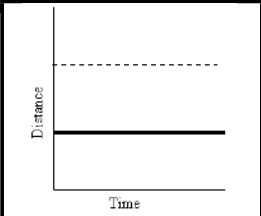
Which graph matches the scenario?
A child runs at a constant speed for 40 s before stopping.


Which graph matches the scenario?
A rabbit runs away from a farmer, not stopping for anything!
Which graph matches the scenario?
A cheetah stalks his prey, moving slowly and stopping occasionally.
Which graph matches the scenario?
A panda moves slowly at a constant speed for 40 seconds before stopping.
Which graph matches the scenario?
A student walked to his locker, stopped for a few seconds, and then continued on the same path to class.


Which graph matches the scenario?
A student ran to the cafeteria, stopped and looked around for his lunch kit, and then ran back to class to get it.
Which graph matches the scenario?
A student walked at a steady, constant pace as she went from one class to another.

Which best explains why the cyclist (#3) cannot be used as a good reference point?
It is heading in the wrong direction.
It is moving too slow.
It is moving too fast.
A good reference point should not move.

