
 Worksheets
SOL 4.7 - Oceans Study Guide
Total questions: 62
Worksheet time: 49mins
What type of ocean ecosystem would you find around the northern polar region of the world?
Arctic Ocean
Antarctic Ocean
Kelp Forest
Coral Reef
About how much of the Earth is covered with ocean?
97%
55%
70%
85%
Which of the following organisms is at the top of an ocean food chain?
Plankton
Cod
Lobster
Shark
Which of the following creates surface currents?
Salinity
Wind and storms
The gravitational pull of the moon
The temperature of the water
Which of the following is NOT a reason why it is difficult for most animals to live in the deep sea?
The pressure is too great.
There are too many predators swimming in the deep sea.
The temperature is too cold.
It is pitch black and they are unable to see
Tides are controlled by....
Salinity
Wind and storms
The gravitational pull of the moon
The temperature of the water
Which of the following is an ocean current that borders the east coast of the United States?
Gulf Stream
Jett Stream
North Atlantic Current
Equatorial Current
What flat underwater feature makes up nearly 50% of the Earth's surface?
Trench
Continental Shelf
Seamount
Abyssal Plain
Which of the following can be found in the most shallow parts of the ocean?
Trench
Abyssal Plain
Continental Rise
Continental Shelf
What do you call an ocean volcano?
Trench
Mid-Ocean Ridge
Seamount
Continental Slope
The Mariana __________ is the deepest known place on Earth
Volcanoe
Seamount
Ridge
Trench
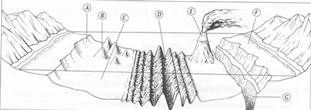
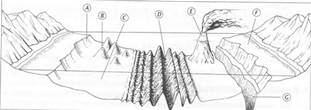
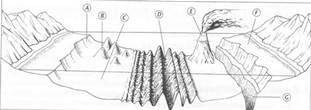
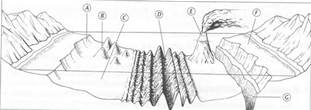
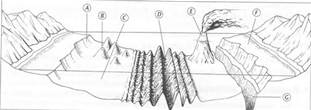
What is the part of the ocean where most life is found? This is also the sloping border on the continent that is below the water.
ocean trench
continental shelf
abyssal plain
ocean current
What are ocean currents?
movement of ocean water from one area to another
the gravitational pull on the water by the moon
the daily newspaper of a coastal town
What causes ocean currents?
It's all the moon's fault.
Wind patterns and differences in water temperature
Plants
The movement of ships on the ocean
The salinity of ocean water is determined by
the depth of the water, melting icebergs, rates of evaporation, and the amount of runoff from nearby land.
the number of ships on the ocean, pollution, and the number of animals in the ocean.
the phase of the moon, the amount of moisture in the air, and the amount of trash in the ocean.
True or False. Ocean water is a mixture of gases, water, and dissolved solids.
True.
False.
The tides are
how easily things float in the ocean water.
the amount of runoff from the land.
the daily rise and fall of the Earth's water on the coastline.
caused only by hurricanes.
What is the name for the group of organisms who float in the water and must have the sun to produce energy through photosynthesis? These organisms are the base of the food chain.
plankton
benthos
nekton
seaweed

In this photo, who is the producer?
The plankton
the shrimp
the fish
the shark
Which of these increases as you go deeper in the ocean?
Temperature
Pressure
Number of plants
Ocean water is different from a lake because ocean water contains
Oxygen
Algae
Salt
Plants
As you go deeper in the ocean, the temperature
Increases (gets warmer)
Decreases (gets colder)
Waves are caused by
Clouds
Wind
Currents

The arrows in this picture represent-
Currents
Tides
Waves
The Ocean Current that affects weather in Virginia is called the-
Virginia Current
Gulf Stream
Pacific Current
Labrador Current
Coral Reefs contain large populations of ocean species. Most coral reefs are found near the equator. This means that-
Most oceans are too deep for coral reefs
Coral reefs need warm water to survive
Ocean currents move coral reefs around
Coral reefs need cold water to survive
Algae and other producers need a lot of sunlight to survive in the ocean. Which part of the ocean would they most likely live in?
Abyssal plain
Trench
Continental Shelf
Continental Slope

What is the Ocean Feature shown at number 1
Continental Shelf
Continental Slope
Continental Rise
Abyssal Plain
What is the Ocean Feature shown at number 2
Continental Shelf
Continental Slope
Continental Rise
Abyssal Plain
What is the Ocean Feature shown at number 3
Continental Shelf
Continental Slope
Continental Rise
Abyssal Plain
What is the Ocean Feature shown at number 4
Continental Shelf
Continental Slope
Continental Rise
Abyssal Plain

Which feature would have the least amount of sunlight and the least amount of life?
Seamount
Abyssal Plain
Continental Shelf
Ocean Trench
Which feature would have the most amount of sunlight and the most amount of life?
Seamount
Abyssal Plain
Continental Shelf
Ocean Trench

Using the Ocean Food web, which answer gives the correct order of an ocean food chain?
Large shark, Tuna, Mackeral, Small fish
Mackeral, Small Fish, Tuna, Shark
One-celled like, shrimp-like creatures, small fish, Tuna, Shark.
One-celled life, shrimp-like creatures, mackeral, tuna, shark.
Which Organisim in the Food web gets its energy from the Sun?
Large shark
Tuna
Small Fish
Phytoplankton

When water evaporates from the surface of the ocean, does that increase or decrease the salinity of the ocean water?
Increase the salinity
Decrease the salinity

What are the causes of Ocean Currents? (Pick three)
The moon's gravity
The differences in temperature
The differenences in salinity
Wind Patterns
A large herd of whales swimming togethers.

The moon's gravity effects what?
Ocean Currents
Ocean Waves
Ocean Depth
Ocean Tides
What is an accurate conclusion that can be made about plants that live close to the water's surface?
Plants need the ocean currents to survive.
Organisms can't live deep in the ocean.
Nothing can live in the dark parts of the ocean.
Plants need sunlight for photosynthesis.
Select all the Floating Organisms below:
Sharks
Plankton
Fish
Phytoplankton
Select all the Swimming Organisms below:
Sharks
Plankton
Fish
Coral
What covers 70% of the earth's surface
Ocean
Rivers
Lakes
Ponds
the process in which plants use light energy to make food
Pistil
Pollen
Anther
Photosynthesis
The depth of the ocean
never changes
varies
Salinity is the measure of all __________dissolved in water.
salts
sand
waves
orgainisms
Most areas are covered with thick layers of sediments like sand, mud, and rocks.
True
False
The ocean floor has features just like the land on continents does.
True
False
This includes plants and floating organisms like algae and phytoplankton. They use the sun's energy to make their own food.
Producers
Consumers
Decomposers
___________________ get their energy by eating other organisms.
Producers
Consumers
Decomposers
_______________ break down dead plants and animals in the ocean, helping to release energy back into the ecosystem.
Producers
Consumers
Decomposers
If something happens to one part of the food chain, it can affect everything else that depends on the food chain.
True
False
A/an _______ is a large body of salt water surrounding large land masses.
lake
river
ocean
pond
The word "marine" means anything that is found in, or made by, the sea.
True
False
An ocean is a/an __________ ecosystem.
marine
rain forest
savanna
fresh water
Marine organisms, or plants and animals that live in the ocean, depend on the dissolved _______________ for survival.
salt
gases
rocks
sand

