
 Worksheets
Unit 12 Light Review
Total questions: 55
Worksheet time: 41mins
A shadow is created by the....
absence of light.
absence of waves.
absence of color.
blocking of sound.

Which images are opaque?
A & C
A,C,E, & F
D, E, & F
A & E
Material that allows light to pass through allowing you to see "clearly" to the other side.
opaque
translucent
transparent
An opaque object...
allows light to pass through
allows some light to pass through
allows no light to pass through
Why does an apple look red?
because it absorbs red light and reflects white light
because it absorbs red light waves and reflects the others
because it absorbs all colors of light
because it reflects red light waves and absorbs the others
White light is made up of all of the colors of the rainbow
True
False
Black absorbs all light.
True
False
What color of light do you get by combining red, green, and blue light?
Black Light
White Light
Ultraviolet Light
Infrared Light
What color is produced when mixing cyan, yellow, and magenta inks (pigments).
White
Black
Blue
Green

A ray of light is incident towards a plane mirror at an angle of 30-degrees with the mirror surface. What will be the angle of reflection?
30°
60°
90°
120°

Which one of the following diagrams depicts diffuse reflection?
A
B
C
D

Which letter represents the angle of incidence?
A
B
C
D
Which picture DOES NOT illustrate regular reflection?


Refers to bouncing back of light when it hits a smooth surface
Reflection
Echo
Refraction
Diffusion
Refer to the diagram drawn on the board. What does a represents?
Incident ray
reflected ray
normal
mirror
The angle of incidence is equal to the angle of reflection
law of light
law of reflection
law of refraction
law of incidence
what is the angle of reflection if the angle of incidence is 300?
100
200
300
600



Light, or “white light”, is made up of all colors of light mixed together.
True
False

If white light is passed through a prism, it can not be separated into light of different colors.
True
False

The colors are red, orange, yellow, green, blue, and violet. These are ALL the colors seen in a rainbow.
True
False

If white light is passed through a prism, it can be separated into the colors are red, orange, yellow, green, blue, indigo and violet.
True
False

The different colors of light revealed when white light is passed through a prism are called the _______.
rainbow
prism
color of white light
Spectrum

Light travels in a straight line away from the light source. But can it travel through transparent material and empty space?
Yes
No

Reflection happens when light bounces back from a surface.
No
Yes
It depends on the object it strikes
Sometimes

Reflection only allows objects to be seen if they produce their own light.
True
False

Reflection allows objects to be seen that do not produce their own light.
True
False

When light strikes a smooth, shiny object, it is ______ so that an image can be seen. For example, a mirror or a pool of water will reflect (bounce back) an image very similar to the object.
Refracted
Reflected

When light is ______ it passes from one type of transparent material to another, and changes direction. For example, when light travels through a magnifying glass, it changes direction, and we see a larger, magnified view of the object.
Refracted
Reflected

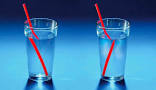
When a straw is viewed in water, light passes from the water to the air causing the path of the light to bend. When the light bends, the straw appears distorted (bent or broken).
True
False
It depends on the size of the straw
Only if there is a lot of water in the glass

The colors of objects are determined by the light that is not absorbed but is reflected by the objects.
True
False

The color of the light that is_________ from an object is the color that the object appears. For example, a red object reflects red colors of light and absorbs all other colors.
Refracted
Reflected

The color _____ is seen when all of the colors of light are reflected.
White
Black
Red + Blue
Magenta
Yellow
Cyan
Red + Green =
Magenta
Yellow
Cyan
Red + Blue + Green =
White Light
Black
Blue
White Light - Red - Blue - Green =
White Light
Cyan
Magenta
Black Light
Cyan - Green
Blue
Yellow
Red
Magenta

