wayground logo

Free Printable Worksheets

NEW

Font size

S
M
L
XL
Worksheets

Academic Year Long Milestones Review

Total questions: 50

Worksheet time: 32mins

Name
Class
Date
1.

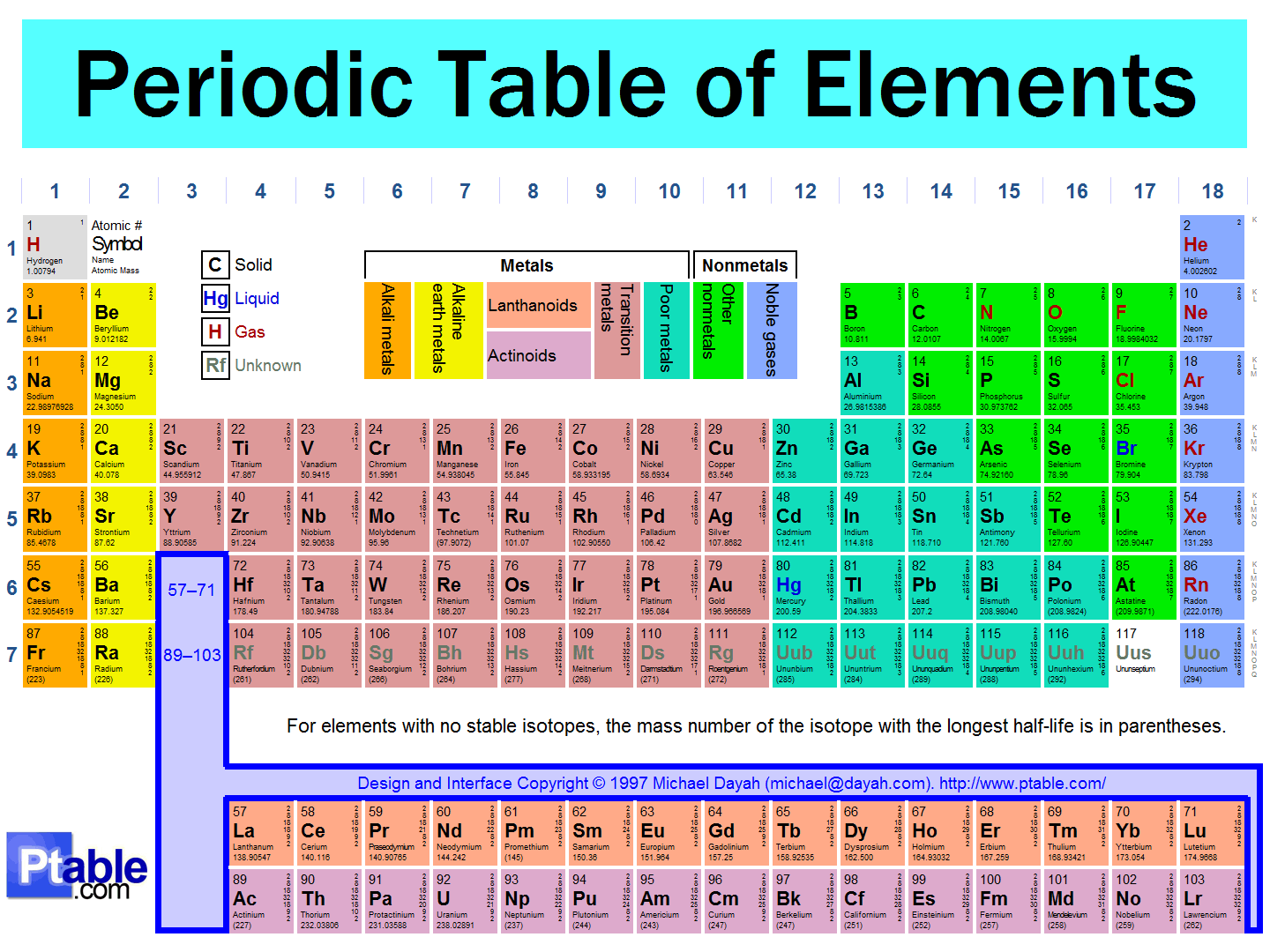
An atom with atomic number 6 would have how many protons?

a)

6

b)

12

c)

3

d)

cannot be determined

2.

If an atom has 12 protons, which of the following must it also have to be considered a "neutral" atom?

a)

12 neutrons

b)

12 electrons

c)

12 protons

d)

24 protons and neutrons

3.

A(n)__________ is a combination of 2 or more substances that are not chemically combined.

a)

element

b)

atom

c)

mixture

d)

compound

4.

A(n)__________ is a sample of matter, either a single element or a compound made of more than one element, that has definite chemical and physical properties.

a)

element

b)

pure substance

c)

atom

d)

mixture

5.
Alex goes into the garden and digs up a shovel full of dirt.  This is a _____________ mixture.
a)
Homogeneous
b)
Heterogenous
6.

The vertical (up and down) columns in the periodic table are called...

a)

groups

b)

towers

c)

periods

d)

atomic numbers

7.

Sodium (Na) is found in Period _____.

a)

3

b)

2

c)

4

d)

1

8.

When objects remain in the same place, it is called a(n)...

a)

gravity

b)

speed

c)

balanced force

d)

unbalanced force

9.

Force is measured in which unit?

a)

kilograms

b)

Newtons

c)

meters

d)

Joules

10.

Inertia states that....

a)

for every action, there is an equal and opposite reaction

b)

larger objects take more force to move

c)

an object in motion tends to stay in motion unless acted on by an opposite force

d)

a push acts in the opposite direction and it slows down.

11.

If you push a tennis ball, a bowling ball, and a basketball with the same amount of force, which one will go farthest?

a)

bowling ball

b)

tennis ball

c)

basketball

12.
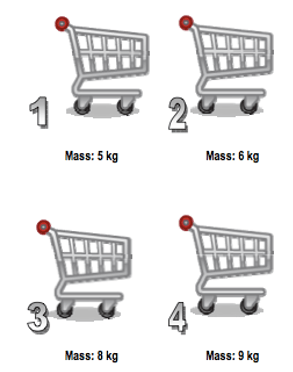
A force of 90N is applied to each cart below, which one will accelerate the fastest?
a)
Cart 1
b)
Cart 2
c)
Cart 3 
d)
Cart 4
13.

If there was no friction, objects in motion would stay in motion forever.

a)

true

b)

false

14.
AS A ROLLER COASTER MOVES DOWN A HILL, POTENTIAL ENERGY IS CONVERTED INTO KINETIC ENERGY, THERMAL ENERGY, AND SOUND ENERGY. WHAT IS TRUE ABOUT THE TOTAL ENERGY OF THIS SYSTEM?
a)
ENERGY IS GAINED (CREATED) AS THE ROLLER COASTER MOVES
b)
ENERGY IS LOST (DESTROYED) AS THE ROLLER COASTER MOVES
c)
THE TOTAL ENERGY REMAINS THE SAME AS THE ROLLER COASTER MOVES
d)
THE TOTAL ENERGY CONSTANTLY CHANGES AS THE ROLLER COASTER MOVES
15.
On a roller coaster, where is maximum potential energy?
a)
At the bottom of a big hill
b)
When going around a corner
c)
When going upside down
d)
At the top of a big hill
16.

Kinetic energy depends on _____________ & _____________.

a)

mass, speed

b)

mass, position

c)

mass, weight

d)

speed, distance

17.
What is happening to the energy of the girl from point A to point B
a)
kinetic changes to potential
b)
potential changes to kinetic
c)
energy is lost
d)
energy is gained
18.
Ironing a shirt is an example of...
a)
condensation
b)
conduction
c)
convection
d)
radiation
19.
Near the ceiling of a room the air is warmer; the warm air rises because of
a)
conduction
b)
convection
c)
radiation
20.

You are in science class and want to see if the hot plates were used recently. You place your hand near the side of the hot plate. Without touching the hot plate, your hand feels warmer. Heat is transferred to your hand by _______.

a)

conduction

b)

convection

c)

radiation

21.

Particles (molecules) in a ______________________ have more energy than the other states of matter.

a)

gas

b)

solid

c)

liquid

d)

plasma

22.
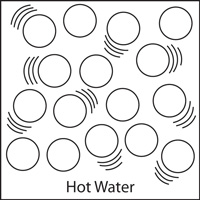
The speed of the molecules determines the _____.
a)
volume
b)
density
c)
pressure
d)
temperature
23.

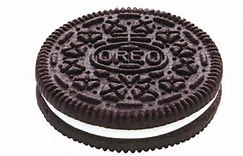
An oreo cookie weighs 20 grams. It gets crushed into crumbs for a recipe. How much do its crumbs weigh?

a)

15 grams

b)

25 grams

c)

20 grams

d)

unable to tell from info given

24.
If there are 4 H atoms on the reactant side, how many H atoms will be on the product side? 
a)
2
b)
4
c)
6
d)
You need more information to answer this question
25.

A change in one or more substances, caused by a reaction, that forms new and different substances is called a(n) _________.

a)

mixture

b)

physical change

c)

element

d)

chemical change

26.
The volume of water in a beaker was 215 mL. After 5 days, the volume of the water was 200 mL. What best explains the change in volume?
a)
Some of the water absorbed the air. 
b)
Some of the water evaporated and escaped into the air as water vapor.
c)
Some of the water disappeared.
d)
Some of the water was released due to condensation.
27.
What is the difference between a physical and a chemical property of matter?
a)
A physical property does not change the identity of a substance, and a chemical property does change something into a new substance.
b)
A chemical property does not change the identity of a substance, and a physical property does change something into a new substance.
c)
A physical property means an object cannot be changed, but a chemical property can change an object.
d)
A chemical property means an object cannot be changed, but a physical property can change an object.
28.

A black film of tarnish develops on silverware over time.

a)

Physical change

b)

Chemical change

29.

Sugar dissolves into water and disappears.

a)

Physical change

b)

Chemical change

30.

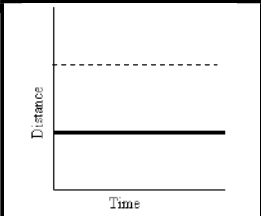
What does the solid line on this graph represent?

a)

Constant speed

b)

Acceleration

c)

At rest

d)

deceleration

31.

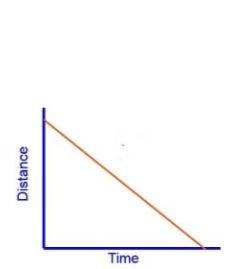
What is this line of this graph showing?

a)

moving away from starting point at a constant speed

b)

moving back towards the starting point at a constant speed

c)

acceleration (getting faster)

d)

deceleration (getting slower)

32.
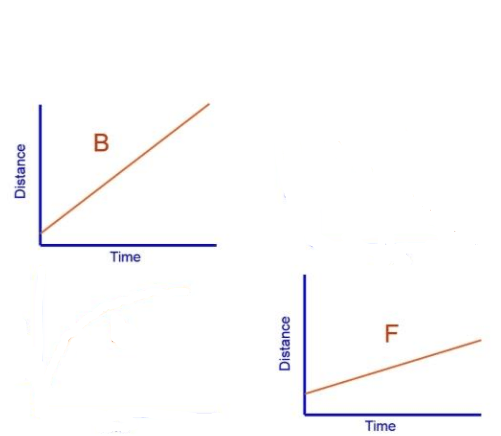
Which graph is showing a faster constant speed?
a)
B
b)
F
c)
They show the same speed
33.

Which of the following shows an energy transformation from chemical energy to electrical energy to light energy?

a)

A bolt of lightning lights the night sky.

b)

A candle glows brightly in the dark.

c)

A fire in a fireplace lights up a room.

d)

A battery causes a flashlight to shine.
34.
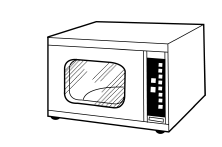
The picture shows a microwave oven. As a microwave oven is operated, electrical energy is transformed into all of the following types of energy EXCEPT —
a)
solar
b)
light
c)
thermal
d)
mechanical
35.
What is the frequency of this wave?
a)
3 Hertz
b)
4 Hertz
c)
5 Hertz
d)
6 Hertz
36.
When wavelength increases, what happens to the frequency?
a)
it increases
b)
it decreases
c)
it stays the same
37.

Which wave has the most energy?

a)

top wave because it has a greater amplitude

b)

bottom wave because it has a greater amplitude

c)

top wave because it has a higher frequency

d)

bottom wave because it has a higher frequency

38.
Refraction occurs when _____________
a)
the wave's speed changes by entering a new medium
b)
a wave bounces off of a boundary
c)
waves parts meet each other
d)
waves bend around a barrier
39.
When a sound wave experiences reflection, we hear
a)
a louder sound
b)
an echo
c)
a quieter sound
d)
nothing
40.

In a longitudinal wave, the parts where the matter is at its highest pressure is

a)

compression

b)

rarefaction

c)

crest

d)

rest position

41.

Shae uses the volume control on her TV to make the sound louder or softer. Which property of waves is Shae's volume control changing?

a)

wave period

b)

amplitude

c)

wavelength

d)

wave speed

42.

Which statement about the effects of medium on the speed of a mechanical wave is true?

a)

Medium has no effect on the speed of a mechanical wave.

b)

A mechanical wave always travels through liquids at the speed of light.

c)

A mechanical wave generally travels faster in solids than liquids.

d)

A mechanical wave generally travels faster in gases than liquids.

43.

Which of the following waves requires a medium to travel?

a)

light from a fire

b)

sunlight

c)

heat wave

d)

the horn blowing from a train

44.
What type of lens do humans have in their eyes? 
a)
Concave Lens 
b)
Convex Lens 
45.
If a negatively charged rod touches a conductor, the conductor will be charged by what method? 
a)
Friction
b)
Conduction
c)
Induction
d)
Convection
46.
A charged balloon is brought near an electroscope but DOES NOT touch the electroscope.  This is an example of charging by
a)
Conduction
b)
Convection
c)
Friction
d)
Induction
47.
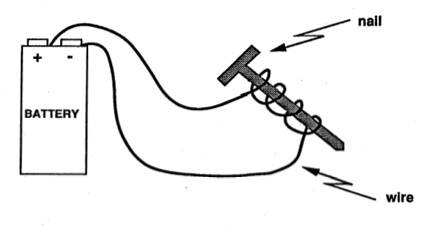
This is a picture of a simple electromagnet. How can the electromagnet be made stronger?
a)
Add more coils of wire to the nail.
b)
Use a smaller battery.
c)
Reverse the poles of the magnet.
d)
Remove all the coils and the nail.
48.
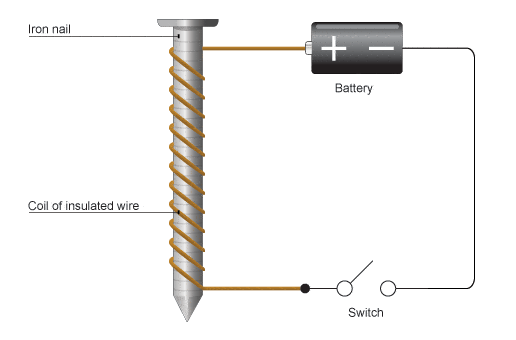
What is most likely to happen when the switch is closed?
a)
A magnetic field should be produced
b)
The nail will rust
c)
The battery will explode
d)
The wire will catch on fire
49.
How do electromagnets differ from regular magnets? 
a)
A. They  can be turned off and on 
b)
B. Their polarity can be reversed
c)
C. Their strength can be changed
d)
D. All of the above
50.

You are making an electromagnet and can choose from a copper, iron or aluminum bar. Which sentence is true?

a)

You can use all of them because they are all made of metal

b)

You can only use the aluminum bar.

c)

You can only use the iron bar.

d)

You can only use the copper bar.