wayground logo

Free Printable Worksheets

Font size

S
M
L
XL
Worksheets

CDB 2 - Review

Total questions: 125

Worksheet time: 2hrs 54mins

Name
Class
Date
1.

How would you calculate the average speed of a toy car that rolls for a time of 0.5 seconds over a distance of 1.5 meters?

a)

1.5 ÷ 0.5

b)

1.5 × 0.5

c)

0.5 ÷ 1.5

d)

0.5 - 1.5

2.

Speed =

a)

Distance ÷ Time

b)

Time ÷ Distance

c)

Time x Distance

d)

Distance + Time

3.

How would you calculate the average speed of a cheetah that runs a distance of 75 meters in only 3 seconds?

a)

75 ÷ 3

b)

75 × 3

c)

3 ÷ 75

d)

3 + 75

4.

How would you calculate the average speed of a ball if it rolls a distance of 5 meters in a time of 10 seconds?

a)

5 ÷ 10

b)

5 × 10

c)

10 ÷ 5

d)

10 + 5

5.

How would you calculate the average speed of a student that is able to run 20 meters in 8 seconds?

a)

20 ÷ 8

b)

20 × 8

c)

8 ÷ 20

d)

8 - 20

6.

How would you calculate the distance it takes a softball player travels if she runs for 8 seconds at an average speed of 6.5 m/s?

a)

6.5 ÷ 8

b)

6.5 × 8

c)

8 ÷ 6.5

d)

8 - 6.5

7.

How would you calculate the distance traveled by a comet that is flying through the solar system at a speed of 50,000 km/hr for 4 hours?

a)

50,000 ÷ 4

b)

50,000 × 4

c)

4 ÷ 50,000

d)

4 - 50,000

8.

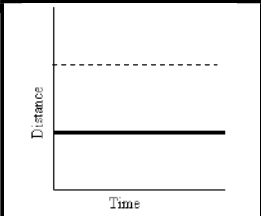
What does the solid line on this graph represent?

a)

Constant speed

b)

Acceleration

c)

At rest

d)

deceleration

9.

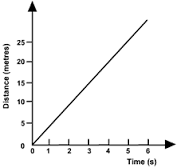
What is the line on this graph showing?

a)

moving away from starting point at a constant speed

b)

moving back towards the starting point at a constant speed

c)

acceleration (getting faster)

d)

deceleration (getting slower)

10.

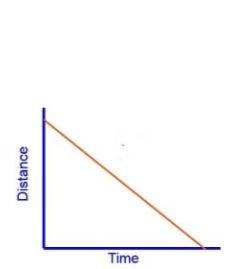
What is this line of this graph showing?

a)

moving away from starting point at a constant speed

b)

moving back towards the starting point at a constant speed

c)

acceleration (getting faster)

d)

deceleration (getting slower)

11.
Which graph is showing acceleration (getting faster)
a)
D
b)
E
c)
both D and E
d)
neither D or E
12.
Which graph is showing deceleration (getting slower)
a)
D
b)
E
c)
both D and E
d)
neither D or E
13.

What does the solid line on this graph represent?

a)

Constant speed

b)

Acceleration

c)

Not moving

d)

deceleration

14.
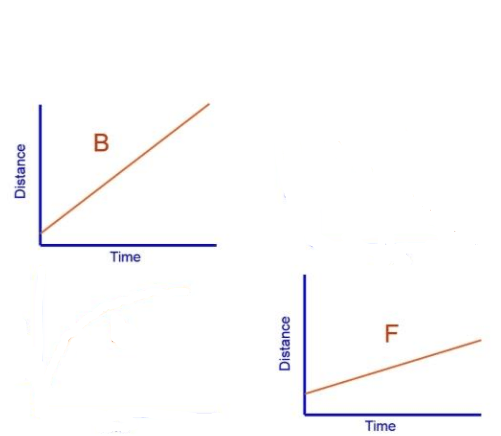
Which graph is showing a faster constant speed?
a)
B
b)
F
c)
They show the same speed
15.
How long did it take this object to travel 10 m?
a)
0 s
b)
10 s
c)
15 s
d)
20 s
16.
At 60 seconds, how far had this object traveled? 
a)
0 m
b)
10 m
c)
20 m
d)
40 m
17.

What happened during A to B point?

a)

not moving

b)

increasing speed at a constant rate

c)

moving at a constant speed

d)

acceleration

18.

What happened during E to F point?

a)

not moving

b)

increasing speed at a constant rate

c)

constant speed

d)

acceleration

19.

What happened during B to C point?

a)

deceleration

b)

constant speed

c)

at rest

d)

acceleration

20.
What units can be used to express density?
a)
g/mL
b)
grams
c)
millimeters
d)
milliliters
21.
Frank has a paper clip. It has a mass of 9g and a volume of 3cm3. What is its density?
a)
3 g/cm3
b)
1/3 g/cm3
c)
27 g/cm3
d)
39 g/cm3
22.
Which box has a higher density?  
a)
Box A
b)
Box B
c)
cannot be determined
d)
they are the same
23.
What are the physical properties of minerals?
a)
color luster hardness streak
b)
fluffy, pretty, shiny, and messy
c)
blue, shiny, 4 and white
24.
Describe what luster means
a)
How an object reflects light
b)
How soft an object is
c)
If an object floats
d)
If an object can be dug out of the earth.
25.
Why is streak important?
a)
It shows a fake color
b)
it shows a mineral true color
c)
it is the shape of a mineral
d)
it allows an object to sink
26.
How do you test for streak?
a)
scrape it against a streak plate
b)
put the mineral in a graduated cylinder
c)
place the mineral on a triple beam balance
27.
How do you find density?
a)
volume/mass
b)
Mass/volume
c)
volume + mass
d)
Mass - volume
28.
What tool do you use to measure volume of an irregular object?
a)
ruler
b)
graduated cylinder
c)
triple beam balance
d)
spring scale
29.
What tool do you use to measure volume of a regular shaped object?
a)
ruler
b)
graduated cylinder
c)
triple beam balance
d)
spring scale
30.
What tool do you use to find mass?
a)
ruler
b)
graduated cylinder
c)
triple beam balance
d)
spring scale
31.
What unit of measurement do we use for mass?
a)
cm
b)
g
c)
cm3
d)
g/cm3
32.
What unit of measurement do we use for volume?
a)
cm
b)
g
c)
cm3
d)
g/cm3
33.
What is the Mohs' Hardness Scale?
a)
How hard Mohs' thinks the test is
b)
helps you find the density of an object
c)
a way to guess how hard an object is
d)
a scale where you use common materials to test for hardness.
34.
How do you find the hardness of a rock/mineral?
a)
use a streak plate
b)
scratch it with a finernail, penny, glass, or steel file
c)
hold a flashlight up to it
d)
guess
35.
I have an object that has a high luster, malleable, and a conductor what is it?
a)
metalloid
b)
non-metal
c)
metal
d)
matter
36.
When an object shatters when struck by a hammer.
a)
luster
b)
malleable
c)
brittleness
d)
ductile
37.
If I have an object that is dull, malleable, ductile, and a semiconductor, what is it?
a)
metalloid
b)
non-metal
c)
metal
d)
matter
38.
If you have a material that can conduct electricity well it is probably a...
a)
Metalloid
b)
Matter
c)
Non-metal
d)
Metal
39.

The property of a mineral that describes the way in which light reflects from its surface

a)

Luster

b)

Fracture

c)

Cleavage

d)

Crystal

40.
Which mineral property is being shown here?
a)
luster
b)
hardness
c)
streak
41.
Which of these minerals is softer than glass?
a)
Topaz 
b)
Corundum 
c)
Calcite 
d)
Orthoclase 
42.
Can a glass plate scratch apatite?
a)
Yes 
b)
No 
43.
Can a penny scratch fluorite?
a)
Yes 
b)
No 
44.
What is the density of Object C in this image?
a)
I don't know how to do this.
b)
125 g/cm3
c)
35 g/cm3
d)
5 g/cm3
45.
Which of the substance below has a mass of 50 grams and a volume of 10 mL?
Density = Mass/Volume
a)
Gold = 19.3 g/mL
b)
Aluminum = 2.7 g/mL
c)
Water = 1 g/mL
d)
Pyrite = 5 g/mL
46.
Density is a property that is used to identify unknown substances
a)
True
b)
False
47.

What is the volume of the rock?

a)

35 mL

b)

5 mL

c)

30 mL

d)

65 mL

48.
Malleability is ___________
a)
the way light is reflected off a surface.
b)
how well a piece of matter conducts electricity
c)
A.  the capability of being drawn out into thin wires or threads.
d)
the capability of being hammered out thin.
49.
Conductivity is ___________
a)
the way light is reflected off a surface.
b)
how well a piece of matter conducts electricity. 
c)
the capability of being hammered out thin
d)
A.  the capability of being drawn out into thin wires or threads.
50.
Brittleness is _________
a)
the capability of being broken.
b)
the capability of being bent.
c)
the capability of being stretched.
d)
the capability of being molded.
51.
Metals have all of the following physical properties except __________.
a)
high conductivity
b)
shiny luster
c)
malleable
d)
brittle
52.
Nonmetals are ________ compared to metals.
a)
highly conductive
b)
brittle
c)
ductile
d)
non-conductive
53.
Metalloids _____________
a)
have no properties of metals.
b)
have no properties of nonmetals.
c)
have some properties of both metals and nonmetals.
d)
none of the above
54.
Which of these is a property of metals?
a)
It's malleable
b)
It can't conduct electricity
c)
They are used in food
d)
It's very brittle
55.
Which of the following is NOT a characteristic of most metals?
a)
Brittle
b)
Good conductor
c)
Ductile
d)
Malleable
56.
How do metals differ from nonmetals?
a)
metals are shiny, nonmetals are dull
b)
metals are good insulators, nonmetals are good conductors
c)
metals are powdery
d)
nonmetals are shiny
57.
At room temperature metals are ____________.
a)
plasma
b)
gases
c)
liquid
d)
solid
58.
Metals that can be used as wire are ____________.
a)
metallic
b)
shiny
c)
malleable
d)
ductile
59.
What are the three major categories of the periodic table?
a)
Alpha, Beta & Gamma
b)
Metals, Non-Metals and Metalloids
c)
Metals, Semi-metals and Metalloids
d)
Non-Metals, Semi-Metals and Metalloids
60.
Which of the following is a good conductor of heat?
a)
Metal
b)
Nonmetal
c)
Metalloid
61.
The table shows the classification and physical state of four elements.Which element most likely has a shiny luster?
a)
Cobalt
b)
Arsenic
c)
Hydrogen
d)
Carbon
62.
If a substance is magnetic it is most likely a 
a)
metal 
b)
non-metal
63.
A substance that has luster, is brittle, and can't conduct electricity would be known as?
a)
A metal
b)
A non metal
c)
A metalloid
64.
Silicon is a semiconductor and has properties of both metals and nonmetals. What type of element is Silicon? 
a)
Metal
b)
Nonmetal
c)
Metalloid
d)
Pretty
65.
Which element is a metalloid?
a)
Titanium
b)
Selenium
c)
Potassium
d)
Polonium
66.
Metalloids are weak conductors of heat and electricity. 
a)
TRUE
b)
FALSE
67.
What is the net force?
a)
40 N left
b)
0 N Balalnced
c)
400 N right
d)
40 N right
68.

What is the net force?

a)

400 N Up at an increasing speed

b)

400 N Down at an increasing speed

c)

400 N Down at a constant speed

d)

800 N Down at a constant speed

69.
What will cause an object to move?
a)
Applied forces
b)
Balanced forces
c)
Unbalanced forces
70.
Are forces balanced or unbalanced when a car is moving at a constant speed in a straight line?
a)
Balanced
b)
Unbalanced
71.

Based on the information in the diagram, what is the net force acting on this object?

a)

12 N downward at a constant speed

b)

4 N upward at an increasing speed

c)

4 N downward at an increasing speed

d)

8 N to the left at a constant speed

72.
The longer the inclined plane, the ___________________ to move the object
a)
the less input force you need
b)
the more input force you need
c)
the more output force you need
d)
the less output force you need
73.
What is a disadvantage of using an inclined plane to lift a heavy object?
a)
The object must be moved a greater distance.
b)
It takes less effort to move the object.
c)
Many objects are difficult to lift straight up.
d)
Heavy object usually take up more space.
74.
Students pulled the same mass up an inclined plane that was 20 cm, 30 cm, and 40 cm long. Each time, they used a spring scale to measure the force needed to pull the mass up the inclined plane. What did they conclude?
a)
Less force was needed on the 20 cm plane
b)
More force was needed on the 40 cm inclined plane.
c)
The least amount of force was needed on the 40 cm inclined plane.
d)
The least amount of force was needed on the 30 cm inclined plane.
75.
An inclined plane reduces the amount of force needed to move an object by - 
a)
increasing the distance the object moves.
b)
transferring more of the force to the object
c)
reversing the direction the object is moved.
76.
Which of the following decreases when an object is moved using an inclined plane?
a)
The distance the object moves.
b)
The pull of gravity on the object.
c)
The force needed to move the object.
d)
The amount of space the object occupies.
77.
Which of these two layers is a solid?
a)
innercore
b)
Outercore
78.
A dense ball of solid iron and nickel.
a)
crust
b)
inner core
c)
mantle 
d)
outer core
79.
Which best describes the asthenosphere?
a)
molten metal
b)
dense, solid metal ball
c)
solid that flows
d)
dry land and ocean floor
80.
What part of the earth is a layer of rock that comprises 67% of Earth’s mass?
a)
mesosphere
b)
mantle
c)
asthenosphere
d)
lithosphere
81.
Which layer of Earth is characterized by rock that is plastic, or soft enough to flow?
a)
asthenosphere
b)
crust
c)
lithosphere
d)
inner core
82.
Which layer has the highest density?
a)
Crust
b)
Mantle
c)
Core
d)
All the same
83.

Plate tectonics, or the movement of pieces of Earth's crust, is thought to be caused by

a)

Hot spots

b)

Convection currents in Earth's crust

c)

Convection currents in Earth's mantle

d)

Convection currents in Earth's core

84.

Going from earth's surface to the interior, what trends are found?

a)

Density and temperature increase

b)

Density and temperature decrease

c)

Density increases and temperature decreases

d)

Density decreases and temperature increases

85.
This is an example of -
a)
convergent
b)
divergent
c)
transform
86.
This is an example of -
a)
convergent
b)
divergent
c)
transform
87.
What causes the tectonic plates to move?
a)
convection of magma
b)
the earth's magnetic field
c)
the earth spinning
d)
earth's gravitational pull
88.
Sea floor spreading happens at what type of boundary
a)
Divergent
b)
Convergent
c)
Transform
d)
Mountainous
89.
Look at the drawing shown.  What likely happens when two continental plates collide?
a)
An ocean trench forms.
b)
Earthquakes occur.
c)
Sea-floor spreading occurs
d)
Folded mountains form.
90.
When plates slip sideways against each other the type of boundary we have is...
a)
Divergent
b)
Convergent
c)
Transform
d)
Slip SIdeways
91.
The Himalayas in Asia are an example of what type of plate boundary?
a)
divergent
b)
continent-to-continent convergent
c)
ocean-to-continent convergent
d)
transform
92.
What forms at a divergent boundary?
a)
mid-ocean ridges
b)
mountains
c)
earthquakes
d)
only volcanoes
93.
Which of these will most likely happen because the lithospheric plates move away from each other?
a)
New sea floor forms.
b)
Tides become higher.
c)
Winds become stronger.
d)
Water moves to higher latitudes.
94.
Which of the following land formation occurs at a divergent continental/continental boundary?
a)
mid-ocean ridge
b)
deep ocean trench
c)
Pacific hot spot
d)
rift valley
95.
Mountains form from....
a)
Plates sliding past one another
b)
collision of plates
c)
plates moving away from each other
d)
none of these
96.
What are mid-ocean ridges?
a)
A chain of underwater falls
b)
A chain of underwater volcanoes
c)
A chain of underwater mountains
d)
A chain of underwater rocks
97.
Whenever a subduction zone is formed a ____ is formed.
a)
mountains
b)
Island arc
c)
rift valley
d)
volcanoes
98.
At which boundary will I most likely find volcanoes?
a)
Convergent
b)
Divergent
c)
Transform
d)
All of the above
99.

Autotrophs

a)

Make their own food

b)

Get their food from others

c)

are Fungi

d)

are none of the above

100.

Heterotrophs

a)

make their own food

b)

get their food from others

c)

are fungi

d)

none of the above

101.

I have no nucleus and live in very hot liquids. Which Kingdom am I in?

a)

Fungi

b)

Protist

c)

Eubacteria

d)

Archaebacteria

102.

Which domain has organisms that live in extreme environments (vocanoes, Yellowstone hot pools, deep under water with no light)

a)

Eubacteria

b)

Archae

c)

Eukarya

d)

No organism can live in those conditions

103.

I am multicellular and autotrophic which kingdom would I be in?

a)

Plantae

b)

Animalia

c)

Fungi

d)

Protists

104.

Which kingdom would I be in if I had:

heterotrophic, usually sexual reproduction, and multicellular

a)

Plantae

b)

Animalia

c)

Fungi

d)

Protist

105.

I am Eukaryotic, mainly multicellular, heterotrophic and reproduce with spores (asexual) and sexually.

a)

Plantae

b)

Animalia

c)

Fungi

d)

Protist

106.

Is this picture abiotic or biotic?

a)

Abiotic

b)

Biotic

107.

Is this picture abiotic or biotic?

a)

Abiotic

b)

Biotic

108.

Is this picture abiotic or biotic?

a)

Abiotic

b)

Biotic

109.

Is this picture abiotic or biotic?

a)

Abiotic

b)

Biotic

110.

Is this picture abiotic or biotic?

a)

Abiotic

b)

Biotic

111.

Is this picture abiotic or biotic?

a)

Abiotic

b)

Biotic

112.

Is this picture abiotic or biotic?

a)

Abiotic

b)

Biotic

113.

Is this picture abiotic or biotic?

a)

Abiotic

b)

Biotic

114.
Which level of organization is the most complex?
a)
organism
b)
population
c)
community
d)
ecosystem
115.
Multiple organisms of the same species describes a
a)
organism
b)
population
c)
community
d)
ecosystem
116.
A forest full of many kinds of trees and grasses is an example of a
a)
group
b)
organism
c)
population
d)
community
117.
Which is an example of an organism?
a)
a beetle
b)
a lake
c)
a rock
d)
a shell
118.
Which level of organization is more complex than a population and less complex than an ecosystem?
a)
organism
b)
population
c)
community
d)
ecosystem
119.
which is the correct order of the levels of organization from simple to complex?
a)
organism, population, community, ecosystem
b)
ecosystem, community, population, organism
120.
Which is the definition of a community
a)
multiple organisms of the same species
b)
all the living and nonliving things in an area
c)
a living thing
d)
multiple organisms of different species
121.

Which level of organization does "N", in the Tundra biome represent from the picture?

a)

ecosystem

b)

organism

c)

community

d)

population

122.

Which represents community level of organization?

a)

lions, zebras, giraffes, trees

b)

lions

c)

lions, zebras, sunlight, trees, rocks

d)

lions and their cubs

123.

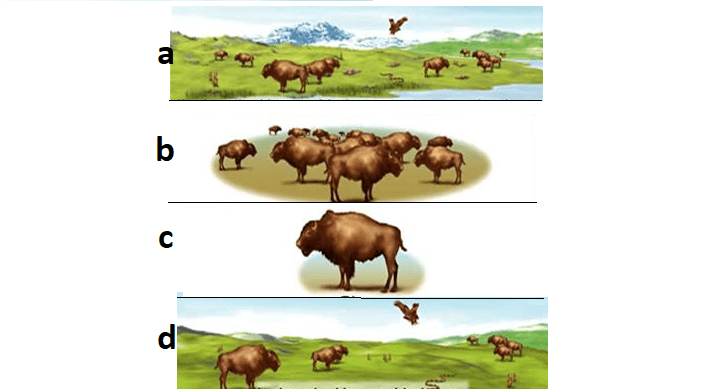
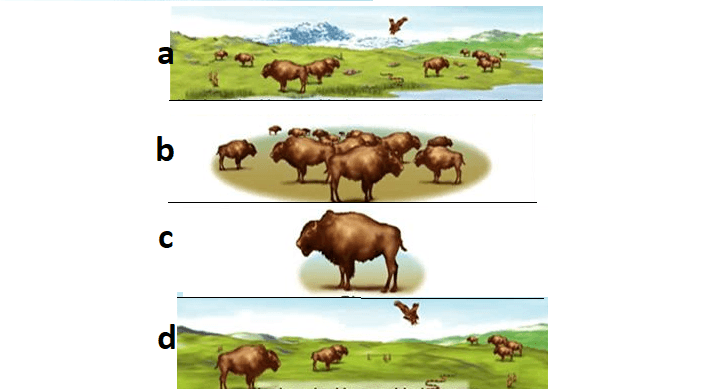
Which represents a community?

a)

a

b)

b

c)

c

d)

d

124.

Which represents an organism?

a)

a

b)

b

c)

c

d)

d

125.

Which of the following shows the correct order of the pictures from the LOWEST (smallest) to the HIGHEST (largest) level of organization?

a)

c > b > d > a

b)

b > c > a > d

c)

c > b > a > d

d)

a > d > b > c