wayground logo

Free Printable Worksheets

Font size

S
M
L
XL
Worksheets

Weather and Energy Review

Total questions: 38

Worksheet time: 49mins

Name
Class
Date
1.

What type of clouds form a thunderstorm?

a)

Stratus

b)

Cumulus

c)

Cirrus

d)

Cumulonimbus

2.
The layers of the atmosphere are classified according to changes in _________.
a)
altitude
b)
density
c)
composition
d)
temperature
3.
The temperature at which water vapor condenses is the 
a)
relative humidity
b)
humidity
c)
freezing point
d)
dew point
4.
Why doesn't cloud formation take place until the dew-point temperature is reached?
a)
because dew-point is the temperature at which water vapor condenses into water droplets
b)
cloud formation can take place at any temperature, and does not depend on the dew-point temerature
c)
because water sublimates at the dew-point temperature
d)
the dew-point temperature only applies on Earth's surface, not in the atmosphere
5.

The process of adiabatic cooling means that an air mass cools as it ______________

a)

compresses

b)

sinks

c)

expands

d)

moves

6.

What is a small particle of salt, dust, or other material around which water droplets can form?

a)

Condensation location

b)

Water collection

c)

Condensation nucleus

d)

Dust bunny

7.

___________ is the amount of water vapor in the air as compared to the level of saturation

a)

Relative humidity

b)

Dew point

c)

Saturation

d)

Cloud formation

8.

What instrument is used to measure dew point and relative humidity?

a)

barometer

b)

psychrometer

c)

anemometer

d)

wind vane

9.

Which substance is a form of precipitation?

a)

frost

b)

fog

c)

hail

d)

dew

10.

As relative humidity increases, the chance for precipitation

a)

increases

b)

decreases

c)

remains the same

11.

What is the value of relative humidity when the air is saturated?

a)

0 %

b)

25 %

c)

50 %

d)

100 %

12.
The phase change from water vapor to liquid water is known as:
a)
evaporation
b)
precipitation
c)
condensation
d)
sublimation
13.
What is the Dew Point Temperature if the dry-bulb temperature on your sling psychrometer is 20ºC and the wet-bulb temperature is 15ºC?
a)
14ºC
b)
12ºC
c)
10ºC
d)
-18ºC
14.
Which statement correctly defines wind?
a)
Wind is the movement of air from areas of low pressure to areas of high pressure
b)
Wind is the movement of air to a colder area in the atmosphere.
c)
Wind is the movement of air from areas of high pressure to areas of low pressure.
d)
Wind is the movement of air pushed around and bouncing off Earth's surface.
15.
What is the initial source for global winds and convection in the atmosphere? 
a)
continental deflection
b)
the rotation of the Earth
c)
Moon's gravity
d)
unequal heating of the Earth by the sun
16.
The Coriolis effect causes ___________.
a)
the Earth to rotate on its axis
b)
continental deflection
c)
global winds and surface currents to move in a curved path instead of a straight line
d)
global winds and deep ocean currents to move in a curved path instead of a straight line.
17.
What kind of breeze is this & what time of day/night would it form?
a)
Land breeze - daytime
b)
Land breeze - nighttime
c)
Sea breeze - daytime
d)
Sea breeze - nighttime
18.
In which direction do prevailing westerlies flow?
a)
from east to west
b)
from west to east
c)
from north to south
d)
from south to north
19.
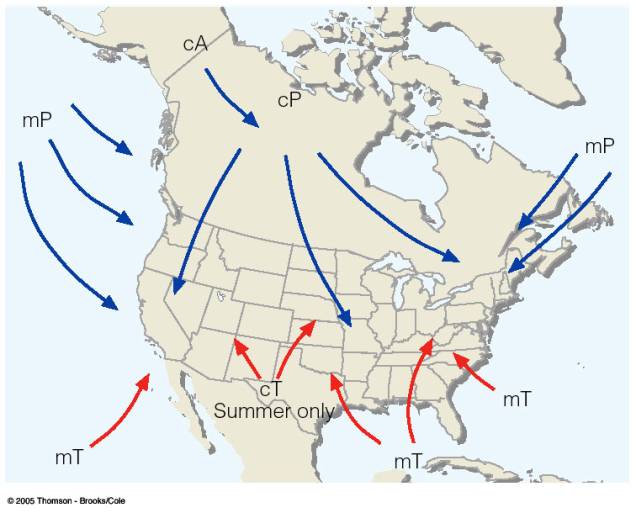
What's the humidity and temperature of a continental tropical air mass?
a)
Wet and cold
b)
Dry and warm
c)
Wet and warm
d)
Dry and cold
20.
What type of storm front is this?
a)
Warm Front
b)
Cold Front
c)
Occluded Front
d)
Stationary Front
21.
What type of storm front if this?
a)
Warm Front
b)
Cold Front
c)
Stationary Front
d)
Occluded Front
22.
What does symbol # 1 mean?
a)
Occluded Front
b)
Stationary Front
c)
Warm Front
d)
Cold Front
23.
When a cold air mass moves into a warm air mass, it will get colder and we will have severe weather. What type of front is this?
a)
warm front
b)
cold front
c)
occluded front
d)
stationary front
24.
What type of air mass is the highlighted arrow?
a)
cold/dry
b)
cold/humid
c)
warm/dry
d)
warm/humid
25.
A body of air that has the same temperature and moisture levels throughout is called what? 
a)
Fronts
b)
Air Masses
c)
A cold front
d)
A warm front
26.
Which abbreviation of an air mass can be identified as dry and hot?
a)
cP
b)
mP
c)
cT
d)
mT
27.
What weather is Seattle having?
a)
Dry with no precipitation
b)
Cold and dry
c)
Warm and sunshine that wil last for days
d)
wet, rainy weather that will last for days
28.

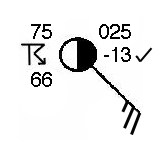
What is the wind speed for the following station model?

a)

10 knots

b)

15 knots

c)

20 knots

d)

25 knots

29.

What is the station model code for a barometric pressure of 1019.5 mb?

a)

101

b)

195

c)

019

d)

119

30.
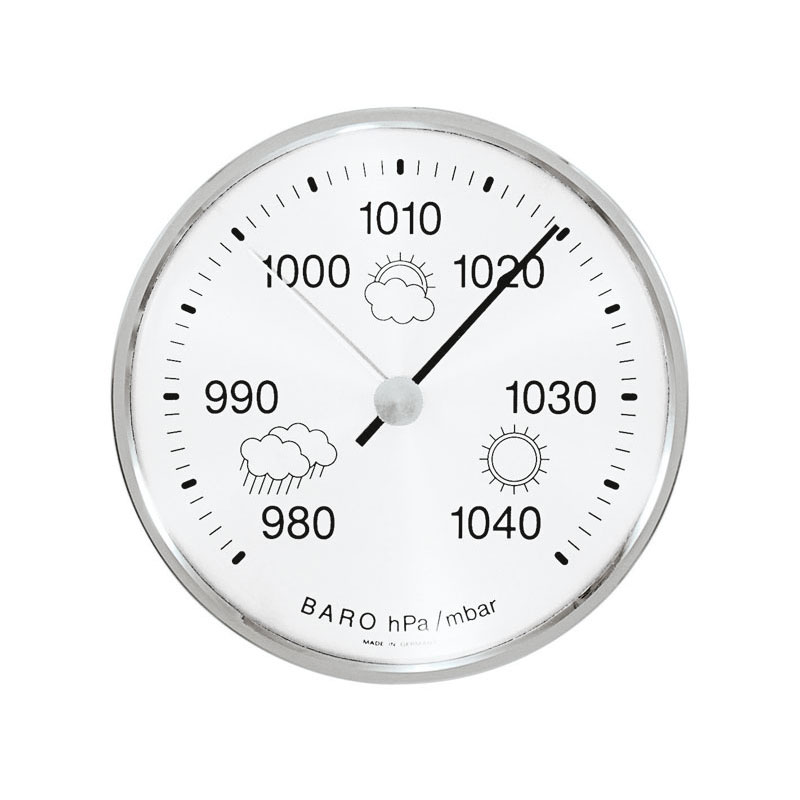
This weather instrument is a...
a)
anemometer
b)
barometer
c)
wind vane
d)
thermometer
31.
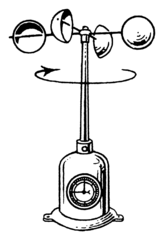
This weather instrument is an...
a)
wind vane
b)
anemometer
c)
barometer
d)
thermometer
32.

What is the barometric pressure for this station?

a)

009.6 mb

b)

909.6 mb

c)

109.6 mb

d)

1009.6 mb

e)

096 mb

33.
If the dew point temperature is 20 °C and the relative humidity is 58 %, what is the dew point? 
a)
5 degrees celsius
b)
12 degrees celsius
c)
15 degrees celsius
d)
38 degrees celsius
34.
Cold air is more_____ than warm air 
a)
Dense
b)
Stale
c)
Colorful 
35.
Air moves away from the center of a _________ pressure system.
a)
High
b)
Low
36.
_______ pressure systems are characterized by fair weather.
a)
High
b)
Low
37.
Where is Tornado Alley located?
a)
Near the equator of the Earth
b)
Near the North Pole
c)
South Central Los Angeles
d)
Middle states of United States
38.
Hurricanes develop in ________ regions.
a)
Arctic
b)
Tropical
c)
Arid
d)
None of the above