wayground logo

Lembar Kerja Gratis yang Dapat Dicetak

BARU

Ukuran huruf

S
M
L
XL
Lembar kerja

SNC1D Static Electricity

Total soal: 34

Worksheet time: 1hrs 8mins

Nama
Kelas
Tanggal
1.
Static electricity is:
a)
electricity flowing in a wire
b)
the buildup of electric charges on an object
c)
when protons move between objects
2.
Two objects with LIKE static charges will
a)
attract each other
b)
even out in the end
c)
repel each other
d)
cause a spark
3.
Which is an example of static dischage?
a)
a motor
b)
lightning
c)
thunder
d)
insulators
4.
Is it possible to CREATE electrons?
a)
Yes, that's what static electricity is.
b)
No, you can move them, but they are never created or distroyed.
c)
Sometimes, it depends on the voltage.
d)
Sometimes, it depends on the element.
5.
Rubbing a balloon on hair is an example of static charge build up created by....
a)
conduction
b)
friction
c)
induction
d)
hairduction
6.
If an object has the same number of positive and negative charges, its electrical charge is...
a)
positive
b)
negative
c)
neutral or no charge
d)
opposite
7.
True or False
A positively charged object has lost electrons
a)
True
b)
False
8.
True or False
Like charges repel
a)
True
b)
False
9.
True or False
A negatively charged object has lost protons
a)
True
b)
False
10.
Materials that tightly hold on to their electrons are considered 
a)
Good conductors
b)
Good insulators
c)
Good anti-static agents
d)
Useful for storing charge
11.
Which one of these objects is a good insulator
a)
Copper wire
b)
Glass
c)
Aluminum 
d)
Gold
12.
Materials that easily loose or accept electrons are considered
a)
Good conductors
b)
Good insulators
c)
Good anti-static agents
d)
Good for storing charge
13.
Charge separation in clouds is one way
a)
that freezing rain occurs
b)
that lightning occurs
c)
that low pressure system occurs
d)
that a tornado occurs
14.
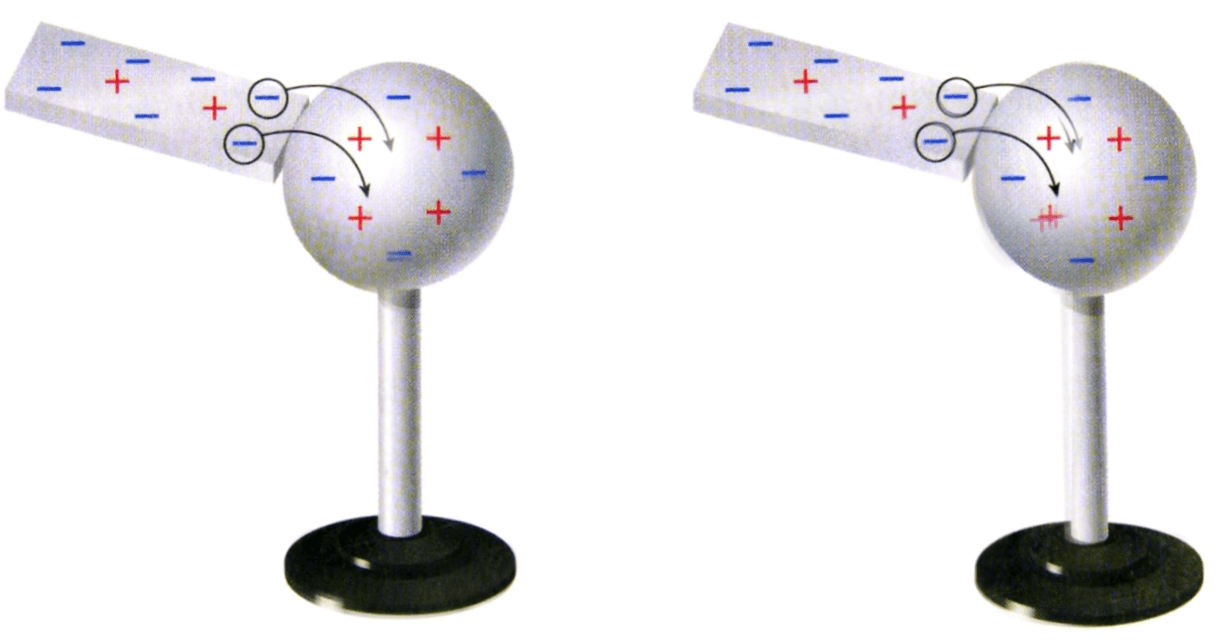
What method of static charging is shown in this picture
a)
Polarization
b)
Friction
c)
Induction
d)
Conduction
15.
If an object has more positive than negative charges, its electrical charge is...
a)
positive
b)
negative
c)
neutral or no charge
d)
opposite
16.
If an object has more negative charges than positive charges, its electrcial charge is...
a)
positive
b)
negative
c)
neutral or no charge
d)
opposite
17.
If an object has the same number of positive and negative charges, its electrical charge is...
a)
positive
b)
negative
c)
neutral or no charge
d)
opposite
18.
Static means...
a)
not moving
b)
moving slowly
c)
moving quicky
19.
Ms Jo Jo rubbed two balloons with a piece of wool. What will happen when the balloons are brought near each other?
a)
The balloons will repel each other.
b)
The balloons will attract each other.
c)
The balloons will become positively (+) charged.
d)
The balloons will pop.
20.
When a glass rod is rubbed with silk and the glass rod becomes positively charged, what happens to the electrons?
a)
they are removed from the rod
b)
they are added to the rod
21.
What do you call the process of charging a conductor by bringing it near another charged object?
a)
induction
b)
polarization
c)
neutralization
d)
conduction
22.
Which of the following is not a good insulator?
a)
Copper
b)
Glass
c)
rubber
d)
wool
23.
assume a rubber rod is rubbed against a rabbit fur and gains 5 electrons.  which of the following is true?
a)
The fur lost 5 electrons
b)
the fur gained 5 electrons
c)
the fur gained 5 protons
d)
The fur lost 2 electrons
24.
Charging by friction requires rubbing. Charging by contact requires ...
a)
rubbing
b)
touching
c)
no contact
25.
Charging by contact results in both objects having the same charge.
a)
True
b)
False
26.
Charging by Friction results in two objects with the same charge.
a)
True
b)
False
27.

Vinyl is rubbed with glass. The vinyl will:

a)

Gain electrons to become positively charged.

b)

Gain electrons to become negatively charged.

c)

Lose electrons to become positively charged.

d)

Lose electrons to become negatively charged.

28.

Your polyester shirt is rubbing against your skin. Electrons will move:

a)

From your skin to the polyester.

b)

From the polyester to your skin.

c)

Who knows? I'm just here for the popcorn...

29.

You want a piece of acetate to obtain the largest charge possible. In order to do this, you should rub it with:

a)

rabbit fur.

b)

nylon.

c)

ebonite.

d)

amber.

30.

What is the end result of charging by contact?

a)

Both object have the same charge, so they will attract one another

b)

Both object have the same charge, so they will repel one another

c)

Both object have the opposite charge, so they will attract one another

d)

Both object have the opposite charge, so they will repel one another

31.

Which image shows a neutral conductive pith ball after a positively charged balloon is brought near the left side, but doesn't touch?

a)

A

b)

B

c)

C

d)

D

32.

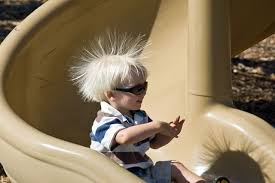
Why does the child's hair stick up?

a)

The boy is grounded since he's at the bottom of the slide

b)

He gained a charge from the slide, and since he's not grounded, his hairs have the same charge so they repel one another

c)

He gained a charge from the slide, and since he's not grounded, his hairs have opposite charges so they repel one another

d)

When hair is neutral, some have a positive side and some have negative side, so they will attract to each other, making it stand up

33.

After grounding, how will objects interact?

a)

Both will have the same charge, so they attract one another

b)

Both will be neutral, so they will attract one another

c)

Botn will be neutral, so they will repel one another

d)

Both will be neutral, so they will not attract nor repel

34.

Examine Before and After picture. Why do electrons move the way they did?

a)

This is grounding - electrons want to even out

b)

This is charging by contact - electrons go to the larger object

c)

This is charging by contact - electrons go from the object with less e- affinity to more e- affinity.

d)

This is charging by contact - electrons want to even out