
 Worksheets
Review of the Cold War
Total questions: 56
Worksheet time: 40mins


Where was Korea divided?
18 parallel
34 parallel
38 parallel
15 parallel
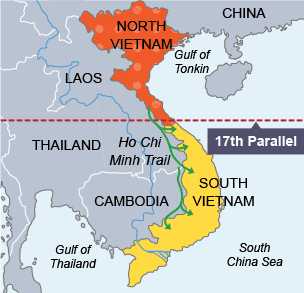
In the 1950s, the United States became involved in the Vietnam War. Why did the United States become involved in this war?
To prevent the collapse of the government of North Vietnam
To stop Vietnam from taking over Hong Kong
To stop the spread of communism to South Vietnam
To prevent attacks against United States shipping

This was the physical barrier separating Communist East Berlin and Democratic West Berlin, erected in 1961
Berlin Blockade
Berlin Base
Berlin Wall
Berlin Barrier


Images like this one refer to what theory about the spread of Communism in Asia (China, Korea, Vietnam)?
The Mar$hall Plan
The Domino Theory
Proxy Wars
Flexible Response
Which leader became president after the assassination of John F. Kennedy?
Lyndon B Johnson
Harry S. Truman
Dwight D. Eisenhower
Richard M. Nixon
Mikhail Gorbachev agreed to arms reduction treaties with the United States in the 1980s because
Soviet economy couldn't handle another arms race
He wanted to compete against STAR WARS
The Soviet Union wanted to become democratic

During the Cold War, what bill did the U.S. Congress pass to provide financial assistance to western European countries?
Truman Doctrine
Open Door Policy
Marshall Plan
Domino Theory

What policy implemented in the Cold War said the U.S. would give military and/or economic aid to any country that needed to resist the spread of communism?
Marshall Plan
Truman Doctrine
Domino Theory
Open Door Policy
During the Cold War, what policy did the U.S. follow to stop the spread of communism?
Open Door Policy
Big Stick Policy
Containment Policy
Dollar Diplomacy
Which individual/group contributed to the Red Scare by accusing American citizens of being communist spies?
McCarthy/HUAC
NAACP/Farm Workers Union
Nativists/Muckrakers
Philanthropists/Entrepreneurs

What happened as a result of the launch of Sputnik in 1957?
It started the space race between the USSR and U.S.
The U.S. government started NASA.
U.S. began to spend more money on math and science to maintain national security.
All of the above

During what Cold War event did the U.S. bypass a Soviet blockade in Germany without provoking a military conflict?
Berlin Airlift
Vietnam War
Watergate Scandal
Bataan Death March

During the Cuban Missile Crisis, what did President J.F. Kennedy do when he heard that the Soviet Union was constructing nuclear missile sites in Cuba.
He launched a nuclear missile at the Kremlin in Moscow.
He gave into the demands of the Soviet & Cuban government.
He ordered a naval blockade around Cuba to prevent Soviet ships from bringing the necessary materials.
He declared war on the Soviet Union & Cuba.
What was the name of the rapid increase of population following the end of WWII called?
Baby Boom
Columbian Exchange
Great Migration
Demographic Shift

How did the Counter-culture movement of the 1960s impact the Vietnam War?
The hippies protested and organized mass demonstrations.
They helped turn public opinion against the war.
They helped get the 26th amendment passed.
All of the above
What theory caused the U.S. to enter the Vietnam War in order to stop the expansion of communism across Southeast Asia?
Marshall Plan
Domino Theory
Eisenhower Doctrine
Dollar Diplomacy

What amendment was passed to lower the voting age because it was unfair that 18-20 year olds could be drafted into the army but not vote?
17th amendment
21st amendment
22nd amendment
26th amendment
What words should you immediately associate with the Cold War?
Hitler & the Nazis
Economic recession
Containment of Communism
Corruption & Industrialization

What body was created for the nations near the end of World War II to try to prevent future global wars?
League of Nations
Allied Powers
Axis Powers
United Nations

The state of tension between the United States and the Soviet Union without actual fighting that divided the world into two camps was the what?
Policy of containment
Warsaw Pact
Cuban Missile Crisis
Cold War

After World War II, who joined forces with the United States to resist Chinese and North Korean aggression which later ended in a stalemate?
Soviet Union
South Korea
Cuba
Vietnam

How did the conflict in Vietnam end?
Both sides won
Cease-fire agreement in which U.S. troops withdrew
Soviets removed the missiles in Cuba in response to a U.S. blockade
The USSR invaded Afghanistan

How did the Cuban Missile Crisis end?
Soviets removed the missiles in Cuba in response to a U.S. blockade
United States responded by placing missiles of its own in China
United States declared war on the Soviet Union
Break up of the Soviet Union into independent countries

Berlin Wall Falls! What happened as a result of the event in the newspaper headline?
Communism spread in Europe
Missiles were removed from Cuba
Collapse of Communism in Europe
Vietnam War ended

President Wipes Out Segregation In The Armed Forces! The newspaper headline is about which President?
Franklin D. Roosevelt
Woodrow Wilson
Harry S. Truman
Dwight D. Eisenhower

United States President, John F. Kennedy and Soviet Union Premier, Nikita Khrushchev The political cartoon is about which conflict?
Cuban Missile Crisis
Desegregation
Korean War
Vietnam War

The United States intervened to stop the spread of communism from North Vietnam into South Vietnam as a result of what?
the Domino Theory
the Marshall Plan
United Nations orders
Yellow Journalism

This international organization works as a cartel to control the supply and price of oil.
OPEC
NATO
UNITED NATIONS
Warsaw Pact


How did détente represent a new direction in U.S. foreign policy?
Détente represented the first time since World War II that the U.S. entered the global arena.
Nixon forced the U.S. to admit defeat in the Cold War and open negotiations with China.
Rather than maintaining the defense of U.S. allies, Nixon offered economic aid.
Instead of fighting communism openly, Nixon focused on negotiations with Communist countries.
President Nixon’s policy of reducing the number of American troops in Vietnam allowing South Vietnam to assume more the fighting was known as…
Vietnamization
Detente
Watergate
Brinkmanship
The secret documents detailing the history of American involvement in Vietnam, which were obtained by Daniel Ellsberg and later printed by the new York Times, were known as the
Watergate tapes
Nixon memoranda
Pentagon Papers
Warren Report
President Gerald Ford lost the most support from the American public for
allowing the fall of South Vietnam to the Communists
his ineffective WIN campaign against inflation
becoming the first unelected president of the United States
his pardon of Richard Nixon

What is the main idea of this cartoon from the Watergate era?
The Supreme Court presides over a presidential impeachment trial.
Congress has to obey the Constitution.
The president has the final word involving constitutional issues.
No person or group is above the law.
What was the purpose of the Camp David Accords led by President Carter?
to broker peace between Egypt and Israel
to end the Iranian hostage crisis
to maintain good relations with the Shah
to find a way to end the economic recession
What incident on the morning of June 17, 1972, began the Watergate scandal?
Five men broke into the Democratic National Committee headquarters.
Bob Woodward published his book, All the President's Men.
The CIA became embroiled in a massive cover-up.
President Nixon resigned from office.
Was the leader of the U.S.S.R after Stalin?
Khrushchev
Gorbachev
Was the leader of the Soviet Union at the end of the Cold War?
Khrushchev
Gorbachev
Which political leader introduced programs that moved the USSR away from totalitarianism, and increased economic freedom and political rights?
Mikhail Gorbechev
Joseph Stalin
Boris Yeltsin
Vladimir Putin
How did the Space Race and arms race contribute to the collapse of the Soviet Union?
Both were expensive programs that put a strain on the country's economy.
There were not enough military bases to support the programs.
The US used espionage to steal the technology from both programs.
The USSR did not have the resources to develop the technology needed for the programs.
Which new Soviet policy granted the people of the USSR more decision making power and greater access to private ownership of businesses?
perestroika
glasnost
democratization
shock therapy
Which of Gorbachev's programs created more openness, more public participation in government, and greater individual rights were given to Soviet citizens?
glasnost
perestroika
democratizatsiya
shock therapy

