wayground logo

Free Printable Worksheets

Font size

S
M
L
XL
Worksheets

Science

Total questions: 149

Worksheet time: 3hrs 59mins

Name
Class
Date
1.
The freezing point of water is ________.
a)
32oC
b)
100oF
c)
0oC
d)
25oF
2.
A student made a mixture using equal amounts of salt and pepper. The salt grains were the same as the pepper grains. What should the student do to most easily separate the pepper from the salt?
a)
Use a pair of tweezers to remove each grain of pepper
b)
Run a small magnet through the mixture to attract the pepper
c)
Put the mixture in water and filter the pepper out of the water
d)
Use a strainer with a fine wire screen to remove the pepper
3.
A teacher wears protective gloves to lift a metal pan filled with boiling water from a hot plate. Why are the protective gloves necessary?
a)
The metal pan creates thermal energy
b)
The metal pan insulates thermal energy
c)
The metal pan conducts thermal energy
d)
The metal pan reduces thermal energy
4.
Students conduct and investigation to determine which substances are soluble in water.  All of the following have the property of solubility in water EXCEPT - 
a)
sugar cubes
b)
salt crystals
c)
cooking oil
d)
food coloring
5.
Which mixture can be separated using a coffee filter?
a)
rocks and sand
b)
sand and water
c)
lemon juice and water
d)
sand and iron filings
6.
What physical property of matter can be measured using the triple beam balance?
a)
length
b)
height
c)
volume
d)
mass
7.
Students are combining dried beans and rice.  What would be the most efficient way to separate the ingredients?
a)
Evaporation
b)
Coffee Filters
c)
Tweezers
d)
Microscope
8.
What describes the ability of a solid to dissolve in water?
a)
melt
b)
dissapear
c)
solubility
d)
evaporate
9.
Cracks in the seafloor called hydrothermal vents send streams of hot water into the ocean. The water from a vent is 387°C. How many degrees above the boiling point of water is this temperature?
a)
175 C.
b)
287 C.
c)
387 C.
d)
Not Here
10.
When a powdered drink mix was added to water, the liquid turned orange. A student decided the taste was too strong, so he poured out half of the liquid and added more water. Which of the following most likely occurred when more water was added?
a)
The physical state changed.
b)
The orange color became lighter.
c)
The liquid had a sweeter taste.
d)
None of the above
11.
A student observes ice forming on the edge of a school building. At what temperature did the water outside the school building most likely begin to change to ice? 
a)
100 C.
b)
32 C.
c)
25 C.
d)
0 C.
12.
If an item floats on top of water it is...
a)
Less dense than water.
b)
More dense than water
c)
The same density as water.
d)
A gas.
13.
Which liquid is the most dense?  
a)
oil
b)
water
c)
syrup
d)
plastic bottle
14.
What would be the best title for this data table?
a)
Tools for Measuring Matter
b)
Tools for Measuring Length
c)
Tools for Measuring Volume
d)
Tools for Measuring Mass
15.
Which two objects are more dense than water?
a)
a penny and a craft stick
b)
a craft stick and an anchor
c)
a beach ball and a paper clip
d)
a seashell and a penny
16.
A chef wears a thick oven mitt to remove a pan from a hot oven. Why does the chef wear the oven mitt? Find the BEST answer.
a)
To move the pan carefully
b)
to insulate his hand from the heat
c)
To protect his hand from electricity
d)
To conduct heat away from his hand
17.
A tiny piece of sand is very light but sinks in water. This is because 
a)
 Sand is a solid
b)
Sand is less dense than water 
c)
There is more water than sand
d)
Sand is denser than water 
18.
What do magnets stick to?
a)
copper
b)
wood
c)
iron
d)
plastic
19.
Which testable question could be used to investigate the effects of force on an object?
a)
Why do toy cars move?
b)
Which type of battery lasts the longest?
c)
Where can magnets be purchased?
d)
Do balls roll faster on rough or smooth surfaces?
20.
The force of friction is caused by:
a)
surfaces rubbing against one another
b)
objects heating or cooling
c)
rough surfaces
d)
smooth surfaces
21.
What would take the most force?
a)
Rolling a rock down a hill
b)
Pushing a rock on ice
c)
Pushing a rock on a gravel road
d)
Pulling a rock on wheels
22.
Some students paint the inside of several boxes. They paint each box a different color. They observe that the inside of the box painted white looks brighter than the others. What is the most likely reason this box looks brighter?
a)
More light is reflected off white paint
b)
More is refracted by white paint
c)
More light passes through white paint
d)
More light is absorbed by white paint
23.
Which property of light makes it possible to produce hand shadows?
a)
Light travels in straight lines.
b)
Light is a form of energy.
c)
Light can be refracted.
d)
Light can be separated into different colors.
24.
A student looks into a mirror and sees an image of an object. Which diagram shows an X where the object is most likely located?
a)
F
b)
G
c)
G
d)
J
25.
A group of students built the circuit shown below. The light bulb does not glow. Which statement explains this observation?
a)
The bell uses most of the energy from the battery.
b)
The light bulb is not part of a complete circuit.
c)
The battery is not charged.
d)
The circuit does not have a switch.
26.
Most cars have lights, power locks, radios, and other equipment that use electricity. Electric circuits power this equipment. Each circuit has a fuse that completes it.  Which of these describes one thing that could happen if the wire in a car fuse burns out?
a)
The car’s lights will burn brighter.
b)
The car’s radio will not work.
c)
The car’s turn signal will blink too slowly.
d)
The car’s power windows will open faster.
27.
What kind of energy?
a)
Thermal
b)
Electrical
c)
Mechanical
d)
Radiant
28.
What kind of energy does this device use?
a)
Chemical
b)
Electrical
c)
Thermal
d)
Chemical
29.
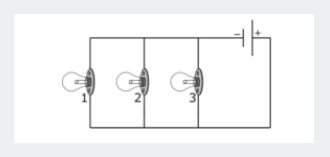
If bulb 1 burns out, what will occur?
a)
bulbs 2 and 3 will go out
b)
bulbs 2 and 3 receive more volts
c)
bulbs 2 and 3 will stay lit
d)
nothing will happen
30.
This instrument can be used to see if materials conduct electricity.  Which of these groups contains items that could all conduct electricity to complete the circuit?
a)
rubber ball, plastic comb, nail
b)
paper clip, penny, screw
c)
cork, dollar bill, tweezers
d)
pencil, eraser, spoon
31.
The pictures shows what a student observed when he looked through a hand lens at a penny.
What happens to light passing through a hand lens that makes the image of the penny appear larger? The light is-
a)
absorbed
b)
reflected
c)
refracted
d)
stopped
32.
A student placed a pencil in a cup of water.  The pencil appears broken because light-
a)
always travels in a straight line
b)
bends when it passes through water
c)
makes the water in the glass evaporate
d)
reflects the pencil on the water's surface
33.
Which of the following materials would reflect the most light?
a)
a flat sheet of aluminum foil
b)
a dark brown carpet square
c)
a smooth, black-topped table
d)
a piece of red construction paper
34.
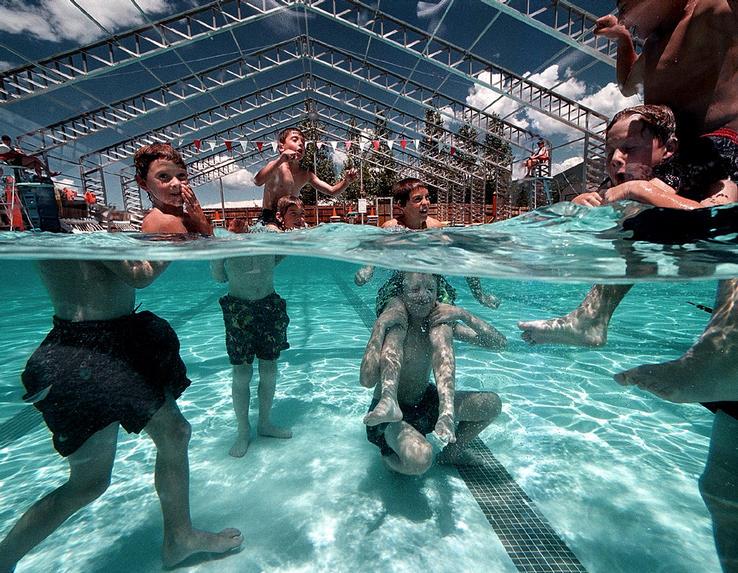
Why does the lower part of the child appear so much different in size from the upper part?
a)
The light rays that travel through water and then into air are refracted.
b)
The light rays that travel through water and then into air are enlarged.
c)
The light rays that travel through air and then into water are reflected.
d)
The light rays that travel through air and then into water are reduced.
35.
a)
Reflection
b)
Refraction
36.
a)
Refraction
b)
Reflection
37.
a)
Reflection
b)
Refraction
38.
a)
Reflection
b)
Refraction
39.
If the forces are the same in Scenario A and Scenario C, which ball would move the fastest?
a)
both balls would move at the same speed
b)
there is no way to determine which ball would move the fastest
c)
the ball in Scenario C
d)
the ball in Scenario A
40.
When conducting an experiment, in order to get reliable results, it is important to:
a)
Disregard results that do not match your hypothesis
b)
Test many different variables at the same time
c)
Test all forces at the same time
d)
Repeat the investigation several times
41.
Students wrap a copper wire around an iron nail and connect the ends of the wire to the battery. The nail attracts other small nails and paper clips as they stick together. What force is being observed?
a)
The students are observing the force of gravity.
b)
The students are observing the force of friction.
c)
The students are observing the force of magnetism.
d)
The students are observing the force of electricity.
42.
What is true about the image of the children on the swings?
a)
Both students are working even though only one is moving
b)
Student 1 is working because the swing is moving
c)
Earth's gravity is preventing Student 2 from moving
d)
Neither Student is working
43.
If you pull the cord, what direction will the box move?
a)
Up
b)
Down
c)
Left
d)
Right
44.
Which of these is NOT an example of a bicycle using mechanical energy?
a)
The pedals, gears, and chain turn the wheels.
b)
The wheels turn when the bicycle moves.
c)
The front wheel guides the bicycle when it moves.
d)
The reflector allows the bicycle to be seen at night.
45.
Which statement describes weather, rather than climate?
a)
The weather is usually hot and humid year around
b)
The destination has hot summers and cold winters
c)
The summer temperatures average between 29 and 35 degrees
d)
The humidity level on Tuesday was 30%
46.
A class learns about fossil fuels.  They learn that coal, oil and natural gas are classified as nonrenewable resources because they take so long to form.  How can the class conserve fossil fuels?
a)
Use both sides of notebook paper
b)
Arrange a car pool to and from school
c)
Create a backyard compost pile
d)
Plant flowers in front of the school
47.
Most alternative energy resources produce more energy at certain times. Which combination can produce a steady flow of energy from only alternative resources 24 hours a day year-round? 
a)
Geothermal and natural gas
b)
Hydroelectric and geothermal 
c)
Solar and petroleum 
d)
Wind and coal 
48.
Erosion is one of the processes involved in the formation of sedimentary rock. Which of these best describes the process of erosion?
a)
Rocks are broken into smaller pieces that remain in the same location.
b)
Pressure compacts layers of sediment and turns them into rock.
c)
Pieces of rock or soil are carried from one place to another.
d)
Sediment grains fall to the bottom of a lake to form sedimentary layers.
49.
Using the weather map shown, which city has most likely seen an increase in temperature? 
a)
Houston
b)
Oklahoma City 
c)
Boston
d)
Los Angeles
50.
Students are asked to classify renewable and non-renewable resources during class. The classification chart is shown below. 
Which two answer choices best complete the blanks. 
a)
Petroleum and water
b)
Plants and coal
c)
Timber and natural gas
d)
Air and fish
51.
All of these are related to the formation of oil or natural gas EXCEPT--
a)
decomposed animals
b)
decayed plants
c)
sedimentary rocks
d)
active volcanoes
52.
Each school year for 30 years, the amount of rain that fell at a school was measured and recorded. Tracking rainfall over a long period provides the most information about which characteristic of an area?
a)
Climate
b)
Temperature of one day
c)
Weather
d)
Type of Soil
53.
Several students investigate the characteristics of soil. The students observe samples of common soils. In one sample they observe that water drains through the soil easily. When they rub the soil between their fingers, it feels rough and scratch, and its particles feel hard. The soil the students observed is most likely----
a)
Sand
b)
Clay
c)
Silt
d)
Loam
54.
The diagram above shows the process of evaporation over the ocean. What is the most likely effect of this process on the land areas nearby?
a)
Increased drought conditions
b)
Decreased erosion of the shoreline
c)
Increased precipitation
d)
Decreased solar energy
55.
An energy company wants to build a hydroelectric power plant. Which of these characteristics of an area is most important to the development of a hydroelectric power plant?
a)
The area has a cool, rainy climate.
b)
The area is located in a valley with very little wind and frequent heavy fog.
c)
The area has a river that flows rapidly from nearby mountains through a valley.
d)
The area has no geysers or hot springs.
56.
Resources can be classified as renewable or nonrenewable. Which of these resources is classified in the same category as coal?
a)
Wood
b)
Wind
c)
Corn oil
d)
Petroleum
57.
If students could rotate the globe quickly or slowly and the globe could rotate only at the rate that Earth actually rotates, about how long would each complete rotation take?
a)
30 Days
b)
60 Minutes
c)
24 Hours
d)
365 Days
58.
A group of fifth-grade students was researching alternative energy resources in the school library. Each student made a list of resources. Which list contains only alternative energy resources?
a)
F
b)
G
c)
H
d)
J
59.
A wide U-shaped valley is shown in the photograph below. This valley was most likely formed by —
a)
Flashing Flooding
b)
A Glacier
c)
A Hurricane
d)
Melting snow
60.
The rotation of Earth on its axis causes the pattern of _____.
a)
night and day
b)
constellations
c)
Earth's seasons
d)
the phases of the moon
61.
It takes Earth _________ to make one complete rotation on its axis.
a)
24 hours
b)
365 days
c)
28 days
d)
24 days
62.
It takes Earth _____________ to make one revolution or orbit around the Sun.
a)
365 days
b)
365 hours
c)
28 days
d)
24 hours
63.
At ____ the length of a shadow is the shortest.
a)
8am
b)
5pm
c)
midday
64.
A shadow is the longest ________ .
a)
at midday
b)
in the morning
c)
in the evening
d)
in the morning and the evening
65.
What type of tide will occur at 9:30 a.m.?
a)
low 
b)
high 
c)
none
d)
high and low
66.
The moon's __________ pulls the water on the earth towards it causing tides to occur. 
a)
gravitational force
b)
light 
c)
shadow 
d)
orbit
67.
Which process takes the longest to change the Earth's surface?
a)
volcanic eruptions
b)
earthquake shaking the Earth 
c)
weather of rock by wind
68.
Weathering in not caused by:
a)
rivers flowing from the mountains
b)
strong winds blowing
c)
the rotation of the Earth
69.
Deltas are created when: 
a)
rivers drop sediments at the mouth of the river
b)
sheets of ice form valleys
c)
wind blows sand in hills
70.
Rock made of layers of compressed sediments
a)
metamorphic rock
b)
igneous rock
c)
sedimentary rock
d)
school house rock
71.
Which of the following is a learned behavior of a kitten?
a)
Having gray fur
b)
Playing with yarn
c)
Drinking Water
d)
Having two ears
72.
A bear receives the energy it needs to survive after it -
a)
drinks plenty of water
b)
eats fish and berries
c)
takes a nap
d)
rests in the sunlight
73.
Plants are known as producers because they produce their own food.  How do producers receive the energy for this process?
a)
By consuming soil nutrients
b)
By absorbing sunlight
c)
By releasing water
d)
By producing oxygen
74.
A student observing birds in a park records some ways that birds interact with living and nonliving parts of their environment. All the following  observations are was that a bird interacts with nonliving parts of its environment except______
a)
reacting to morning sunlight by singing
b)
drinking and taking a bath in a puddle of water
c)
responding to cold temperatures by fluffing its feathers
d)
feeding insects to its chicks
75.
What would most likely happen to the carbon dioxide–oxygen cycle if Earth’s large forests were all cut down?
a)
 There would be more carbon dioxide in the atmosphere because fewer plants would be using it to produce their own food.
b)
The remaining plants would stop producing carbon dioxide, and animals would use less oxygen.
c)
The remaining plants would produce more oxygen, and animals would produce less carbon dioxide.
d)
There would be more oxygen in the atmosphere because fewer plants would be using it to produce their own food.
76.
A teacher is setting up the terrarium shown in a science classroom. Which of these organisms is best suited for the terrarium?
a)
Blue Jay
b)
Lobster
c)
Snail 
d)
Water lily
77.
In a food chain, energy does NOT flow directly from---
a)
producer to decomposer
b)
producer to consumer
c)
consumer to decomposer
d)
consumer to producer
78.
Which of these is learned behavior of a dog?
a)
Begging for food
b)
Drinking water
c)
Panting on a hot day
d)
Chewing on a bone
79.
Wild Texas hogs, similar to the one shown, are descended from hogs brought here from other countries. These wild hogs eat many different kinds of food, including plants, fungi, and insects. Besides being very destructive to the habitats of other animals, how do wild hogs most likely harm other animals?
a)
By competing with other animals for food
b)
By moving slower than most other animals
c)
By causing other animals to reproduce more
d)
By eating foods that no other animals eat
80.
Prairie dogs eat plants and dig underground tunnels. Prairie dog tunnels help breakup hard prairie soils, and the animals’ waste adds nutrients to the soil. In the past,large groups of prairie dogs lived in many parts of the U.S. Great Plains, but people have destroyed most of these colonies.  Which of these will most likely happen when prairie dogs are removed from an area?
a)
The population of predators that eat prairie dogs will decrease.
b)
The population of plants that prairie dogs eat will decrease.
c)
The nutrients in the soil will increase.
d)
The number of underground tunnels will increase.
81.
The roots of the prickly pear cactus spread out in a wide underground network. How does this type of root system benefit a prickly pear cactus?
a)
By producing fruit and storing water
b)
By capturing sunlight and getting rid of waste materials
c)
By absorbing water and supporting the plant in loose, sandy soil
d)
By releasing nutrients into the sandy soil and taking in oxygen
82.
An organism that gets energy from breaking down dead organisms, non-living material or waste
a)
producer
b)
consumer
c)
decomposer
d)
autotroph
83.
The arrows in a food chain or web represents what?
a)
They point to the organism that is being eaten.
b)
It shows how sunlight flows within an ecosystem.
c)
They show what direction the energy is flowing between organisms. 
d)
They represent how water is transferred within a habitat.
84.
In this food chain, what will happen if the frogs become extinct?
a)
The snakes will increase.
b)
The grasshoppers will decrease.
c)
The eagles will remain the same.
d)
The grasshoppers will increase.
85.
Which of the following is a herbivore?
a)
cricket
b)
frog
c)
hawk
d)
shrew
86.
Which of the following would have a negative impact on an ecosystem
a)
constructing highways
b)
planting trees
c)
recycling paper
87.
How do you know this insect is undergoing incomplete metamorphosis? 
a)
The insect changes color when it becomes an adult.
b)
The first stage of the insects development is as an egg.
c)
The insect undergoes more than four stages in its development.
d)
The insect has similar body parts throughout its development.
88.
List the four stages of the complete metamorphosis life cycles in the correct order. 
a)
egg, pupa, larva, adult
b)
egg, larva, pupa, adult
c)
adult, egg, larva, pupa
d)
adult, egg, pupa, larva
89.
a)
complete
b)
incomplete
90.
a)
complete
b)
incomplete
91.
a)
complete
b)
incomplete
92.

What do you call the temperature at which a liquid turns into a gas?

a)

Condensing point

b)

Boiling point

c)

Freezing point

d)

Melting point

93.

If I mix one cup of sand with a half cup of iron fillings, can I separate them? If yes, how?

a)

No, you can not separate this mixture

b)

By using your hand

c)

With a filter

d)

By using a magnet

94.

Which of the following does NOT have mass?

a)

Light from a flashlight

b)

Water in a glass

c)

Air in a balloon

d)

An empty box

95.

Astronauts who have walked on the Moon....

a)

weighed less on the Moon

b)

weighed more on the Moon

c)

had greater mass on the Moon

d)

felt greater magnetism on the Moon

96.

Which of the following is NOT a Conductor?

a)

Water

b)

Iron

c)

Penny

d)

Wood

97.

If a piece of wood is floating at the top of the pitcher with water, that means that the wood is.....

a)

more dense than water

b)

less dense than water

c)

is neither an insulator or conductor

d)

solid

98.

How can I separate sugar and water?

a)

By letting the sugar evaporate

b)

By letting the water evaporate

c)

By drinking the water and leaving the sugar behind

d)

By mixing it

99.

A toaster is powered by electrical energy. The toaster changes the electrical energy to.....

a)

wind energy

b)

solar energy

c)

thermal energy

d)

mechanical energy

100.

What name is given to any material that allows electricity to pass through it?

a)

Battery

b)

Conductor

c)

Insulator

d)

Appliance

101.

A source of power would be a....

a)

battery

b)

open circuit

c)

closed circuit

d)

a wire

102.

In science, what is the definition of energy?

a)

Movement of things

b)

Ability to do work

c)

Use of electricity

d)

Cycle of work

103.

What would cause refraction?

a)

a mirror

b)

a metallic pan

c)

a hand lens

d)

a pan balance

104.

What kind of energy do we use when we carry out trash to the trash can?

a)

Sound

b)

Mechanical

c)

Thermal

d)

Solar

105.

About 50% of the electricity produced in the U.S. is created by burning coal. What form of energy is coal?

a)

Chemical

b)

Heat

c)

Light

d)

Natural

106.

Which statement about light and water is correct?

a)

Light cannot pass through water.

b)

Light bends just before entering water.

c)

Light changes speed when passing through water.

d)

Light bounces in the difference directions when passing through water.

107.

Reflection means that light

a)

bends

b)

bounces

c)

refracts

d)

magnifies

108.

Which of the following would probably reflect the most light?

a)

Coffee cup

b)

Notebook paper

c)

Polished spoon

d)

Wooden block

109.

Sunlight can pass through our classroom windows because the windows are...

a)

clean

b)

opaque

c)

translucent

d)

transparent

110.

Which process would probably create the most rapid change in Earth's surface?

a)

Erosion

b)

Heating

c)

Volcanic eruption

d)

Weathering

111.

Soil is made up of both living and non-living materials. Which of the following is a living material that might be found in soil?

a)

Air

b)

Algae

c)

Mineral

d)

Silt

112.

Which of the following is NOT a characteristic of sedimentary rocks?

a)

Sedimentary rocks often contain fossils.

b)

Layers or bands are often visible in sedimentary rocks.

c)

Sedimentary rocks formed as a result of volcanic eruptions.

d)

Sedimentary rocks usually scrape easily and often crumble.

113.

Which landforms would normally be created by water erosion?

a)

Lakes and cliffs

b)

Canyons and deltas

c)

Mountains and hills

d)

Sand dunes and valleys

114.

Which Earth-changing process involves the gradual wearing away of rock by wind, water, and ice?

a)

Cooling

b)

Rotation

c)

Sedimentation

d)

Weathering

115.

Large cities use hydroelectric power to produce electricity. Hydroelectric power is energy created from....

a)

the heat from the Sun

b)

the movement of wind

c)

moving or falling water

d)

materials that were once alive

116.

What is the source of all energy on Earth?

a)

Coal

b)

Wind

c)

Water

d)

Sun

117.

About how much time is needed to create fossil fuels?

a)

100 years

b)

Millions of years

c)

2000 years

d)

500 years

118.

Which statement BEST explains why soils are different in appearance and texture?

a)

Soils form only after a very long period of time.

b)

Soils can contain different amounts of air and water.

c)

Soils contain living things that affect their appearance and texture.

d)

Soils come from different rocks and develop under different conditions.

119.

Which is NOT a fossil fuel

a)

Biomass

b)

Natural gas

c)

Petroleum

d)

Coal

120.

Which best describes fossil fuels?

a)

Organic matter trapped in the Earth's crust

b)

Organic matter trapped in igneous rock

c)

Organic matter trapped in sedimentary rock

d)

Non-organic matter trapped in metamorphic rock

121.

Which of the following is an example of using biomass as a fuel?

a)

pouring cooking oil into a trashcan

b)

a swimming pool being heated by solar energy

c)

a sugar mill burns leftover plants to create electricity

d)

a gardener rakes fallen leaves and places them in a plastic bag

122.

Which of the following causes the greatest change in the Earth's surface over a long period of time?

a)

Heat from the Sun

b)

Hurricanes and tornadoes

c)

Volcanoes and earthquakes

d)

Erosion by wind and water

123.

Why is topsoil significant?

a)

it does not hold too much water

b)

it protects the harder rock below it

c)

it supports structures built on top of it

d)

topsoil contains nutrients important to plants.

124.

The uppermost surface of the earth is.....

a)

silt

b)

top soil

c)

clay

d)

sand

125.

Which is not a fossil

a)

bone fragment

b)

a shell imprint

c)

pollen grains

d)

a leaf print in a rock

126.

In which layer of sedimentary rock would a scientist find the oldest fossil?

a)

youngest layer

b)

top layer

c)

bottom layer

d)

middle layer

127.

Which causes the formation of sand dunes?

a)

erosion

b)

gravity

c)

water

d)

wind

128.

Which is an example of using an alternative energy source?

a)

cooking food in microwave

b)

chilling drinks in the refrigerator

c)

cooling a room with a fan

d)

allowing washed clothes air-dry outdoors

129.

Picture a glacier moving down a mountain....Which statement about glaciers is correct?

a)

Glaciers are the main force in the creation of mountains

b)

Glaciers move to slowly to change Earth's landscape

c)

Glaciers create both deep valleys and mountain lakes

d)

Glaciers carved all of the rivers that currently exist on Earth.

130.

Nathan checks the outside temperature every morning before he gets ready for school. Nathan is checking....

a)

climate

b)

weather

c)

forecast

d)

pattern

131.

What is the source of energy that begins the water cycle?

a)

electricity

b)

gravity

c)

moon

d)

sun

132.

What causes tides?

a)

Earthquakes deep undergroud

b)

depth of the water near a beach

c)

winds blowing across the water's surface

d)

pull of gravity from the Moon and Sun

133.

The Moon's appearance seems to change shape, or go through phases because....

a)

the Moon rotates on its axis

b)

the Moon is seen at the different angles from Earth

c)

the Moon orbits Earth more slowly than Earth orbits the Sun

d)

only the parts of the of the Moon lit by the Sun are visible from Earth

134.

During which season of the year does Texas receive them most direct rays from the Sun?

a)

Spring

b)

Summer

c)

Fall

d)

Winter

135.

Which of the following correctly describes the Sun

a)

A gaseous satellite Earth

b)

The largest star in the universe

c)

A star at the center of the solar system

d)

A gaseous planet at the center of the solar system

136.

Which statement about Earth's water is correct?

a)

Earth's water supply is decreasing dude to evaporation

b)

Earth's water is consistently moving and being recycled

c)

The amount of water on Earth increases over time

d)

Earth's water cycle is controlled by gravity

137.

Which is the largest planet in the solar system?

a)

Earth

b)

Jupiter

c)

Saturn

d)

Uranus

138.

About how long does one rotation of Earth take?

a)

365 days

b)

52 weeks

c)

24hours

d)

30 days

139.

How many times does Earth revolve around the Sun in one year?

a)

1

b)

7

c)

24

d)

365

140.

Why is carbon-dioxide important for plants?

a)

it gives plants their green color

b)

they release carbon-dioxide

c)

they use carbon dioxide for photosynthesis

d)

it helps plants absorb water through their roots

141.

Ecosystems change for many reasons. Which of the following is a natural cause of changes in an ecosystem

a)

Farming

b)

Housebuilding

c)

Hurricanes

d)

Pollution

142.

During which stage of complete metamorphosis does an insect change itself completely from a larva to an adult...

a)

Egg stage

b)

Larva stage

c)

Nymph stage

d)

Pupa stage

143.

Which organisms release oxygen into the air as part of the carbon-dioxide oxygen cycle?

a)

Consumers

b)

Decomposers

c)

Predators

d)

Producers

144.

The purpose of a food chain is to show

a)

the flow of energy through an ecosystem

b)

the number of organisms in an ecosystem

c)

how animals compete for food in an ecosystem

d)

the organisms living near each other in an ecosystem

145.

Insects go through stages to grow and change form. This process is called

a)

adaptation

b)

cycle

c)

development

d)

metamorphosis

146.

Some insects hatch directly from eggs during incomplete metamorphosis. These young insects are called

a)

adults

b)

larva

c)

pupa

d)

nymphs

147.

Nymphs do not have

a)

eyes

b)

legs

c)

antennae

d)

wings

148.

Most lizards can change colors to camouflage themselves on the ground or in plants. This is an example of....

a)

learned behavior

b)

natural response

c)

inherited traits

d)

physical behavior

149.

In order for me to MASTER the Science STAAR TEST I must...

a)

Stay focused! I will read the questions carefully and box in power words that will help me remember the skills I have acquired; also use all of the acronyms I learned and have been using all year.

b)

Try my best but rush on the test before my time is up so that I may finish earlier than everyone else.

c)

Guess the best answer and hope that I am able to remember everything.

d)

Read the questions and record the best answer in hope I do well.