wayground logo

Free Printable Worksheets

Font size

S
M
L
XL
Worksheets

Unit 8 2018-2019

Total questions: 113

Worksheet time: 3hrs 31mins

Name
Class
Date
1.
The pH scale is a range from:
a)
1-7
b)
0-14
c)
1-14
d)
1-20
2.
A(n) ______ is a substance with a pH less than 7
a)
Acid
b)
Alkaline
c)
Base
d)
Buffer
3.
A(n) _______ is a substance with a pH greater than 7.
a)
Base
b)
Acid
c)
Buffer
d)
Water
4.
What is the only substance with a neutral pH of 7?
a)
Milk
b)
Orange Juice
c)
Water
d)
Blood
5.
Which solution releases H+ in solution?
a)
Base
b)
Acid
c)
Buffer
d)
Water
6.
This substance releases OH- into solution
a)
Acid
b)
Base
c)
Neutral
7.
A solution with a pH of 3.6 would be...
a)
Acid
b)
Base
c)
Neutral
d)
Acid and Base
8.
A solution with a pH of 8.6 would be...
a)
Acid
b)
Base
c)
Neutral
d)
Acid and Base
9.
Tastes Sour
a)
Acids
b)
Bases
c)
Salts
d)
All
10.
Tastes bitter.
a)
Acids
b)
Bases
c)
Salts
d)
All
11.
According to the pH range which substance is more acidic than lemon juice
a)
Hydrochloric acid
b)
cabbage
c)
milk
12.
Bleach is a strong base, what is the pH level of bleach?
a)
13
b)
14
c)
1
d)
2
13.
Feels slippery.
a)
Acids
b)
Bases
c)
All
14.
If the [H+] of a solution is 1 x 10⁻² mol/L the pH is
a)
2
b)
12
c)
-2
d)
1
15.
If the pH of a solution is 5 the [H+] is
a)
1.0 x 10 M
b)
1.0 x 10 M
c)
5.0 x 10 M
d)
1.0 x 10⁻⁵  M
16.
If the pH of a solution is 5.6 the pOH is
a)
6.5
b)
12.4
c)
8.4
d)
5.6
17.
A  pH and a pOH will add up to:
a)
0
b)
7
c)
14
d)
1.0 x 10⁻¹⁴
18.
if the [H+] of a solution is 1.0 x 10⁻² mol/L the pH is
a)
2
b)
-2
c)
1
d)
12
19.
If the [H3O+] of a solution is 1 x 10⁻⁸ mol/L the [OH-] is
a)
1.0 x 10⁻⁶
b)
1.0 x 10⁶
c)
1.0 x 10⁻⁸
d)
1.0 x 10⁸
20.
If the [OH-] of a solution is 2.7 x 10⁻⁴ mol/L the pOH of the solution is
a)
10.44
b)
3.56
c)
1.00
d)
-4.43
21.
A solution with a [H+] of 9.4 x 10⁻⁵ mol/L is said to be
a)
Acidic
b)
Basic
c)
Neutral
d)
negative number, no solution.
22.
If the [H+] of a solution is 6.8 x 10⁻⁹ mol/L the pH is
a)
8.17
b)
8.2
c)
9.99
d)
8.62
23.
An indicator will ______________ when it is in contact with an acid or base
a)
Bubble
b)
Form a new substance
c)
Change color
d)
Stay the same color
24.
What is a substance that is one color in an acid and another color in a base? 
a)
Oxidizer
b)
Indicator
25.
The pH of a strong acid would be:
a)
1-2
b)
5-6
c)
8-9
d)
12-13
26.
The pH of a strong base would be:
a)
1-2
b)
5-6
c)
8-9
d)
13-14
27.
The pH of a weak base would be:
a)
1-2
b)
5-6
c)
8-9
d)
12-13
28.
The pH of a weak acid would be:
a)
1-2
b)
5-6
c)
8-9
d)
12-13
29.

What does pH measure?

a)

the amount of hydrogen (H+) ions

b)

the amount of hydroxide (OH-) ions

c)

amount of water

d)

all of the above

30.
How many liters would you need to make a 1 M solution if you have 6 mol of Sodium Hydroxide? 
a)
2
b)
3
c)
4
d)
31.
What is the molarity of 4 g of NaCl (MM=58.45) in 3,800 mL of solution?
a)
0.018 M
b)
0.0011 M
c)
1.052 M
d)
0.062 M
32.
How many grams of solute are dissolved in 125.0 mL of 5.00 M NaCl (MM = 58.45)?
a)
0.625 g NaCl
b)
625 g NaCl
c)
36.5 g NaCl
d)
0.04 mol NaCl
33.
Find the molarity of 186.55 g of sucrose, C12H22O11 (MM = 342) in 250 mL of water.
a)
2.18 M
b)
0.746 M
c)
1.18 M
d)
0.545 M
34.
How many moles of NaCl are present in a solution with a molarity of 8.59 M and a volume of 125 mL?
a)
1074 mol
b)
0.069 mol
c)
1.07 mol
d)
62.7 mol
35.
Which of the following has the most NaCl (MM = 58.44)?
a)
100 mL of a 1.8 M solution
b)
50 mL of a 4.1 M solution
c)
9.35 grams
d)
1 mole
36.

How much 0.05 M HCl solution can be made by diluting 250 mL of 10 M HCl?

a)

301 mL

b)

50,000 mL

c)

80,000mL

d)

343 mL

37.
What is the volume (in liters) of a 0.20 M solution that contains 0.30 moles of Na2SO4 dissolved in it?
a)
1.5 L
b)
0.060 L
c)
0.67 L
d)
2.3 L
38.

How many mL of 10.8M HCl are required to make 100.0 mL of 3.00M acid?

(Hint: use the dilution equation)

a)

27.8 mL

b)

27.78 mL

c)

2.8 mL

d)

278 mL

39.

How much 1.50M KBr can be made from 15.6 mL of concentrated KBr with a molarity of 9.65 M?

(hint: use the dilution equation)

a)

150. mL

b)

151 mL

c)

1.00 L

d)

100. mL

40.
acid + base ₋>
a)
salt + hydrogen
b)
salt + water
c)
salt + carbon dioxide + water
d)
salt
41.
HCl + NaOH → 
a)
NaH + ClOH
b)
NaCl + H2
c)
NaCl + H2O
d)
NaCl + Cl2
42.
What is the endpoint of a titration
a)
Where the amount of acid and base are balanced according to the equation
b)
Where there is no base
c)
At the end
43.
I am titrating 1M HCl with 1M NaOH.  I have 25mL of HCl. How much NaOH will I need?
a)
2.5mL
b)
5mL
c)
25mL
d)
50mL
44.
what is the reading on this burette?
a)
4.40mL
b)
3.50mL
c)
3.60mL
d)
4.50mL
45.
I have 25mL of 1M HCl which neutralises 20mL of NaOH. What is the concentration of the NaOH?
a)
0.8 M
b)
1 M
c)
1.25 M
46.
Identify the products of the chemical equation
3 LiOH + H3PO4
a)
Li3PO4 + 3 H2O
b)
LiPO4 + 3 H2O
c)
Li(PO4)3 + 3 H2O
d)
BOY + La + N2
47.
What acid and what base would you choose to prepare the salt potassium chlorate?
a)
KOH and HClO3
b)
KOH and HClO2
c)
HK and OHClO3
d)
HK and OHClO2
48.
A 50.0 mL sample of Ca(OH)2 is neutralized by 300.0 mL of HCl solution with a pH of 1.3. Calculate the molarity of the Ca(OH)2 solution.
a)
1.0 M
b)
0.50 M
c)
0.15 M 
d)
0.30 M
49.
How many moles of Ca(OH)2 are needed to neutralize three moles of HCl? 
a)
8
b)
1.5
c)
6
d)
3
50.
For the acid-base titration combination of NaOH with 0.79 mol HCl, find the number of moles of NaOH that would be the chemically equivalent amount of HCl.
a)
0.79 mol
b)
1.6 mol
c)
0.38 mol
d)
3.2 mol
51.
If phenolphthalein turns bright pink, it indicates
a)
an acid 
b)
a base
c)
a neutral
52.
What is the conjugate acid in the following equation?
a)
PO43- 
b)
HNO3 
c)
NO3- 
d)
HPO42-
53.
What is the conjugate base in the following reaction?
a)
HCO3- 
b)
HCl
c)
 H2CO3 
d)
Cl-
54.
HSO4-(aq)+H2O(l)             H3O+(aq)+SO42-(aq)
Identify the Acid in the above reaction.
a)
HSO4-
b)
H2O
c)
H3O+
d)
SO42-
55.
CO32-(aq)+H2O(l)      →              HCO3-(aq)+OH-(aq)
Using the above reaction, which compound is the conjugate base?
a)
CO32-
b)
H2O
c)
HCO3-
d)
OH-
56.
A compound that donates H+ ions is 
a)
A Bronsted-Lowry Acid
b)
An Arrhenius Acid
c)
A Bronsted-Lowry Base
d)
An Arrhenius Base
57.
Which of the following is transferred between a conjugate acid-base pair?
a)
An Electron
b)
A OH- ion
c)
A Proton
d)
A Neutron
58.
What is the molarity of 3 mole of hydrochloric acid in 3 L of water. 
a)
3
b)
1
c)
6
d)
9
59.
How many moles of NaCl are present in a solution with a molarity of 8.59M and 125 mL of solution?
a)
1.07 gram
b)
62.7 mol
c)
1.07 mol
d)
62.7 grams
60.
What is the molarity of 4 grams of sodium chloride in 3,800 mL of solution?
a)
0.018 M
b)
0.018 mol
c)
1.052 M
d)
1.052 mol
61.
Molarity is measured in
a)
moles per kg
b)
mols per L
c)
moles per kJ
d)
moles per mL
62.
The ___ is the thing being dissolved
a)
solute
b)
solvent
63.
True or false? Insoluble means that two substances can dissolve in one another.
a)
true
b)
false
64.

How much 0.05 M HCl solution can be made by diluting 250 mL of 10 M HCl?

a)

301 mL

b)

50,000 mL

c)

80,000mL

d)

343 mL

65.
What is the volume (in liters) of a 0.20 M solution that contains 0.30 moles of Na2SO4 dissolved in it?
a)
1.5 L
b)
0.060 L
c)
0.67 L
d)
2.3 L
66.

How many mL of 10.8M HCl are required to make 100.0 mL of 3.00M acid?

(Hint: use the dilution equation)

a)

27.8 mL

b)

27.78 mL

c)

2.8 mL

d)

278 mL

67.

How much 1.50M KBr can be made from 15.6 mL of concentrated KBr with a molarity of 9.65 M?

(hint: use the dilution equation)

a)

150. mL

b)

151 mL

c)

1.00 L

d)

100. mL

68.
If the equilibrium constant is much greater than one (K >> 1) then
a)
Equilibrium is not established.
b)
Equilibrium lies to the right (products are favored)
c)
Equilibrium lies to the left (reactants are favored)
d)
Neither products or reactants are favored.
69.
If the equilibrium constant is much less than one (K << 1) then
a)
Equilibrium is not established.
b)
Equilibrium lies to the right (products are favored)
c)
Equilibrium lies to the left (reactants are favored)
d)
Neither products or reactants are favored.
70.
N2O4(g) ↔ 2 NO2(g)
What is the concentration equilibrium constant expression?
a)
K= [NO2]2/[N2O4]
b)
K= [N2O4]/[NO2]2
c)
K= [N2O4]2/[NO2]
d)
K= [NO2]/[N2O4]2
71.
What is the equilibrium-constant expression for 
CO2(g) + H2(g) ↔ CO(g) + H2O(l)
a)
Kc= [CO][H2O] / [CO2][H2]  
b)
Kc= [CO2][H2] / [CO]
c)
Kc= [CO2][H2] / [CO][H2O]
d)
Kc= [CO] / [CO2][H2]  
72.

Which factors affect the rate of a reaction? (2 answers)

a)

decrease temperature

b)

increase concentration

c)

decrease surface area

d)

catalyst

73.

A temperature increase causes the particles to ......

a)

to slow down

b)

move faster

c)

collide higher

d)

in the right order

74.
What is the rate of reaction?
a)
How fast a reaction is 
b)
How big a reaction is
c)
How loud a reaction is
d)
How much gas a reaction produces
75.

Grinding a effervescent tablet into powder increases the rate of reaction due to increased

a)

concentration

b)

surface area

c)

temperature

d)

reactants

76.

Which factors increase the rate of a reaction?

a)

increasing temperature

b)

increasing concentration

c)

increasing surface area

d)

All of these

77.
In an exothermic reaction, heat is ...
a)
taken in
b)
given out
78.

The ______________is required to break the bonds of the reactants.

a)

Carbonic energy

b)

Activation energy

c)

Plutonic energy

d)

Energi Gaib

79.
Located on the left side of the reaction
a)
reactants
b)
products
80.

The minimum amount of energy needed for colliding particles to react is called

a)

Chemical Energy

b)

Kinetic Energy

c)

Activation Energy

d)

Potential Energy

81.

Icing sugar has a greater ______ _____ than a solid cube of

sugar.

a)

Surface Area

b)

Catalyst

c)

Temperature

82.

The word for a substance created in a chemical reaction...

a)

Reaction

b)

Reactant

c)

Product

d)

Mass

83.

Objects hitting each other

a)

Collision

b)

Catalyst

c)

Explosion

d)

Reaction

84.
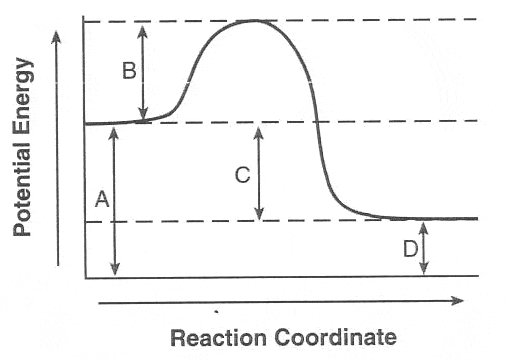
What type of reaction is this?
a)
Endothermic
b)
Exothermic
85.
What letter represents the activation energy?
a)
A
b)
B
c)
C
d)
D
86.
A substance that increases speed of chemical reaction without being being changed is called:
a)
Catalyst
b)
Acid
c)
Base
d)
pressure
87.
Le Chaltelier's Principle states that if a chemical system at equilibrium is stressed,
a)
the system will adjust to increase the stress
b)
the system will adjust to reduce the stress
c)
the system will not adjust
88.
An exothermic reaction is allowed to reach equilibrium. If heat energy is then removed, the equilibrium will shift
a)
toward the middle
b)
toward the reactant side
c)
toward the product side
89.
For the reaction...
SO2(g) + O2(g) <−>  SO3(g)
If the concentration of 
SO2(g)  is increased, the equilibrium of the reaction will ___________.
a)
shift to the left
b)
shift to the right
c)
not shift
90.
For the reaction...
SO2(g) + O2(g) <−>  SO3(g)

If the equilibrium shifts to the right, the concentration of O2(g) will ___________.
a)
increase
b)
decrease
c)
remain the same
91.
2SO2(g)+O2(g)⇌2SO3(g) is an exothermic reaction.
an in Increase temperature will...
a)
shift equilibrium toward the right
b)
shift equilibrium toward the left
c)
increase pressure
d)
have no change
92.
For the reaction...
heat  +  N2  +  O2  <−>  2NO
If the heat is added to the chemical system, the equilibrium will shift _______.
a)
left
b)
right
c)
left and right
d)
neither left nor right
93.
For an endothermic reaction, heat can be thought of as:
a)
a reactant
b)
a product
c)
either it has no effect
d)
neither it effects both sides equally.
94.
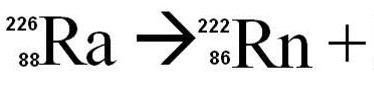
Complete the nuclear equation and determine the type of decay that is occurring in this reaction. 
a)
alpha
b)
beta
c)
gamma
d)
none
95.
If we start off with element 24X50 after an alpha decay we get another element Y that looks like
a)
22Y50
b)
22Y46
c)
20Y48
d)
26Y54
96.
What does the symbol -10e represent
a)
alpha
b)
beta
c)
gamma
d)
the zero element
97.
Balance the following equation:
146C --> 0-1e + ________
a)
145B
b)
146C
c)
147N
d)
42He
98.
What is the symbol for an alpha particle?
a)
42He
b)
0-1e
c)
0+1 e
d)
10n
99.
What is Half-life?
a)
The amount of time it takes for some of the nuclei in a sample of the isotope to decay
b)
The amount of time it takes for half the electrons in a sample of the isotope to decay
c)
The amount of time it takes for half the nuclei in a sample of the isotope to decay
d)
the amount of time it takes to double the nuclei in a sample of the isotope to decay
100.
The half-life of Zn-71 is 2.4 minutes. If one had 100.0 g at the beginning, how many grams would be left after 7.2 minutes has elapsed?
a)
100.0g
b)
50.0g
c)
12.5g
d)
8.5g
101.
Pd-100 has a half-life of 3.6 days. If one had 620,310,740 atoms at the start, how many atoms would be present after 21.6 days?
a)
9.7x10⁶ atoms remain
b)
97.0x10⁶ atoms remain
c)
0.97x10⁶ atoms remain
d)
9.7x10⁵ atoms remain
102.
After the third half-life, how much of the sample is left?
a)
1/2
b)
1/3
c)
1/16
d)
1/8
103.
The half-life of strontium-90 is 25 years. How much strontium-90 will remain after 100 years if the initial amount is 4.0 g?
a)
3.0g
b)
0.25mg
c)
0.3g
d)
0.25g
104.
If the half-life of uranium-232 is 70 years, how many half-lives will it take for 10 g of it to be reduced to 1.25 g?
a)
1 half-life
b)
2 half-lives
c)
3 half-lives
d)
4 half-lives
105.
At approximately what temperature does the solubility of sodium chloride, NaCl, match the solubility of potassium dichromate, K2Cr2O7?
a)
60 ºC
b)
30 ºC
c)
50 ºC
d)
83 ºC
106.
How many grams of K2Cr2O7, are soluble in 100 g of water at 95 ºC?
a)
83 grams
b)
75 grams
c)
40 grams
d)
12 grams
107.
Which substance is MOST soluble at 0 ºC?
a)
KI
b)
NaNO3
c)
NaCl
d)
Ce2(SO4)3
108.
Which solute is the most soluble at 10 ⁰C?
a)
KI
b)
KClO3
c)
NH4Cl
d)
NH3
109.
Which solute is the least soluble at 90 ⁰C?
a)
SO2
b)
KClO3
c)
KI
d)
HCl
110.
How does a solution become supersaturated?
a)
dissolve lots of solvent in it.
b)
dissolve a little solute in it. 
c)
dissolve more solute than you should be able to. 
d)
dissolve a super amount of solvent in it. 
111.
When 20 grams of potassium chlorate, KClO3, is dissolved in 100 grams of water at 80 ºC, the solution can be correctly described as:
a)
supersaturated
b)
saturated
c)
unsaturated
112.
When 20 grams of KNO3 is dissolved in 100 grams of water at 80 ºC, the solution can be correctly described as:
a)
supersaturated
b)
saturated
c)
unsaturated
113.
When 42 grams of potassium chloride, is dissolved in 100 grams of water at 50 ºC, the solution can be correctly described as:
a)
supersaturated
b)
saturated
c)
unsaturated