
Font size
 Worksheets
AN Quizizz #5: S1 T6-9 and S4 T6-10
Total questions: 50
Worksheet time: 2hrs 38mins

Simplify
5√2
0
2√2
-3√2

Simplify
-3√5
-3√6
√6
6

Simplify
9
5√2 + 2
√10 + 4
2√2 + 3√30

Rewrite the expression in radical form.
A
B
C
D

Rewrite the expression in exponential form.
A
B
C
D
The square root of 25x6 is ______.
25x
5x2
5x3
x3
Simplify: √5 + √20
5
25
3√5
2√3
Simplify completely: √48
2√12
24√2
4√3
2√3
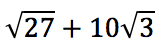
Simplify.
13√3
10√30
13√6
11√3

Write the expression in exponential form.


Write the above expression in exponential form.


Write the above expression in exponential form.


Rewrite ∛x5 using rational exponents.
x3/5
x5/3
3x5
5x3
Select the number that is NOT a perfect square.
49
36
81
82

Simplify
A
B
C
D

A
B
C
D
The product of a nonzero rational number and an irrational number is irrational.
Always true
Sometimes true
Never true
The difference of a non-zero rational number and an irrational number is irrational.
Always true
Sometimes true
Never true
The product of a rational number and a rational number is rational.
Always true
Sometimes true
Never true
The sum of a rational number and an irrational number is irrational.
Always true
Sometimes true
Never true
This set of numbers includes integers, fractions, terminating and repeating decimals.
Rational Numbers
Irrational Numbers
Irrational Numbers....
cannot be represented as a fraction
can be represented as a fraction
can be a repeating decimal
.141414141414...
Rational
Irrational
The side length of a square is √11.
True or False: The area of the square is rational, but the perimeter of the square is irrational.
False
True
The side lengths of a rectangle are √12 and √3.
True or False: The area and the perimeter of the rectangle are both irrational.
True
False

If a system of linear equations has one solution, what COULD this mean about the two lines? (select all that apply).
Parallel lines
Overlapping lines
Intersecting lines
Perpendicular lines
3x + 2y = 16
7x + y = 19
2x + 4y = 450
2x + 4y = 315
3x + 4y = 450
True or False: The intersection point of the two lines below is (4, 1).
y = -x + 5
y = 2x - 7
True
False
-x + y = -13
-8x - 4y = -8
y = -4x + 5
y = 3x - 16
8x + 4y = 12
y = -2x + 3
Which of the following is a solution?
y > -2x + 1
y≤ x + 3
(2, 0)
(-1, 2)
(0, 4)
(0, -4)

Determine a solution.
No solution
Infinite solutions
(-5, 5)
(5, -5)

True or False: The coordinate of the intersection point (smiley face on the graph) is included in the solution to the system.
True
False

Which point is a solution to the system of inequalities?
(-8,2)
(-2,-5)
(0,6)
(4, 3)

Select all TRUE statements about the linear inequality.
(0, 1) is a solution.
The inequality that represents this graph is y < -2x + 1
(-2, 3) is a solution.
The inequality that represents this graph is y ≤ -2x + 1
(1,-1) is not a solution.

Select the system of linear inequalities that represents the graph.
y < x−2
y < 3
y > -x+2
y > 3
y < -x+2
y < 3
y < -x+2
y > 3

Solve the system of inequalities by graphing.


Solve the system of inequalities by graphing.


Select all the points that ARE INCLUDED in the solution set of the system.
(0, 6)
(0, 1)
(1, 0)
(-3, 4)
(2, 5)
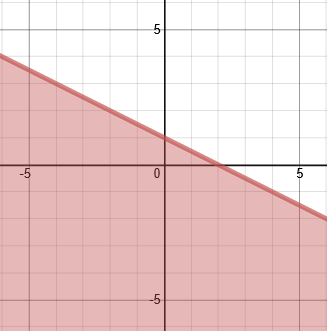

Select the following points that are NOT INCLUDED in the solution set of the system.
(0, 3)
(0, 1)
(-3, 2)
(3, 4)
(-2, 1)
y = 12x + 20
y = 15x + 12
y = 12x + 15
Consider this system of equations.
y = -3x + 2
y= (1/3)x - 4
Select all the statements that are true.
This system has no solution.
This system has one solution.
These lines are perpendicular.
These lines intersect, but not at a 90 degree angle.
These lines are parallel.

