Wayground logo

Free Printable Worksheets

Font size

S
M
L
XL
Worksheets

Water Cycle

Total questions: 37

Worksheet time: 31mins

Name
Class
Date
1.
During which phase of the water cycle does water go from liquid to gas?
a)
condensation
b)
evaporation
c)
collection
d)
precipitation
2.

During which phase of the water cycle is water vapor turned back to liquid water?

a)

collection

b)

evaporation

c)

precipitation

d)

condensation

3.
Which phase of the water cycle is divided into rain, sleet, hail, and snow?
a)
precipitation
b)
condensation
c)
collection
d)
evaporation
4.

What percentage of Earth's water is freshwater?

a)

97%

b)

5%

c)

2%

d)

75%

5.

What drives the water cycle?

a)

the Sun

b)

the moon

c)

Earth

d)

gravity

6.
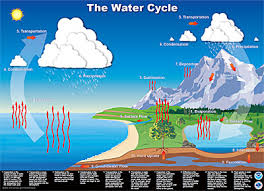
Why is the precipitation snow in one area and rain in another in this picture?
a)
air pressure
b)
mountains
c)
temperature difference
d)
the sun is warmer in some places
7.
1. What happens when water evaporates? 
a)
It rains.
b)
It forms clouds.
c)
The liquid turns into a gas called water vapor.
d)
The gas turns into a liquid.
8.
Where can you find most of the Earth's water? 
a)
lakes
b)
rivers
c)
oceans
d)
streams
9.
What happens when water vapor condenses and collects in the atmosphere?
a)
Groundwater flows faster.
b)
More ocean water evaporates.
c)
Clouds can form in the sky.
d)
The sun shines brighter.
10.
Which sentence is TRUE?
a)
Precipitation is liquid water changing into a gas.
b)
Evaporation is liquid water changing into a gas.
c)
Condensation is liquid water changing into a gas.
11.
When water is heated in the ocean by the sun and turns into water vapor - 
a)
condensation
b)
evaporation
c)
transpiration
12.
When water vapor is cooled and forms droplets - 
a)
condensation
b)
evaporation
c)
transpiration
13.
After condensation, the droplets of water in the clouds fall to Earth in different forms -
a)
precipitation
b)
condensation
c)
evaporation
14.

Precipitation occurs because

a)

the droplets evaporate in the cloud

b)

the droplets are too light for the cloud to hold

c)

the droplets are too heavy for the clouds to hold

15.
What is the water cycle?
a)
the 3 forms of water
b)
the movement of water on, above, or below the surface of the Earth
c)
when water melts
d)
when clouds form
16.
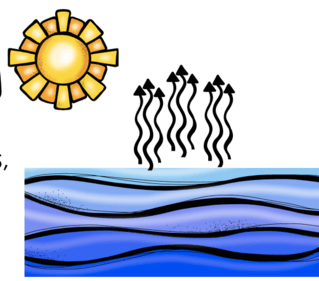
What part of the water cycle does this picture show?
a)
condensation
b)
precipitation
c)
evaporation
17.
What part of the water cycle does this picture show?
a)
condensation
b)
precipitation
c)
evaporation
18.
Which stages does liquid water from the ocean turn into water vapor?
a)
condesantion
b)
evaporation
c)
precipitation
d)
run off
19.

What does the picture shows?

a)

Evaporation

b)

Condensation

c)

Precipitation

d)

Transpiration

20.

What does the number 1 shows?

a)

Transpiration

b)

Evaporation

c)

Precipitation

d)

Condensation

21.

What does the number 2 shows?

a)

Condensation

b)

Transpiration

c)

Evaporation

d)

Precipitation

22.

What does the number 3 shows?

a)

Condensation

b)

Evaporation

c)

Transpiration

d)

Precipitation

23.
Water from rain or snow that flows over the surface of the land into streams, rivers, and lakes is called...
a)
accumulation
b)
runoff
c)
ground water
d)
surface water
24.
Water vapor is the _______ form of water.
a)
solid
b)
liquid
c)
gaseous
25.
The higher water vapor rises in the atmosphere the _______ it gets.
a)
warmer
b)
colder
26.
Any form of water that falls from clouds and reaches Earth's surface as rain, snow, sleet, or hail is called...
a)
surface water
b)
precipitation 
c)
ground water
d)
runoff
27.
All of the water we see in lakes, rivers, and oceans is called...
a)
runoff
b)
surface water
c)
ground water
28.
What collects in cracks and spaces in the rocks and sediments beneath Earth's surface?
a)
runoff
b)
surface water
c)
ground water
d)
water vapor
29.
The energy that drives the water cycle comes from the...
a)
Sun
b)
Moon
c)
Clouds
30.
When precipitation hits the ground, it can flow over the surface of the Earth, or...
a)
be absorbed into the ground
b)
immediately turn into a cloud
31.
Evaporation occurs when the sun heats up water in rivers, lakes, or the ocean, and turns it into...
a)
snow
b)
water vapor
c)
rain
d)
sleet
32.
When is the best time for water to evaporate?
a)
When it is cold and snowy.
b)
When it is hot and dry.
c)
When it is raining.
d)
None of the answers.
33.
True or False -
The greatest amount of water found on earth is fresh water.
a)
True
b)
False
34.

What powers the water cycle? SELECT ALL THAT APPLY.

a)

Gravity

b)

Electricity

c)

Sun (Heat)

d)

Nothing

e)

Water

35.
The map shows the location of South Carolina. South Carolina is humid during the summer months. Which of the following is the most likely cause of the humid conditions?
a)
runoff from inland mountains
b)

flooding from rivers and streams
c)
groundwater bubbling to the surface
d)
evaporation from the surface of the ocean
36.
During most of the year, the air over
Boston, Massachusetts, contains a high
amount of moisture. Which of the
following best explains why there is a
high amount of moisture in the air?
a)
Boston is close to an ocean.
b)
Boston is at a low elevation. (Not high in the mountains)
c)
Boston is near many mountains.
d)

Boston is far north of the equator.
37.
An area received six inches of snow during the winter. Before the snow can continue through the water cycle as groundwater or runoff, it must first
a)
condense
b)
evaporate 
c)
freeze
d)
melt