
 Worksheets
Chapter 14 Biology 2019
Total questions: 45
Worksheet time: 41mins

What type of fossil is this?
Mold fossil
Cast fossil
True Form fossil
Trace Fossil

What kind of fossil is this?
Mold Fossil
Cast Fossil
True Form Fossil
Trace Fossil

What kind of fossils are these?
Mold fossils
Cast fossils
True Form fossils
Trace fossils

What kind of fossil is this?
Mold fossil
Cast fossil
True Form fossil
Trace fossil
This kind of fossil leaves behind evidence of an animal's behavior or activity.
Mold fossil
Cast fossil
Trace fossil
True Form fossil
Footprints, nests, and eggs are all examples of what kind of fossils?
Mold fossil
Cast fossil
Trace fossil
True Form fossil
What can NOT become a fossil?
plants
animals
soft body parts
rocks
A mold fossil is
evidence of animal's behavior such a footprints or nests
the positive image of a fossil that was formed by sediments and minerals
the entire preserved organism
the impression of the animal or plant left after it decomposed
What do fossils teach us about?
Everything we need to know about a plant or animal.
They teach us about the past and the environment.
Everything single living thing will become a fossil when it dies.
That wooly mammoths are not extinct.

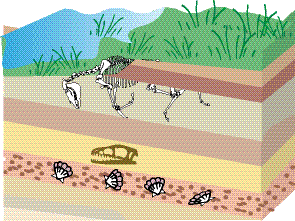
What could you NOT conclude by looking at this dinosaur fossil?
It has sharp teeth so it probably ate meat.
It had long legs so it probably ran fast.
It had a long tail which it probably used for defense.
It had claws so it was probably a great swimmer.




This scientist showed that that flies breed and lay eggs and do not, as was popularly believed, spontaneously generate.
Virchow
Chargaff
Redi
Avery
What is the idea that life can arise form nonliving material?
biogenesis
evolution
spontaneous combustion
spontaneous generation
This scientist used broth to show that bacteria does not arise from spontaneous generation.
Francesco Redi
Virchow
Einstein
Louis Pasteur

Why did Redi cover the jars with gauze?
To prove that the meat did not make the maggots
To prove the maggots did not come from the air
Both A and B
Neither A or B


Pasteur's experiment consisted in
6 flasks with rotten meat
2 flasks with swan neck
2 flasks, one with straight neck and the other with a swan neck
6 flasks with meat

Pasteur confirmed that
Life appears spontaneously
Life appears from inorganic molecules
Life appears from organic molecules
Life appears from life
Milley and Urey experiment consisted in
Water, organic molecules and energy
Water, inorganic molecules and energy
Meat in flasks
A soup heated

Oparin and Haldane designed an experiment
Based on meat and flasks
Based on soup and two different flasks (straight and swan neck)
Recreating the conditions of the early earth
They didn't design an experiment

This image shows
Pasteur's experiment
Redi's experiment
Oparin and Haldane's experiment
Miller and Urey's experiment

The gases found on the early earth were
NH3; CH4; H2O and O2
NH3; CH4; H2O and H2
NH3; O2; H2O and H2
NH3; H2; CH4 and CHON

