wayground logo

Free Printable Worksheets

NEW

Font size

S
M
L
XL
Worksheets

Biology Keystone Exam Vocabulary Review: Unit 5

Total questions: 21

Worksheet time: 14mins
Name
Class
Date
1.
What is the name given to part of a DNA molecule that codes for a protein?
a)
Glucose
b)
Chromosome
c)
Gene
d)
Phosphate
2.

A variation of a gene's nucleotide sequence (alternative forms of the gene)

a)

allele

b)

genotype

c)

heredity

d)

gamete

3.

Series of events that take place in a cell leading to its division and duplication. Main phases are interphase, nuclear division, and cytokinesis.

a)

Budding

b)

Carbon Cycle

c)

Cell Cycle

d)

Translocation

4.
Which of the following phrases best describes cytokenesis
a)
division of the cytoplasm
b)
division of the nucleus
c)
division of DNA
d)
division of surface area
5.

The process in which DNA makes a duplicate copy of itself.

a)

Translation

b)

Transcription

c)

DNA Replication

d)

mitosis

6.
A reproductive cell (egg or sperm)
a)
Autosome
b)
Zygote
c)
Diploid
d)
Gamete
7.
A cell that has one set of chromosomes  (Ex. gametes - egg or sperm)
a)
Haploid
b)
Diploid
c)
Tripoid
d)
Quadloid
8.

The process in which a nucleotide sequence of a gene is used to make a functional product such as a protein.

a)

Gene Experience

b)

Gene Expression

c)

Genetic Recombination

d)

Gene Duplication

9.
During which phase of cell division does the cell double in size and replicate its DNA?
a)
Prophase
b)
Telophase
c)
Interphase
d)
Metaphase
10.
Which of the following best describes meiosis?
a)
It is carried out in all tissues theat require cell replacement
b)
It occurs only in cells in the reproductive structures of an organism
c)
It happens in all of the tissues except the brain and spinal cord
d)
It is the first stage of mitosis
11.
Meiosis is the _____.
a)
 nuclear division of gametes
b)
nuclear division of body cells
c)
division of body cells
d)
division of sex cells
12.
Which of the following lists, in order, the phases of mitosis?
a)
interphase, metaphase, anaphase, telophase
b)
prophase, metaphase, anaphase, telophase
c)
prophase, metaphase, anaphase, interphase
d)
prophase, anaphase, metaphase, telophase
13.
What process does a multi-cellular organism use to replace its damaged body cells?
a)
mitosis
b)
meiosis
c)
replication
d)
transcription
14.
After interphase is completed the cell moves into the next stage of the cell cycle called _________.
a)
anaphase
b)
cytokinesis
c)
metaphase
d)
mitosis
15.

The failure of one or more pairs of homologous chromosomes or sister chromatids to separate "normally" during meiosis is called _____________________.

a)

nondisjunction

b)

anaphase I

c)

nondiploidy

d)

karyotype

16.
The process to go from DNA to mRNA is _______
a)
translation
b)
transcription
c)
replication
17.
Translation is the process where
a)
mRNA is created in the Nucleus
b)
mRNA is decoded to form a protein 
c)
glucose molecules are made
d)
is where lipids are synthesised
18.

The process in which amino acids are arranged in a linear sequence through the process of transcription and translation to form a polypeptide.

a)

Lipid Synthesis

b)

Gene Synthesis

c)

RNA synthesis

d)

Protein Synthesis

19.
What do we call DNA replication since new DNA has 1 parent strand and 1 new strand?
a)
Conservative 
b)
Semiconservative 
c)
Dispersive
20.
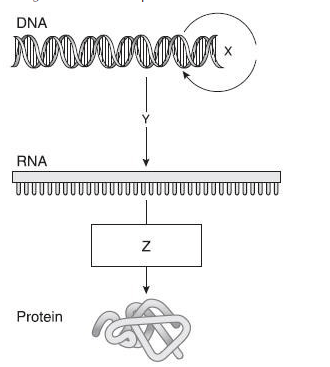
 A diagram of a cellular process is shown below. Which of the following identifies the process shown at point Z?
a)
Translation
b)
Translocation
c)
Replication
d)
Transcription
21.
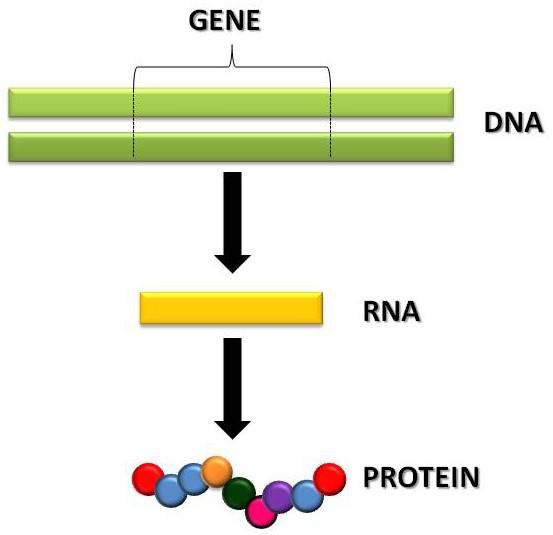
Which process is occuring in the image? 
a)
Transcription
b)
Translation
c)
DNA Replication