
 Worksheets
Chap. 11 (Genetics) Final Exam Review
Total questions: 46
Worksheet time: 33mins

Name the Genetic Disorder: A dominant genetic disorder; affects the nervous system; first symptoms do not appear until between the ages of 30 - 50 years old, some symptoms include paranoia, hallucinations, and uncontrollable movements.
Achondroplasia
Albinism
Huntington's Disease
Tay-Sachs Disease

Name the Genetic Disorder: Autosomal dominant genetic condition; affects height and body size; adult height is about 4 ft.
Huntington's Disease
Tay-Sach's Disease
Turner Syndrome
Achondroplasia

What is a symptom of Cystic Fibrosis?
thick mucus in the lungs
sickle-shaped red blood cells
cannot produce blood clotting protein
different physical appearance

Name the Genetic Disorder: recessive genetic disorder; gene found on chromosome 15; characterized by lack of enzyme that breaks down fatty acids; predominant among Jews of eastern European descent
Huntington's Disease
Tay-Sach's Disease
Sickle Cell Anemia
Parkinson's Disease

Which describes the 23 pairs of human chromosomes?
1 autosome pair; 22 sex chromosome pairs
2 sex chromosome pairs; 21 autosome pairs
2 autosome pairs; 21 sex chromosome pairs
1 sex chromosome pair; 22 autosome pairs

Name the Genetic Disorder: caused by altered genes; results in lack of skin pigment
Albinism
Cystic Fibrosis
Hemophilia
Achondrolasia

When both alleles are expressed in the heterozygous condition
Incomplete dominance
Codominance
Complete dominance
Intolerance

Name the Genetic Disorder: recessive genetic disorder; characterized by the body's inability to tolerate galactose
Sickle Cell Anemia
Parkinson's Disease
Cystic Fibrosis
Galactosemia
Name the Genetic Disorder: recessive genetic disorder; affects mucus-producing glands, digestive enzymes, sweat glands, and is most common among Caucasians
Cystic Fibrosis
Parkinson's Disease
Achondroplasia
Huntington's Disease

Blood type and Coat Color of Rabbits are examples of:
Incomplete Dominance
Multiple Alleles
Codominance
Mendel's Laws
Name the Genetic Disorder: affects the red blood cell and their ability to transport oxygen; red blood cell is crescent shaped; symptoms can include abdominal pain, ulcers, fatigue, fever, and stroke
Tay-Sachs Disease
Sickle Cell Anemia
Achondroplasia
Huntington's Disease
If a gene is found only on the X chromosome and not the Y chromosome, it is said to be what?
sex-linked trait
polygenic trait
codominant trait
incomplete dominance trait

TRUE or FALSE: There are four alleles for blood type, making blood type a good example of multiple alleles.
True
False

In the second generation-how many people have the disease or display the physical trait?
2
4
5
6
Which of the following is homozygous dominant?
Yy
Y
yy
YY

Looking at this pedigree, how many family members have the disease?
4
7
All
None

Based on the data on human height, it is reasonable to conclude that height is an example of a(n) ________ trait.
polygenic
codominant
x-linked
multallelic
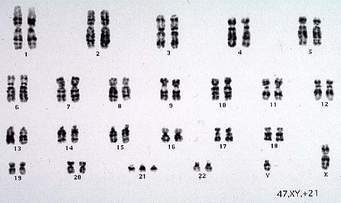
Based on the Karyotype shown, at which chromosome pair can we identify a genetic disorder?
Chromosome pair 5
sex chromosomes
Chromosome pair 21
There are no chromosomal disorders
Testing the amniotic fluid for birth defects.
Chorionic Villi Sampling
Ultrasound
Amniocentesis
Embryo Test
Incomplete dominance means that the traits are
expressed equally
dominant
recessive
blended
Which of the following genotypes is a purebred?
Bb
Gg
bb
Dd
Dominant alleles are-
capital
lowercase
both
neither
Recessive alleles are-
capital
lowercase
both
neither

Which is the correct phenotype for this organism?
BB
blue
green
bb

Squidward has light blue skin, and his genotype for this trait is Bb. Which of the following would describe Squidward?
Purebred
Hybrid
Homozygous
Sex-linked

A ________________________ is used to predict the possible genotype from certain parents
Mendel Grid
Genetic Tic Tac Toe
Punnett Square
Pedigree Plot

In this pedigree, the shaded individuals represent family members that CAN roll their tongue. How many males in the 2nd generation can roll their tongue?
1
2
3
5
Heredity is the passing of traits from _____________________ to _____________________
predators to prey
water to rain
parents to offspring
fungi to protists
Determines an individual’s gender (two types: X and Y chromosomes).
Sex-Linked Traits
Carrier
Sex Chromosomes
Multiple Alleles
Codominance
The occurrence of one or more extra sets of all chromosomes in an organism.
Homozygous
Heterozygous
Polyploidy
Haploid
Diploid
The interaction of multiple pairs of genes
Polygenic Inheritance
Multiple Alleles
Karyotyping
Telomere
Incomplete Dominance
Which is a Barr body?
inactivated X chromosome
activated Y chromosome
activated X chromosome
inactivated Y chromosome
Which causes genetic recombination?
alleles
crossing over
genes
hybrid crosses

Use the figure to help you answer the following question. (Remember to click on the image to enlarge, if needed to see the image more clearly.)
What type of inheritance pattern does the trait represented by the shaded symbols in the figure illustrate?
Incomplete Dominance
Multiple Alleles
Codominance
Sex-Linked Traits
Use the figure to help you answer the following question. (Remember to click on the image to enlarge, if needed to see the image more clearly.)
What is the relationship between individual I-2 and individual III-2 in the figure?
grandfather - granddaughter
grandmother - grandson
great aunt - nephew
mother - son
TRUE or FALSE
The trait for red-green color blindness is a dominant X-linked trait.
True
False

Which genetic disorder can block the veins and prevent oxygen from flowing?
Sickle Cell Disease
Cystic Fibrosis
Down syndrome
Hemophilia

This flower would be an example of which inheritance pattern?
polygenic traits
incomplete dominance
multiple alleles
codominance

Mice reproduce sexually. Mice offspring share about what percent of the mother's genetic code?
100%
25%
50%
0%
Which of the following is an example of a sex-linked trait?
Blood Type
Height
Color Blindness
Eye Color

If primarily males are affected, such as in the above pedigree, the trait is:
Autosomal
Sex-linked
Dominant
Recessive

What is the mode of inheritance shown here?
Recessive because it "skips" a generation
Dominant because it shows up in every generation

What type of inheritance is determined by multiple genes and there can be a range of traits?
Codominance
Incomplete dominance
Polygenic traits
Multiple Alleles
Which of the following statements is true regarding blood types?
A and O are codominant, B is recessive.
B and O are codominant, A is recessive.
A and B are codominant, O is recessive.
A , B and O are all codominant with each other.
If two parents have type AB blood, what is the probability that their child will have type O blood?
0%
25%
50%
100%
_____ help us understand the relative importance of environmental and genetic influences on individual traits and behaviors. (1)
Environmental triggers
Twin studies
Monozygotics
Dizygotics

