wayground logo

Free Printable Worksheets

NEW

Font size

S
M
L
XL
Worksheets

Weather Unit 6 Review

Total questions: 39

Worksheet time: 24mins

Name
Class
Date
1.

What causes wind?

a)

differences in air pressure

b)

differences in gravity

c)

difference in oxygen

d)

differences in the thermosphere

2.

What causes differences in air pressure?

a)

even heating of the Earth

b)

Even cooling of the earth

c)

uneven heating of the earth

d)

global warming

3.

Local winds blow over:

a)

short distances

b)

long distances

c)

the poles

d)

the equator

4.

Flow of air from land to a body of water is called:

a)

doldrum

b)

chinook

c)

sea breeze

d)

land breeze

5.

Sea breezes occur?

a)

during the day

b)

during the night

c)

high noon

d)

full moon

6.
Which is NOT a characteristic of local winds?
a)
They occur within a small area.
b)
Land and sea breezes are examples.
c)
They blow over short distances.
d)
They blow steadily over long distances.
7.
What kind of air pressure does COLD air have?
a)
High pressure
b)
Low pressure
8.
What kind of air pressure does WARM air have?
a)
High pressure
b)
Low pressure
9.
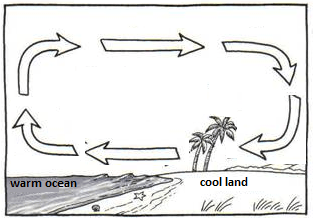
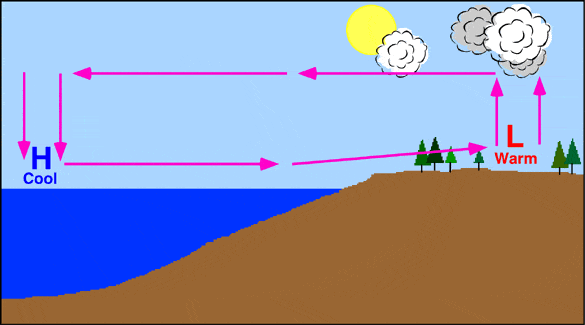
During the day, warm air rises over the land then cools and falls over water in a continuous cycle.
a)
Land breeze
b)
Sea breeze
10.
What is responsible for warming the Earth’s surface and creating wind?
a)
The Moon
b)
Earth's interior (inside)
c)
Coriolis effect
d)
The Sun
11.
Which statement correctly defines wind?
a)
Wind is the movement of air from areas of low pressure to areas of high pressure
b)
Wind is the movement of air to a colder area in the atmosphere.
c)
Wind is the movement of air from areas of high pressure to areas of low pressure.
d)
Wind is the movement of air pushed around and bouncing off Earth's surface.
12.
Why does warm air rise?
a)
Warm air is more dense than cooler air.
b)
Warm air has more pressure than cooler air.
c)
Warm air is less dense than cooler air.
d)
Warm air has a higher dew point than cooler air.
13.
What kind of breeze is this and when would it form?
a)
Land breeze - daytime
b)
Land breeze - nighttime
c)
Sea breeze - daytime
d)
Sea breeze - nighttime
14.
Is this a land or a sea breeze?
a)
land breeze
b)
sea breeze
15.
Why do land breezes occur at night?
a)
Land cools off slower than water, so the air above water is cooler.
b)
Water cools off faster than land, so the air above land is warmer.
c)
Land heats up slower than water, so the air stays cooler during the day.
d)
Water cools off slower than land, so the air above water is warmer.
16.

During the land breeze, what starts moving the cooler air out and warmer air in?

a)

conduction

b)

convection

c)

radiation

17.
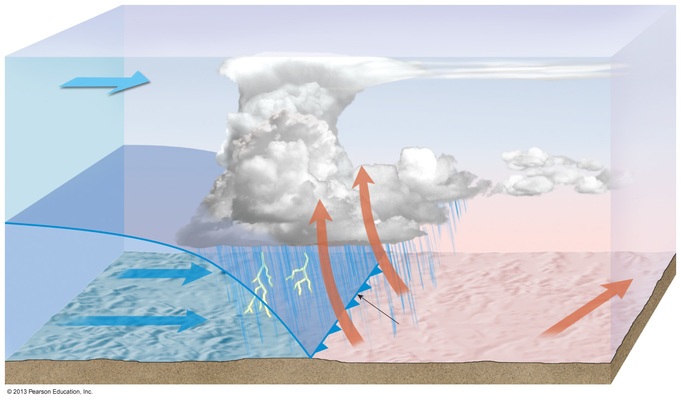
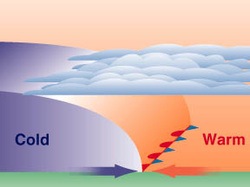
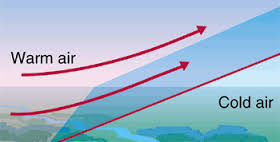
What type of storm front is this? 
a)
warm front
b)
cold front
c)
stationary front
d)
occluded front
18.
A front is
a)
where warm air is cooling at earth's surface
b)
a line where hot and cold air are separating
c)
a line where two different air masses meet
d)
where cold air is rising and forming rain clouds
19.
Which most likely produces clear, cool weather?
a)
zero air pressure
b)
stable air pressure
c)
a low pressure system
d)
a high pressure system
20.
_____________ air is more dense and tends to sink
a)
cold
b)
warm
c)
moist
d)
dry
21.
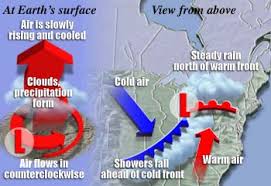
Which type of front is pictured?
a)
Cold front
b)
Warm front
c)
Occluded front
d)
Stationary front
22.
Which type of front is pictured?
a)
Cold front
b)
Warm front
c)
Occluded front
d)
Stationary front
23.
What symbol is this?
a)
warm front
b)
cold front
c)
stationary front
d)
occluded front
24.
Which system results in rainy or stormy weather?
a)
high pressure
b)
low pressure
c)
hurricane
d)
weather system
25.
When a cold front is approaching, what happens?
a)
warm air is pushing under cold air causing humid weather and lower temperatures
b)
warm air is pushing under cold air causing humid weather and higher temperatures
c)
warm air rises, cools, and causes rain and thunderstorms
d)
cold air is pushed over warm air causing rain and thunderstorms
26.
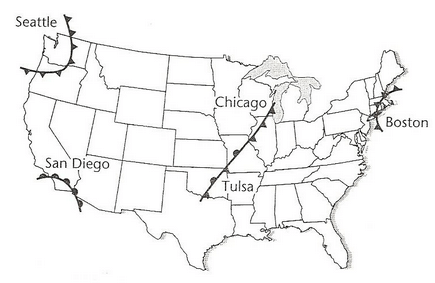
Which type of front is near Seattle?
a)
cold front
b)
warm front
c)
occluded front
d)
stationary front
27.
Which front is located near San Diego?
a)
cold front
b)
warm front
c)
occluded front
d)
stationary front
28.
Which type of front is located near Boston?
a)
warm front
b)
cold front
c)
stationary front
d)
occluded front
29.
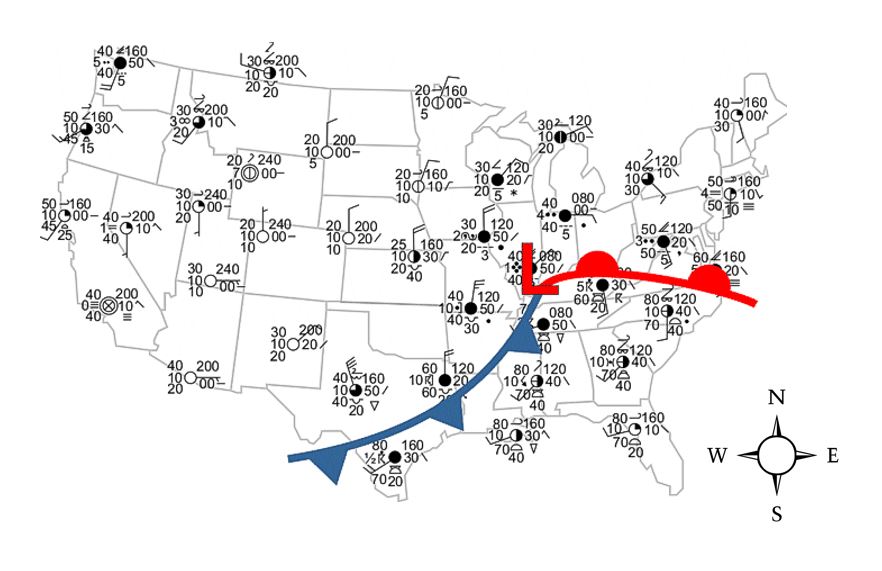
What direction is the warm front moving on the map? 
a)
North
b)
South
c)
East
d)
West
30.
What direction is the cold front moving on the map? 
a)
Southwest
b)
Northwest
c)
Southeast
d)
Northeast
31.

Which one shows a warm front?

a)
b)
c)
d)
32.

What kind of weather is a low-pressure system most likely to bring?

a)

Clear weather

b)

Hot, sunny weather

c)

Precipitation (rain or snow)

d)

Light breezes

33.

At which humidity is it most likely to rain?

a)

50%

b)

20%

c)

77%

d)

99%

34.

What kind of weather is a high-pressure system most likely to bring?

a)

Clear, sunny weather

b)

Hot, sunny weather

c)

Precipitation (rain and snow)

d)

Light breezes

35.

A warm air mass is moving towards a cold air mass. What type of front is this describing?

a)

Cold front

b)

Occluded front

c)

Warm front

d)

Stationary front

36.

Maritime tropical (mT) air masses forms above ____ and near _____

a)

water; the poles

b)

land; the poles

c)

water; the equator

d)

land; the equator

37.

The local meteorologist said that a maritime polar mP air mass was moving over New Jersey in the next few days. What kind of weather will it possible bring?

a)

Warm, dry weather

b)

Cold, dry weather

c)

Warm, wet weather

d)

Cold, wet weather

38.

Field Day is in two days, and a warm front is just reaching us today. Will we have to cancel because of bad weather?

a)

Yes, warm fronts move slowly.

b)

No, warm front move quickly.

39.

Continental polar (cP) air masses forms above ____ and near _____

a)

water; the poles

b)

land; the poles

c)

water; the equator

d)

land; the equator