wayground logo

Free Printable Worksheets

NEW

Font size

S
M
L
XL
Worksheets

Geometry

Total questions: 40

Worksheet time: 41mins
Name
Class
Date
1.

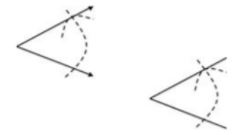
The given diagram is what kind of construction?

a)

Perpendicular bisector

b)

Congruent angles

c)

Angle bisector

d)

Congruent line segments

2.

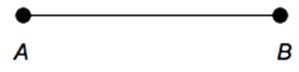
When copying line segment AB using a straight edge and a compass, the compass should be used to:

a)

Draw an arc above point A

b)

Measure the length of segment AB

c)

Draw an arc between point A and point B

d)

Measure half the length of line segment AB
3.

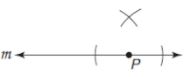
What is being constructed in the figure?

a)

the perpendicular bisector of line m

b)

the line perpendicular to line m through a point on the line

c)

the line parallel to line m through a point NOT on the line

d)

an angle that has line m as its bisector
4.

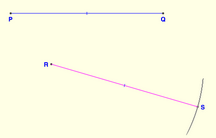
What was duplicated?

a)

line

b)

line segment

c)

ray

d)

angle

5.

When constructing a line parallel to a given line, you will be

a)

copying a segment

b)

bisecting a segment

c)

copying an angle

d)

constructing a perpendicular

6.

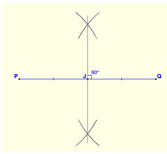
What type of construction do you see?

a)

midpoint

b)

angle bisector

c)

perpendicular bisector

d)

altitude

7.

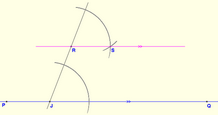
In the image, line RS is _______ to line JQ.

a)

parallel

b)

congruent

c)

similar

d)

perpendicular

8.

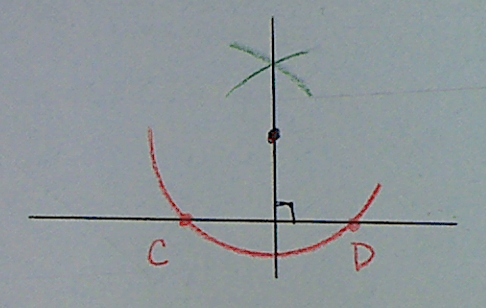
Name the construction.

a)

midpoint

b)

perpendicular through a point on the line

c)

perpendicular through a point NOT on the line

d)

Circumcenter of a right triangle

9.

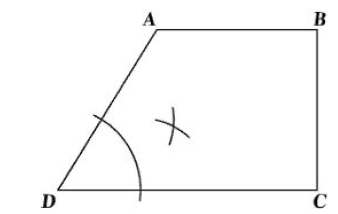
What type of construction is illustrated in the diagram?

a)

Angle congruent to angle D

b)

Line segment congruent to AD

c)

Angle congruent to angle D

d)

Bisection of angle D

10.
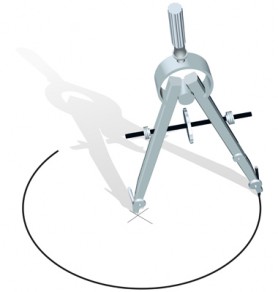
What is this?
a)
Compass
b)
Circle creator
c)
Pencil swingy-thing
d)
Arc maker
11.
An angle that measures exactly 90°
a)
Acute Angle
b)
Right Angle
c)
Triangle
d)
Straight Angle
12.
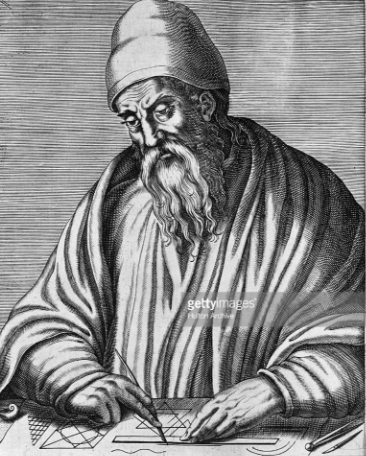
Euclid
a)
American mathematician - Father of Algebra
b)
Greek mathematician - Father of Calculus
c)
Greek mathematician - Father of Geometry
d)
Greek scientist - Father of Chemistry
13.
(x, y) -------> (x, -y) is a reflection over the x axis.       
a)
True
b)
False
14.
(x,y) -------> (-x, -y) is a reflection over the y = x axis.
a)
True 
b)
False
15.
(x, y) -------> (-y, -x) is a rotation of 90 degrees counterclockwise.  
a)
True 
b)
False
16.
Which transformation is not a rigid transformation?
a)
Translation
b)
Reflection
c)
Rotation
d)
Dilation
17.
C(-6, 2) and B(-1, -1)
Reflect over the line y = x
a)
C' (-6, 2), B' (-1, -1)
b)
C' (6, 2), B' (1, -1)
c)
C' (2, -6), B' (-1, -1)
d)
C' (-6, -2), B' (-1, -1)
18.
C(-6, 2) and B(-1, -1)
Rotate 90 degrees counterclockwise.
a)
C' (-6, 2), B' (-1, -1)
b)
C' (6, 2), B' (1, -1)
c)
C' (2, -6), B' (-1, -1)
d)
C' (-2, -6), B' (1, -1)
19.
A(-2, 2) and B(3, 2)
Rotate 180 degrees 
a)
A' (-2, 2), B' (3, 2)
b)
A' (-2, -2), B' (-3, -2)
c)
A' (2, -2), B' (-3, -2)
d)
A' (2, -2), B' (2, 3)
20.
A(-2, 2) and B(3, 2)
Reflect over the x-axis 
a)
A' (-2, 2), B' (3, 2)
b)
A' (-2, -2), B' (3, -2)
c)
A' (2, -2), B' (-3, -2)
d)
A' (2, -2), B' (2, 3)
21.
The point Z(4, -2) is rotated 180 degrees about the origin.  What is the image of Z?
a)
Z'(2, 4)
b)
Z'(-4, 2)
c)
Z'(-2, -4)
d)
Z'(-4, -2)
22.
Describe the transformation shown in the graph.
a)
Reflect over x-axis
b)
Reflect over y-axis
c)
Rotate 270 degrees CCW
d)
Rotate 90 degress CCW
23.
A turn is also called a ___________.
a)
Translation
b)
Reflection
c)
Rotation
d)
Transformation
24.
Name the image of C(6, -4) under a rotation 90 degrees counterclockwise about the origin.
a)
C'(4, 6)
b)
C'(-4, -6)
c)
C'(6, 4)
d)
C'(-6, -4)
25.
Given C(2, 9), under which reflection is C'(-2, 9)?
a)
reflected in the x-axis
b)
reflected in the y-axis
c)
reflected in the line x = 2
d)
reflected in the line y = x
26.
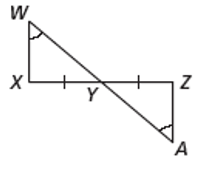
Are these triangles congruent?
a)
Yes, by ASA
b)
Yes, by SAS
c)
Yes, by AAS
d)
No, this is the SSA one!!
27.
Are these triangles congruent?
a)
Yes, by SSS
b)
Yes, by SAS
c)
Yes, by ASA
d)
No, this is the SSA one!!
28.
Are these triangles congruent?
a)
Yes, by AAS
b)
Yes, by SAS
c)
Yes, by ASA
d)
No, this is the SSA one!!
29.
Are these triangles congruent?
a)
Yes, by AAS
b)
Yes, by SAS
c)
Yes, by ASA
d)
No, this is the SSA one!!
30.
Are these triangles congruent?
a)
Yes, by AAS
b)
Yes, by SAS
c)
Yes, by SSS
d)
No, this is the SSA one!!
31.
Are these triangles congruent?
a)
Yes, by AAS
b)
Yes, by SAS
c)
Yes, by ASA
d)
No, this is the SSA one!!
32.
Are these triangles congruent?
a)
Yes, by SSS
b)
Yes, by SAS
c)
Yes, by AAS
d)
No, this is the SSA one!!
33.
Are these triangles congruent?
a)
Yes, by ASA
b)
Yes, by SAS
c)
No they are not congruent
d)
Not enough information to know for sure
34.
Are these triangles congruent?
a)
Yes, by AAS
b)
Yes, by ASA
c)
No they are not congruent
d)
Not enough information to know for sure
35.
If L is the midpoint of TJ, what must be true?
a)
TL=JT
b)
JL=TJ
c)
TL=LJ
d)
T is also the midpoint of JL
36.
If DA bisects IE, then
a)
ID=ED
b)
IA=EA
c)
<IDA=<EDA
d)
<IAD and <EAD are right angles
37.
If DA is perpendicular to IE, then we can immediately conclude that
a)
IA=AE
b)
<IAD = <DAE
c)
<IDA=<EDA
d)
<IAD and <DAE are right angles
38.
An angle bisector cuts an angle into two congruent _________
a)
Angles!
b)
Segments
c)
Mysteries
39.
A segment bisector cuts a segment into two congruent
a)
Segments!
b)
Angles
c)
Mysteries
40.

Is there enough information to conclude that the two triangles are congruent? If so, what is a correct congruence statement?

a)

∆CAB ≅ ∆DAC

b)

∆ACB ≅ ∆ACD

c)

∆ABC ≅ ∆ACD

d)

No, the triangles cannot be proven congruent.