wayground logo

Free Printable Worksheets

NEW

Font size

S
M
L
XL
Worksheets

STAAR Review

Total questions: 70

Worksheet time: 52mins
Name
Class
Date
1.
What is going on with the atmosphere at any particular time.
a)
Weather
b)
Climate
2.
What is going on with the atmosphere at any particular time.
a)
Weather
b)
Climate
3.
Daily temperature, daily rainfall, daily amount of sunshine
a)
Weather
b)
Climate
4.
Determines the type of animals that can live there.
a)
Weather
b)
Climate
5.
Grasslands have a rainy and dry season.
a)
Weather
b)
Climate
6.
The tropical rainforest has experienced 50 to 260 inches of rainfall annually for the last  few decades.
a)
Weather
b)
Climate
7.
Right now the Earth is tilted away from the sun, so we experience winter.
a)
Weather
b)
Climate
8.
Wind speed is changing as the Hurricane moves over land.
a)
Weather
b)
Climate
9.
We can expect rain on Tuesday.
a)
Weather
b)
Climate
10.
The average wind speed of Brenham, Texas is 0 mph to 15 mph.
a)
Weather
b)
Climate
11.
The North and South Poles are usually cold and dry.
a)
Weather
b)
Climate
12.
What is the energy source for the water cycle?
a)
the sun
b)
the earth
c)
water
d)
the moon
13.
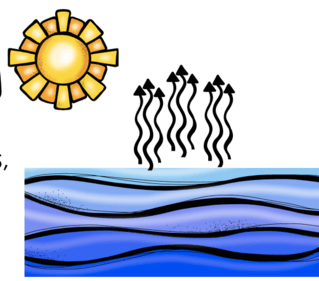
What part of the water cycle does this picture show?
a)
condensation
b)
precipitation
c)
evaporation
14.
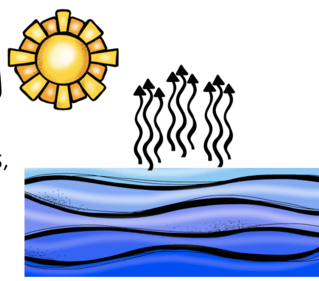
What part of the water cycle does this picture show?
a)
condensation
b)
precipitation
c)
evaporation
15.
What is evaporation?
a)
The part of the water cycle when the sun heats up water, turning it from a liquid into water vapor or steam. It rises from the ground into the air.
b)
The part of the water cycle when the water vapor in the air gets cold. The water turns back into a liquid and forms clouds.
c)
The part of the water cycle when clouds get heavy and can no longer hold the liquid water. This causes the water to fall from the sky to the earth as rain, snow, sleet, or hail.
16.
What is condensation?
a)
The part of the water cycle when the sun heats up water, turning it from a liquid into water vapor or steam. It rises from the ground into the air.
b)
The part of the water cycle when the water vapor in the air gets cold. The water turns back into a liquid and forms clouds.
c)
The part of the water cycle when clouds get heavy and can no longer hold the liquid water. This causes the water to fall from the sky to the earth as rain, snow, sleet, or hail.
17.
What is precipitation?
a)
The part of the water cycle when the sun heats up water, turning it from a liquid into water vapor or steam. It rises from the ground into the air.
b)
The part of the water cycle when the water vapor in the air gets cold. The water turns back into a liquid and forms clouds.
c)
The part of the water cycle when clouds get heavy and can no longer hold the liquid water. This causes the water to fall from the sky to the earth as rain, snow, sleet, or hail.
18.
When water condenses, the water vapor in the air gets ___________ and changes back into liquid.
a)
cold
b)
hot
c)
warm
d)
solid
19.
When water condenses, the liquid water forms ______________.
a)
water vapor
b)
steam
c)
air
d)
clouds
20.
Precipitation happens when clouds of water droplets are too ______________.
a)
cold
b)
light
c)
heavy
d)
hot
21.
Evaporation happens when the sun ___________ water and turns it into vapor.
a)
cools
b)
heats up
c)
freezes
d)
lights up
22.
Which of these is an example of precipitation?
a)
snow
b)
air
c)
clouds
d)
vapor
23.
Does evaporation happen before or after condensation?
a)
before
b)
after
c)
during
24.
Does precipitation happen before or after condensation?
a)
before
b)
after
c)
during
25.
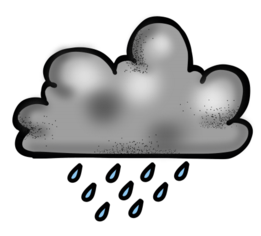
What part of the water cycle does this picture show?
a)
condensation
b)
precipitation
c)
evaporation
26.
What is the water cycle?
a)
the 3 forms of water
b)
the movement of water on, above, or below the surface of the Earth
c)
when water melts
d)
when clouds form
27.
Which of these is not an example of precipitation?
a)
rain
b)
clouds
c)
sleet
d)
snow
28.
Which is the opposite of condensation?
a)
runoff
b)
evaporation
c)
precipitation
d)
transpiration
29.
Which best explains why runoff is important?
a)
It returns water to other locations on Earth
b)
It increases the chance of flooding
c)
It makes evaporation occur faster
d)
It increases condensation
30.
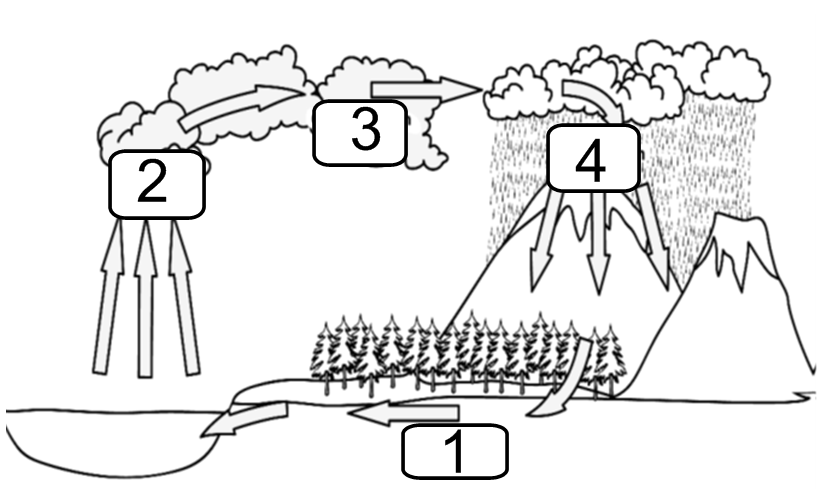
Which stage does the #2 show in the diagram?
a)
condensation
b)
evaporation
c)
precipitation
d)
run off
31.
Which stage does the #3 show in the diagram?
a)
condensation
b)
evaporation
c)
precipitation
d)
run off
32.
what does the #4 show in the diagram?
a)
condensation
b)
evaporation
c)
precipitation
d)
run off
33.
Dew also forms directly onto items, as water droplets.  What part of the water cycle is this?
a)
run-off 
b)
condensation
c)
evaporation
d)
precipitation
34.
On which kind of day would you expect the most evaporation from the surface of a  pond?
a)
sunny and hot
b)
sunny and cold
c)
rainy and hot
d)
rainy and cold
35.
Flood water pounding against a canyon wall and wearing it down
a)
Weathering
b)
Erosion
c)
Deposition
36.
Rain washing away soil from a hillside
a)
Weathering
b)
Erosion
c)
Deposition
37.
Layers of sediment forming at the bottom of the ocean floor
a)
Weathering
b)
Erosion
c)
Deposition
38.
Waves dropping sand on the beach
a)
Weathering 
b)
Erosion
c)
Deposition
39.
Caves being formed by acid rain dissolving underground limestone
a)
Weathering
b)
Erosion
c)
Deposition
40.
Deltas forming at the mouths of rivers
a)
Weathering
b)
Erosion
c)
Deposition
41.
Water getting into cracks, freezing, and breaking the rocks or pavement apart
a)
Weathering
b)
Erosion
c)
Deposition
42.
Wind blowing sand from one location to another
a)
Weathering
b)
Erosion
c)
Deposition
43.
Wind blasting sand at rock and carving out arches
a)
Weathering
b)
Erosion
c)
Deposition
44.
Glaciers scraping rocks across the earth’s surface
a)
Weathering
b)
Erosion
c)
Deposition
45.
Agents of weathering
a)
living things, water, wind, ice, and heat
b)
formed from the remains of once-living things
46.
Large flat area of land that is higher than the surrounding land.
a)
Plateau
b)
Valley
c)
Hill
47.
Land formation that is flat on top with steep walls. Usually in a dry area
a)
Hill
b)
Plateau
c)
Mesa
48.
Flat land with only small changes in elevation.
a)
Valley
b)
Plateau
c)
Plain
49.
Large body of water surrounded by land on all sides.
a)
Sea
b)
River
c)
Lake
50.
A piece of land surrounded by water.
a)
Island
b)
Peninsula
c)
Gulf
51.
What is the way wind or water wears away the land?
a)
erosion
b)
region
c)
environment
d)
landform
52.
What is a shape or feature on the Earth's surface?
a)
landform
b)
geography
c)
natural resources
d)
environment
53.
What is this landform?
a)
mountain
b)
canyon
c)
coast
d)
cliff
54.

What is this landform?

a)

lake

b)

delta

c)

canyon

d)

island

55.
What is this landform?
a)
valley
b)
hills
c)
river
d)
lake
56.
A group of mountains together is called a(n)
a)
Mountain group
b)
Foothill
c)
Mountain Range
d)
Mount Everest
57.
What is weathering?
a)
A type of climate
b)
A transport of sediment
c)
The breakdown of rock
d)
The aging of rock
58.

The time it takes the Earth to make one complete rotation on it's axis. (24 hour period)

a)

Axis

b)

Compass

c)

Rotation

d)

Shadow

59.

An instrument that measures the time of day using the position of the sun.

a)

Axis

b)

Sundial

c)

Rotation

d)

Shadow

60.

An instrument that shows direction and uses a small magnet to show North. (N,E,S,W)

a)

Compass

b)

Day/Night

c)

Axis

d)

Shadow

61.

A line, real or imaginary, around which something spins.

a)

Shadow

b)

Day/Night

c)

Rotation

d)

Axis

62.

Earth faces the Sun and is lighted

a)

Day

b)

Night

c)

Shadow

d)

Rotation

63.

Earth faces away from the Sun and is dark.

a)

Day

b)

Night

c)

Shadow

d)

Rotation

64.

The path one object takes as it revolves around another object in space

a)

Sun

b)

Craters

c)

Orbit

d)

Gravity

65.

The star at the center of our Solar System and supplies heat and light to Earth, its gravity keeps the system in orbit.

a)

Moon

b)

Crater

c)

Earth

d)

Sun

66.

A force that pulls objects toward the center of the Earth.

a)

Orbit

b)

Craters

c)

Moon

d)

Gravity

67.

Bowl shaped indents or cavities on the surface of a planet that are caused by a collision with another object.

a)

Crater

b)

Moon

c)

Gravity

d)

Mountain

68.

A natural satellite that orbits a planet.

a)

Sun

b)

Earth

c)

Moon

69.

A planet in our Solar System that has life on it.

a)

Sun

b)

Earth

c)

Moon

70.

The Sun, Earth and moon all rotate on an axis.

a)

True

b)

False