

wayground logo

Free Printable Worksheets

NEW

Font size

S
M
L
XL
Worksheets

Bold Body Systems

Total questions: 65

Worksheet time: 3hrs 54mins

Name
Class
Date
1.
What is the smallest unit of any living organism?
a)
Organ
b)
Organ System
c)
Tissue
d)
Cell
2.
Many cells that work together to perform a similar function make up a(n):
a)
Cell
b)
Organ
c)
Tissue
d)
Organ System
3.
Tissues that work together to fulfill a specific role in the body is called a(n)
a)
Cell
b)
Organ
c)
Tissue
d)
Organ System
4.
Organs work together to make up a(n)
a)
Cell
b)
Organ
c)
Organ System
d)
Tissue
5.
This system provides structure and support for the body
a)
Skeletal
b)
Muscular
c)
Nervous
d)
Excretory
6.
Which system is responsible for the production of blood cells?
a)
Circulatory
b)
Skeletal
c)
Nervous
d)
Excretory
7.
This system works in pairs to allow for movement?
a)
Muscular
b)
Skeletal
c)
Nervous
d)
Respiratory
8.
Which system helps generate warmth?
a)
Nervous
b)
Digestive
c)
Immune
d)
Muscular
9.
Which of the following best describes the function of the circulatory system?
a)
It transports nutrients and waste through the body.
b)
It brings in oxygen for the body.
c)
It removes waste out of the body.
d)
It breaks down food into smaller molecules.
10.
Why is the respiratory system important to the body?
a)
It provides carbon dioxide for cellular respiration and removes oxygen.
b)
It brings in glucose for cellular respiration and removes water.
c)
It brings in oxygen needed for cellular respiration and removes carbon dioxide.
d)
It brings in water for cellular respiration and removes glucose.
11.
What does the digestive system do for the body?
a)
It controls all other body systems and coordinates movement.
b)
It allows for movement.
c)
It filters and removes waste.
d)
It breaks down food in smaller molecules.
12.
How would the body be affected if it lacked the excretory system?
a)
Waste would not be removed from the body.
b)
The body would not be able to break down food.
c)
The body would not be able to control any movement.
d)
The body would  not be able to transport nutrients and waste.
13.
Which of the following best describes the role of the nervous system?
a)
It moves nutrients and waste around the body.
b)
It provides a framework for the body and gives posture.
c)
It monitors and controls all processes in the body.
d)
It helps break down food into smaller molecules.
14.
Which system acts as a defense system against pathogens?
a)
Skeletal
b)
Immune
c)
Respiratory
d)
Nervous
15.
What is the reproductive system responsible for?
a)
Controlling all process in the body
b)
Creating male and female sex cells
c)
Working in pairs to provide movement
d)
Filter waste out of the bloodstream
16.
Smooth muscle can be found in the walls of blood vessels and in the _____.
a)
spinal cord
b)
joints
c)
lungs
d)
digestive tract
17.
What type of muscle is only found in the heart?
a)
cardiac muscle
b)
smooth muscle
c)
skeletal muscle
d)
biceps muscle
18.
To digest food, your stomach works with organs such as the ______.
a)
lungs
b)
heart
c)
intestines
d)
bladder
19.
Which dome-shaped muscle contracts to begin the process of inhaling (breathing in)?
a)
lungs
b)
diaphragm
c)
heart/cardiac
d)
pharnyx
20.
Which organ passes oxygen to the blood?
a)
lungs
b)
heart
c)
brain
d)
stomach
21.
Which system includes the heart and blood vessels?
a)
respiratory
b)
circulatory
c)
excretory
d)
nervous
22.
Where is urine stored until it can be eliminated?
a)
kidneys
b)
stomach
c)
bladder
d)
liver
23.
What is the term for a disease-causing organism?
a)
t-cell
b)
antibody
c)
cell
d)
pathogen
24.
What are two examples of pathogens?
a)
poor diet and little sleep
b)
smoking and no exercise
c)
lungs and heart
d)
bacteria and viruses
25.
What protects the spinal cord?
a)
Skull
b)
Vertebrae (spine)
c)
Ribs
d)
Cartilage
26.
Based on your knowledge of this body system, how would the body be affected if it stopped working?
a)
The body would not be able to fight off illness.
b)
The body would not be able to gather oxygen.
c)
The body would not be able gather nutrients.
d)
The body would not be able to stand upright.
27.
When these two systems work together, they are able to send disease-fighting cells throughout the body.
a)
immune and circulatory
b)
circulatory and nervous
c)
respiratory and immune
d)
respiratory and nervous
28.
On the way home from school, Ralph was surprised when his friend jumped out in front of him. In his surprise, he jumped and screamed. These responses to a stimulus are a part of which body system?
a)
Skeletal
b)
Respiratory
c)
Nervous
d)
Digestive
29.
Which two systems work together to gather and transport oxygen through the body?
a)
skeletal and respiratory
b)
muscular and circulatory
c)
skeletal and muscular
d)
respiratory and circulatory
30.
The smallest of blood vessels with thin walls to allow nutrients and waste to pass through them are called _______.
a)
Arteries
b)
Veins
c)
Aorta
d)
Capillaries
31.
Which body system sends electrical signals to all other body systems?
a)
circulatory system
b)
nervous system
c)
digestive system
d)
skeletal system
32.
Which system of the human body provides protection to most of the major organs?
a)
Nervous System
b)
Muscular System
c)
Skeletal System
d)
Circulatory System
33.
Bone cells need nutrients. Which two systems get nutrients to bone cells?
a)
the digestive system and the circulatory system
b)
the circulatory system and the respiratory system
c)
the respiratory system and the skeletal system
d)
the skeletal system and the digestive system
34.
Which two human body systems are most responsible for getting oxygen to cells?
a)
digestive and skeletal
b)
skeletal and circulatory
c)
circulatory and respiratory
d)
respiratory and digestive
35.
Which best explains how the muscular system relies on the respiratory system?
a)
The respiratory system cools the muscular system.
b)
The respiratory system acts as the support system for the muscular system.
c)
The respiratory system brings oxygen into the body for the muscular system to use.
d)
The respiratory system provides nutrients for the body to use as fuel.
36.
Which best describes the relationship between the cardiovascular system and the muscular system?
a)
The cardiovascular system captures carbon dioxide from the air for muscle energy.
b)
The cardiovascular system produces red blood cells to bring oxygen to muscles.
c)
The cardiovascular system provides a framework for muscle movement.
d)
The cardiovascular system delivers oxygen for muscle energy.
37.
Which best compares the respiratory system to the circulatory system?
a)
The respiratory system transports oxygen to cells, while the circulatory system provides oxygen for cells.
b)
The respiratory system provides oxygen for cells, while the circulatory system transports oxygen to cells.
c)
The respiratory system breaks down food for cell energy, while the circulatory system rids the body of waste.
d)
The respiratory system rids the body of waste, while the circulatory system breaks down food for cell energy.
38.

Which is an example of a function the muscular system performs?

a)

Voluntary muscles pump blood through the body.

b)

Skeletal muscles keep a body’s joints working properly.

c)

Cardiac muscles move bones and hold a body’s skeleton in place.

d)

Smooth muscles help move food through the organs they surround.
39.
How do the muscular and skeletal systems work together to help the body?
a)
they provide blood to the body
b)
They provide nutrients to the body.
c)
They provide structure and movement for the body.
d)
They provide oxygen and carbon dioxide to the body.
40.
How does the circulatory system work with the digestive system?
a)
Blood is used to build muscle strength.
b)
Food is broken down in the bloodstream
c)
Blood carries nutrients throughout the body.
d)
Food waste is filtered by the heart and blood vessels.
41.
Which body systems work together to allow the body to move?
a)
nervous and skeletal
b)
muscular and skeletal
c)
nervous and circulatory
d)
muscular and circulatory
42.
How does the muscular system depend on the nervous system?
a)
The nervous system transports blood to the muscles.
b)
The nervous system provides support for the muscles.
c)
The nervous system supplies food and oxygen to the muscles.
d)
The nervous system sends signals to the muscles to cause movement.
43.
Which system is responsible for creating red blood cells?
a)
Skeletal
b)
nervous
c)
digestive
d)
circulatory
44.
Which example best shows structures that make up the digestive system in the human body?
a)
heart, blood, vessels
b)
nose, trachea, lungs
c)
brain, spinal cord, nerves
d)
esophagus, stomach, intestines
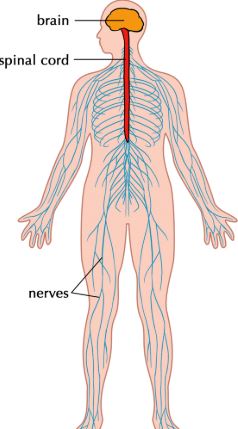
45.

What system is pictured?

a)

Skeletal

b)

Circulatory

c)

Nervous

d)

Muscular

46.

What system eliminates non solid waste from the body?

a)

Integumentary

b)

Digestive

c)

Excretory

d)

Respiratory

47.

What is the function of the system pictured?

a)

Helps pumps your blood through out your body.

b)

Helps move and protect your body.

c)

Helps take in oxygen and remove carbon dioxide.

d)

Helps maintain body your temperature.

48.

What system gathers information and responds to that information? Ex: Touching something that is hot and quickly pulling your hand away.

a)

Skeletal

b)

Muscular

c)

Integumentary

d)

Nervous

49.

Which system includes the nose, trachea and the lungs?

a)

Excretory

b)

Respiratory

c)

Circulatory

d)

Muscular

50.

Which system includes the kidneys, ureters, urinary bladder, urethra?

a)

Digestive

b)

Muscular

c)

Excretory

d)

Nervous

51.

The muscular organ that pumps blood through out your body is your

a)

Arteries

b)

Diaphragm

c)

Heart

d)

Larynx

52.

All your body systems work together to maintain a stable environment which is called __________________.

a)

Hydration

b)

Regular

c)

Gucci

d)

Homeostasis

53.
The main function of the digestive system is to...
a)
Protect the body from infections
b)
Store nutrients into the bones
c)
Break down food to be absorbed
d)
Support and protect the organs of the body
54.
What is the main function of the excretory system?
a)
Convert food into nutrients
b)
Send signals in the form of hormones
c)
Filter water and remove waste products from the body
d)
Exchange gases between the body
55.
What three body systems get rid of waste from our bodies?
a)
Respiratory, Reproductive, and Circulatory
b)
Digestive, Excretory, and Respiratory
c)
Digestive, Reproductive, and Circulatory
d)
Excretory. Reproductive, and Endocrine
56.
What is a neuron?
a)
Part of the brain
b)
A nerve cell
c)
A sweat gland
d)
A blood cell
57.
What can you conclude from the fact that your skin prevents harmful germs from entering your body?
a)
Without skin, your immune ystem wouldn't function
b)
Germs can enter your body through cuts and scrapes
c)
Wearing heavy clothes protects you against diseases
d)
Skin cells contain powerful antibiotics
58.

Where is blood made?

a)

Periosteum

b)

Bone Marrow

c)

Compact Bone

d)

Melanocytes

59.

What two things do muscle cells need in order to make energy?

a)

glucose and sugar

b)

sugar and water

c)

glucose and oxygen

d)

oxygen and lactic acid

60.

What organ is this?

a)

liver

b)

lung

c)

heart

d)

kidney

61.

Two body systems that work together to remove wastes.

a)

integumentary and respiratory

b)

skeletal and muscular

c)

muscular and integumentary

d)

excretory and circulatory

62.

Which one is the correct level of organization?

a)

tissue-organ-organ system-organism-cell

b)

cell-tissue-organ system-organ-organism

c)

cell-tissue-organ-organ system-organism

d)

organ-organ system-tissue-organism-cell

63.

When your stomach is feeling ill, one way your body tries to maintain homeostasis is?

a)

eat more food

b)

drink a lot of water

c)

force the pathogen out of body

d)

kill the pathogen

64.

What happens to your breathing rate and heart rate when you exercise or scared?

a)

your heart stops beating and you drop dead

b)

you stop breathing and suffocate

c)

heart rate increases and breathing rate increases

d)

nothing happens

65.

Where does digestion begin?

a)

small intestine

b)

esophagus

c)

mouth

d)

pancrea
