wayground logo

Free Printable Worksheets

Font size

S
M
L
XL
Worksheets

4th Grade Total Science Review

Total questions: 108

Worksheet time: 2hrs 36mins

Name
Class
Date
1.
What is happening to the temperature in New York City?
a)
It is remaining about the same.
b)
It is mostly decreasing.
c)
It is mostly increasing.
d)
There is a pattern of increasing and decreasing.
2.
Which variable do "I" change intentionally?
a)
Independent variable
b)
Dependent variable
c)
Constant
d)
s
3.
Which variable may change and probably will change in the experiment, but "I" don't change it?
a)
Independent variable
b)
Dependent variable
c)
Constant
4.
That this animal has fur is an...
a)
inference
b)
conclusion
c)
observation
d)
opinion
5.
The number of apples in this basket is ______________________ data?
a)
quantitative
b)
qualitative
c)
independent
d)
dependent
6.
The dependent variable in this experiment is - 
a)
Number of Bacteria
b)
Time of Incubation
c)
Culture Number
d)
Type of Bacteria
7.
What can you infer about the temperature for E.coli bacterial growth?
a)
E. coli does not grow well at low and high temperatures.
b)
E coli will continue to grow at very high temperatures.
c)
E.coli grows best at very low temperatures
d)
E.coli grows best at very high temperatures.
8.
A student wants to test the effects of type of exercise on heart rate.  What is the dependent variable?
a)
heart rate
b)
type of exercise
c)
amount of exercise
d)
time of day exercise occurs
9.
Data that is observed using your 5 senses and is described through the use of WORDS is...
a)
Quantitative Data
b)
Qualitative Data
10.
Which following statement is an inference?
a)
The boy is in pain.
b)
The boy's knee is bleeding.
c)
The boy has tears coming from his eyes.
11.

A push or a pull changes an objects...

a)

size

b)

direction

c)

weight

d)

temperature

12.

An object's location is called its _________.

a)

motion

b)

position

c)

friction

d)

push

13.

The force that pulls objects toward the center of the earth is what?

a)

Force

b)

Gravity

c)

Friction

d)

Motion

14.

____ happens when two items rub against each other.

a)

Gravity

b)

Motion

c)

Magnestism

d)

Friction

15.
At which point is potential energy greatest?
a)
W
b)
X
c)
Y
d)
Z
16.
__________ is stored energy. 
a)
Potential
b)
Kinetic
c)
None of the above 
d)
All of the above 
17.
The faster an object moves, the ________ kinetic energy it has. 
a)
more
b)
less
c)
none of the above
d)
same
18.
What kind of energy is in a moving skateboard?
a)
Potential
b)
Kinetic
c)
Both potential and kinetic energy
d)
none of the above
19.
What kind of energy is in a rock at the edge of a cliff?
a)
Potential
b)
Kinetic
c)
Both potential and kinetic energy
d)
none of the above
20.
Energy due to motion is ____________ energy. 
a)
Potential 
b)
Energy
c)
Kinetic
d)
Friction
21.
Electricity that flows in a closed path is called a
a)
path
b)
current
c)
circuit
22.
The flow of electricity in a circuit-
a)
current
b)
flow
c)
circuit
23.
Magnetism created by an electric current
a)
electricity
b)
electromagnetism
c)
wind energy
24.
____________ allows electricity to flow.
a)
A conductor
b)
An insulator
c)
A magnet
25.
____________ stops the flow of electricity.
a)
A conductor
b)
An insulator
c)
A magnet
26.
To complete a circuit the switch must be
a)
unattached
b)
open
c)
closed
27.
When the switch is closed, the light
a)
comes on
b)
stays off
c)
burns out
28.
The plastic around the wire is
a)
conductor
b)
insulator
c)
decoration
29.
Two batteries in a circuit make the lights in the circuit brighter than one battery.
a)
true
b)
false
30.
If the lights are on, the circuit is
a)
closed
b)
open
31.
If the lights are off, the circuit is
a)
closed
b)
open
32.
In a parallel circuit the current
a)
makes one circle
b)
stays in one path
c)
splits and goes through two components
33.
Two types of circuits are
a)
parallel and magnetic
b)
electromagnetic and series
c)
series and parallel
34.
Copper is used in wiring because it is an excellent______________ of electricity.
a)
circuit breaker
b)
conductor
c)
insulator
d)
fuse
35.
I am the crackle you hear when you touch a doorknob after rubbing your feet across a carpet.
a)
electric circuit
b)
electric discharge
c)
fuse
d)
conductor
36.
The buildup of electric charges on an object is called static electricity.
a)
true
b)
false
37.
Lightning is an example of static electricity.
a)
true
b)
false
38.
After fertilization what does the ovule develop into?
a)
Fruit
b)
Bud
c)
Seed
d)
Flower
39.
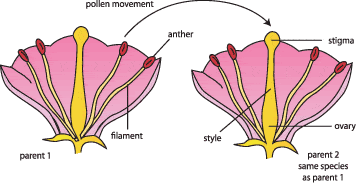
The part of the stamen that produces pollen grains is the ___.
a)
anther
b)
pistil
c)
filament
d)
ovary
40.
The tip of the style that has sticky hairs to trap pollen is the ___.
a)
stamen
b)
stigma
c)
ovary
d)
style
41.
Which part may develop into a fruit?
a)
E
b)
D
c)
C
d)
A
42.
The male reproductive structure of a flower is the ___.
a)
pistil
b)
ovary
c)
stamen
d)
ovule
43.
Small leaf-like structures forming an outer circle at the base of a flower.
a)
petals
b)
sepal
c)
anthers
d)
dicots
44.
Which part produces pollen?
a)
A
b)
B
c)
C
d)
E
45.
Pollination can occur between flowers of the same plant. 
a)
True 
b)
False 
46.
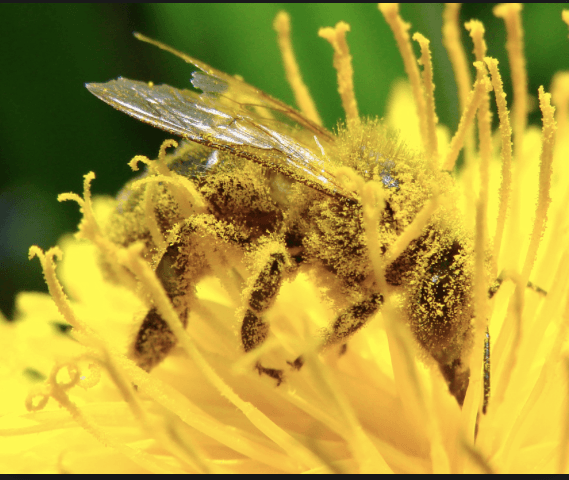
Insect dispersed pollen is usually sticky and spiky so that it can _______________. 
a)
attach to the pollinators' body without falling off easily 
b)
prevent pollinators from eating them
c)
stay attached to the anther so that it doesn't attach to a pollinator
d)
be used as glue
47.
What are 3 requirements for germination?
a)
Air, water, and warmth.
b)
Air, roots, seeds.
c)
Air, seeds, sun.
d)
Sun, soil, air.
48.
Seeds are only able to sprout or___________ under the right conditions
a)
photosynthesise
b)
germinate
c)
multiply
d)
spread
49.
Pollination is the process by which pollen
a)
causes people to sneeze
b)
is formed inside a plant
c)
moves from stamen to stigma
d)
moves from stigma to stamen
50.
What is #5 pointing to?
a)
anther
b)
filament
c)
stigma
d)
style
51.

What do plants need to make food?

a)

O2, CO2, water, bread and pasta.

b)

CO2, light, energy, minerals and water.

c)

O2, CO2 and water

d)

C02, water, minerals, light and milk.

52.

Which part of the plant makes the food?

a)

Through their leaves.

b)

Through the flower.

c)

Through the roots.

d)

Through the stem.

53.

Plants can make their own food, this process is called...

a)

Dinner

b)

Breakfast

c)

Photosynthesis

d)

Lunch

54.
All of the different populations that live in a specific area.
a)
ecosystem
b)
habitat
c)
ecology
d)
community
55.
The place where an organism lives that provides it with shelter, food and water.
a)
ecosystem
b)
population
c)
community
d)
habitat
56.
All the members of one type of species in a specific area.
a)
habitat
b)
community
c)
population
d)
ecosystme
57.
All of the different populations that live in a specific area.
a)
community
b)
habitat
c)
ecosystem
d)
village
58.
An example of a behavioral adaptation is
a)
The long neck of a giraffe
b)
Penguins huddling together for warmth
c)
A camel's hump used to store water
d)
A polar bear's white fur used for camouflage
59.
An example of a physical adaptation is...
a)
a turtle hiding inside its shell
b)
The spikes on a porcupine fish
c)
a rabbit burrowing underground
d)
a viper biting when threatened
60.
An animal's color or pattern that helps it blend into its surroundings
a)
Environment 
b)
Mimicry
c)
Camouflage
61.
A squid will squirt black ink at predators when frightened.
a)
Behavioral Adaptation
b)
Structural Adaptation
62.
A monkey has a long tail to help it swing from branch to branch.
a)
Behavioral Adaptation
b)
Structural Adaptation
63.
The direction of the flow of energy in a food web is represented by ___.
a)
Light bulbs
b)
Dotted Lines
c)
Arrows
d)
Bubbles
64.
What does every food chain start with?
a)
producers
b)
sun
c)
consumer
d)
decomposers
65.
What is this called?
a)
Food Web
b)
Food Chain
c)
Abiotic Factors
66.
Which is a producer?
a)
deer
b)
tall grass
c)
lion
d)
worm
67.
What is this called?
a)
Food Web
b)
Food Chain
c)
Abiotic Factors
68.
An organism that lives by breaking apart dead organic matter into simpler parts is...
a)
scavenger
b)
consumer
c)
decomposer
d)
carnivore
69.
In a food web, arrows point at:
a)
who gets energy.
b)
who gets eaten.
70.
What does a food web represent?
a)
All connections of energy flow throughout all organisms in a ecosystem.
b)
The specific ways that mutualism is carried out.
c)
A single pathway or energy flow between organisms. 
d)
How carnivores get their food. 
71.
If the grasshopper were to be removed completely from the food web, what organism would be most effected?
a)
The squirrel
b)
The shrew
c)
The deer
d)
The rabbit
72.
What does this device show?
a)
a change in temperature
b)
a change in humidity
c)
wind speed
d)
the amount of rainfall
73.
A severe storm which involves a funnel cloud forming over land is:
a)
hurricane
b)
tornado
c)
thunderstorm
d)
blizzard
74.
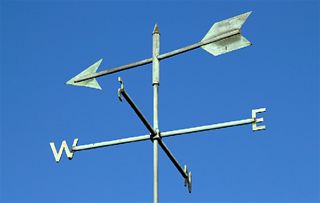
From which direction is the wind blowing in this picture?
a)
north
b)
east
c)
south
d)
west
75.
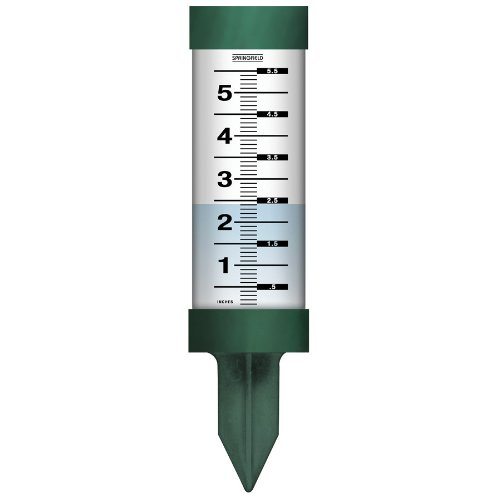
What weather instrument is this and what does it measure?
a)
thermometer-temperature
b)
rain gauge-rain fall
c)
barometer-air pressure
d)
hygrometer-humidity
76.
What weather instrument is this and what does it measure?
a)
wind vane- wind direction
b)
thermometer-temperature
c)
rain gauge-rain fall
d)
anemometer-wind speed
77.
Which of the following types of weather would probably have the strongest winds?
a)
thunderstorms
b)
hurricanes
c)
blizzards
d)
sunny day
78.
A person that studies, reports and forecast weather conditions is a
a)
radiologist
b)
geologist
c)
astronomer
d)
meteorologist
79.
A front is
a)
where warm air is cooling at earth's surface
b)
a line where hot and cold air are separating
c)
a line where two different air masses meet
d)
where cold air is rising and forming rain clouds
80.
Which most likely produces clear, cool weather?
a)
zero air pressure
b)
stable air pressure
c)
a low pressure system
d)
a high pressure system
81.
_____________ air is more dense and tends to sink
a)
cold
b)
warm
c)
moist
d)
dry
82.
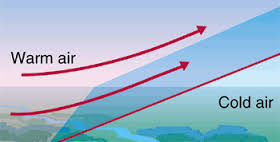
Which type of front is pictured?
a)
Cold front
b)
Warm front
c)
Occluded front
d)
Stationary front
83.
Which type of front is near Seattle?
a)
cold front
b)
warm front
c)
occluded front
d)
stationary front
84.

When the Moon is directly between the Sun and the Earth, what phase would the Moon be in?

a)

Full Moon

b)

New Moon

c)

Half Moon

d)

Waxing Crescent

85.

What term is associated with the moons that are increasing in size (more light on them) each day?

a)

Waxing moons

b)

Waning moons

c)

Crescent moons

d)

Gibbous moons

86.

What phase of the moon is this?

a)

Waxing Gibbous

b)

Waning Gibbous

c)

Waxing crescent

d)

Waning crescent

87.
The different phases of the Moon are caused by:
a)
The days of the months
b)
The angle at which we see the lit Moon as it revolves around the Earth
c)
The position of the Earth in its orbit around the Sun
d)
The tides of the ocean
88.

The Moon gets its light from the

a)

It reflects the Earth's light

b)

It reflects the other stars' light

c)

It reflects the Sun's light

d)

It makes its own light

89.

What phase of the moon is shown?

a)

waning gibbous

b)

1st quarter

c)

waxing crescent

d)

Waxing gibbous

90.

About how long does it take the Moon to complete it's cycle?

a)

around 1 week

b)

around 1 month

c)

around 1 year

d)

around 1 day

91.
What are the correct phases of the Moon from position 6 through 8?
a)
Waning Crescent, First Quarter, Waning Gibbous
b)
Waning Gibbous, Third Quarter, Waning Crescent
c)
Waxing Crescent, First Quarter, Waxing Gibbous
d)
Waxing Gibbous, Third Quarter, Waxing Crescent
92.
The Earth spinning on its axis is called what?
a)
revolution
b)
rotation
c)
retrograde rotation
d)
orbit
93.
Day and night are caused by...
a)
the tides
b)
the tilt of the Earth's axis
c)
the revolution of the Earth around the Sun
d)
the rotation of the Earth on its axis
94.
What causes the Earth to have seasons?
a)
the revolution of the Earth around the Sun
b)
The tilt of the Earth's axis
c)
The tilt of the Earth's axis and the revolution of the Earth around the Sun
d)
the distance of the Earth from the sun
95.
What season does A represent?
a)
Summer
b)
Fall
c)
Winter 
d)
Spring
96.
What is the largest planet in our solar system?
a)
Earth
b)
Saturn
c)
Jupiter
d)
The Sun
97.
The four planets that are nearest the sun are called the.........
a)
Inner planets
b)
Outer planets
c)
Small planets
d)
Gas giants
98.
Which of the following planets is Earths sister planet?
a)
Venus
b)
Neptune
c)
Mars
d)
Mercury
99.
Which planet is closest to the sun?
a)
Uranus
b)
Mercury
c)
Neptune
d)
Earth
100.
Which is the sixth planet from the sun?
a)
Earth
b)
Uranus
c)
Saturn
d)
Neptune
101.
 Which of these is a natural resource of Virginia?
a)
A dam
b)
A glacier
c)
A river
d)
A power plant
102.
 Which of these is the most important product of Virginia forests?
a)
Pecan trees
b)
Pine cones
c)
Hardwood lumber
d)
Maple leaves
103.
A student is hiking through a forest taking pictures for science class. Which picture would most likely be used as an example of human impact on Earth?
a)
A trail built by cutting down trees
b)
A river eroding away the riverbank
c)
A bird nest made of dead branches
d)
A group of butterflies landing on flowers
104.

Which is the best action to help protect water resources in Virginia?

a)

Rinse spilled gas with a hose.

b)

Put pet waste in a stream.

c)

Put hazardous waste in your house trash.

d)

Organize a river clean up program.

105.

Which of the following is a common plant that grows wild in Virginia?

a)

Orange Tree

b)

Lemon Tree

c)

Dogwood Tree

d)

Cactus Tree

106.

Coal is important for Virginia because it —

a)

it can be used for energy

b)

it can be divided into 4 parts

c)

is found in many areas of the country

d)

is formed from plant and animal remains

107.
The land area that drains a particular set of streams and rivers is called  
a)
an acre
b)
a drainage hectare 
c)
a woodland
d)
watershed 
108.
The area that is drained by a river and all the streams that empty into it
a)
Water table
b)
Divide
c)
Watershed
d)
Delta