
Font size
 Worksheets
6.5 IB Synaptic Transmission
Total questions: 20
Worksheet time: 2hrs 36mins
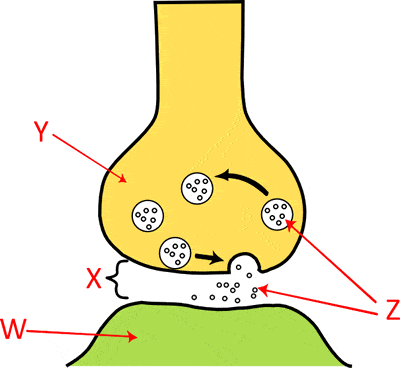
What is W?
Axon Terminal
Neurotransmitters
Dendrite
Synapse

What is Y?
Axon terminal
Neurotransmitters
Dendrite
Synapse
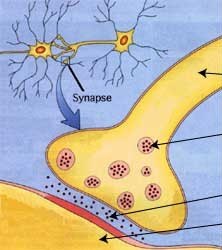
Where are neurotransmitters located within in neuron?
axon terminals
dendrites
Schwann cells
cell body

Calcium ions (Ca2+)are responsible for.....
signaling the release of the neurotransmitter
signaling Na+ to be released into the membrane
signaling the release of K+ out of the membrane
serving as the neurotransmitter

These are chemical substances that breaks down a neurotransmitter so that the post synaptic neuron can depolarize in order to fire again...
Enzymes
Ions
Lipids
Binding agents

The actual gap in the synapse is called the...
synaptic bridge
synaptic vesicle
synaptic membrane
synaptic cleft

Location at which a neuron can transfer an impulse to another cell with the use of neurotransmitters is called ...
myelin sheath
axon
threshold
synapse

Neurotransmitters are released from the....
Dendrites
Post-synaptic neuron
Presynaptic neuron
Axon

Which is the correct sequence in the transmission of a neural impulse?
axon, dendrite, cell body, synapse, axon terminal
dendrite, axon, axon terminal, cell body, synapse
synapse, axon terminal, axon, dendrite, cell body
dendrite, cell body, axon, axon terminal, synapse

This releases neurotransmitters which are sent into the synaptic cleft for receptors on the dendrite to respond to...
axon
axon terminal
gene
neuron

A chemical produced by neurons that carries messages to other neurons....
myelin sheath
neurotransmitter
axon
axon terminal

What type of gated channel is #2?
Na+
K+
Ca2+
Mg2+
What is contained in #4?
Acetylcholine
Acetylcholinase
Na+
K+
Ca2+
By what process do vesicles containing neurotransmitter leave the axon terminal?
Exocytosis
Endocytosis
Diffusion
Through gated channels
What is the purpose of Ca2+ entering the cell?
They halt the action potential
They signal for the synaptic vesicles to move towards the membrane
The start a new action potential
The signal the release of acetylcholinase
What 3 things happen to the acetylcholine in the synaptic cleft?
It binds to an autoreceptor as part of a negative feedback loop to stop anymore neurotransmitter being released into the synaptic cleft.
It is broken down in to its component parts by acetylcholinase
It diffuses to the postsynaptic cell and binds with receptors in its membrane
It is taken into the postsynaptic cell by endocytosis
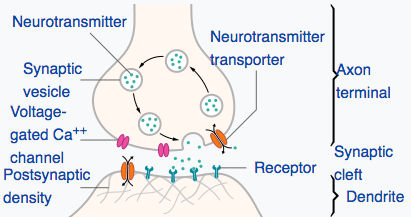
What is the response in the postsynaptic cell once the acetylcholine has bound to it?
In opens the Na+ gated channels and Na+ rush in
It opens the Ca2+ gated channels and Ca2+ rush in
It closes the K+ channels creating a resting potential
It releases its own neurotransmitter into the synaptic cleft

What is an neonicotinoid?
A chemical that blocks the receptors in the postsynaptic membrane of most insects
A chemical inhibits the production of neurotransmitters in insects
The insect version of acetylcholine
The enzyme in insects that breaks down their type of neurotransmitter

The decline in European honeybee (Apis mellifera) populations may be linked to neonicotinoid pesticides. What effect do these pesticides have on the nervous system of insects?
They prevent acetylcholinesterase from breaking down acetylcholine.
They inhibit depolarization in the presynaptic neuron which increases the levels of acetylcholine.
They produce an inhibitor that promotes the binding of acetylcholine.
They block synaptic transmission by binding with postsynaptic acetylcholine receptors.

What is happening at the point labelled X?
Neurotransmitter binding
Ca2+ diffusing
Neurotransmitter moving across synapse
Na2+ binding

