wayground logo

Free Printable Worksheets

Font size

S
M
L
XL
Worksheets

Meiosis Practice

Total questions: 51

Worksheet time: 55mins

Name
Class
Date
1.
What causes genetic variation in meiosis?
a)
chromosomes lining up
b)
crossing over of chromosomes
c)
separation of chromosomes
d)
chromosomes pulling apart
2.
What kind of cells are made in MEIOSIS?
a)
Haploid cells
b)
Diploid Cells
c)
Skin Cells
d)
Liver Cells
3.
Diploid Cells are represented by
a)
2n
b)
n
c)
4n
d)
1/2 n
4.
If the Diploid number of Carrots is 18, the haploid number is
a)
18
b)
9
c)
27
d)
36
5.
The chromosomes that pair up during meiosis, are called __________ chromosomes.  
a)
homozygous 
b)
asexual
c)
homologous
d)
genes
6.
Crossing over creates
a)
male genotype
b)
genetic variation (differences)
c)
DNA replication
d)
mitosis
7.
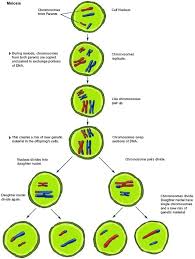
Which cellular process is shown?
a)
meiosis
b)
endocytosis
c)
mitosis
d)
phagocytosis
8.
Which of the following best describes meiosis?
a)
It is carried out in all tissues theat require cell replacement
b)
It occurs only in cells in the reproductive structures of an organism
c)
It happens in all of the tissues except the brain and spinal cord
d)
It is the first stage of mitosis
9.
products of meiosis are genetically
a)
different
b)
identical
10.
Which of the following cells is a gamete?
a)
egg
b)
bone
c)
heart
d)
muscle
11.
Meiosis is the _____.
a)
 nuclear division of gametes
b)
nuclear division of body cells
c)
division of body cells
d)
division of sex cells
12.

1n indicates that the cell is ____.

a)

Diploid

b)

Haploid

13.
Which statement best describes the importance of sexual reproduction?
a)
sexual reproduction produces variation in offspring
b)
sexual reprosuction provides regeneration of body parts
c)
sexual reproduction occurs between individuals of the same species
d)
sexual reproduction produces offspring that are identical
14.
Which of the following cell types is formed by meiosis?
a)
skin cells
b)
sperm cells
c)
blood cells
d)
muscle cells
15.
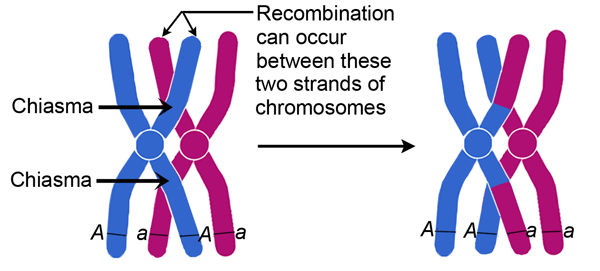
This image shows chromosomes during Prophase 1. Which of the following correctly describes the process shown?
a)
segregation of sister chromatids
b)
condensation and segregation of alleles
c)
mutationin which the DNA content of the gene is altered
d)
crossing - over in which alleles are exchanged
16.
Which of the following statements correctly describes meiosis?
a)
Meiosis does not occur in reproductive cells.
b)
The cells produced at the end are identical 
c)
the cells produced at the end contain half the # of chromosomes
d)
cells divide only once during meiosis
17.
What process is necessary for the inherited traits of an organism to be passed along by sexual reproduction?
a)
meiosis
b)
mutation
c)
mitosis
d)
fission
18.
What is one advantage of sexual reproduction?
a)
The offspring are identical to the parents
b)
the offspring are resistant to viruses
c)
the offspring are born live, instead of from eggs
d)
The offspring inherit a wider variety of genetic information
19.
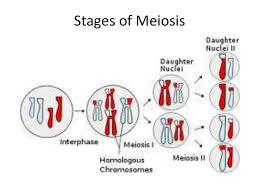
This diagram  shows which cellular process that occurs in organisms?
a)
endocytosis
b)
mitosis
c)
meiosis
d)
phagocytosis
20.
If an intestinal cell in a butterfly contains 24 chromosomes, a butterfly egg cell would contain___________.
a)
12 chromosomes
b)
6 chromosomes
c)
3 chromosomes
d)
24 chromosomes
21.
Which of the following normally results from meiosis in a human cell that contains 46 chromosomes?
a)
an egg cell with 46 chromosomes
b)
a liver cell with 23 chromosomes
c)
a sperm cell with 23 chromosomes
d)
a blood cell with 46 chromosomes
22.
Meiosis is the key process in the production of_________.
a)
body cells
b)
RNA
c)
white blood cells
d)
gametes
23.
Which process and type of resulting cells are represented in the diagram?
a)
meiosis, which produces body cells
b)
mitosis, which produces body cells
c)
meiosis, which produces body cells
d)
meiosis, which produces gametes
24.

What kind of cells are made in MEIOSIS?

a)

Haploid Gametes

b)

Diploid Somatic Cells

c)

Skin Cells

d)

Liver Cells

25.

A human body (somatic) cell usually has how many chromosomes?

a)

6

b)

22

c)

4

d)

46

26.
If the Diploid number of Carrots is 18, the haploid number is
a)
18
b)
9
c)
27
d)
36
27.
The cells produced via meiosis are called:
a)
sex cells
b)
somatic cells
c)
body cells
d)
skin cells
28.
If a somatic (body) cell in a butterfly contains 24 chromosomes, a butterfly egg would contain
a)
3
b)
6
c)
12
d)
24
29.
The result of meiosis is:
a)
two diploid cells
b)
two haploid cells
c)
four diploid cells
d)
four haploid cells
30.
What causes genetic variation in meiosis?
a)
chromosomes lining up
b)
crossing over of chromosomes
c)
separation of chromosomes
d)
chromosomes pulling apart
31.
The purpose of meiosis is to form ________ cells.
a)
body
b)
sex
c)
somatic
d)
brain
32.

The chromosomes that pair up during meiosis, are called __________ chromosomes.

a)

heterozygous

b)

asexual

c)

homologous pairs

d)

genes

33.
How many daughter cells are produced at the end of meiosis?
a)
1
b)
2
c)
3
d)
4
34.
Which of the following is NOT a gamete (sex cell)?
a)
egg
b)
sperm
c)
skin cell
d)
all of the above are gametes
35.
What is one of the advantages, why is it better to reproduce sexually versus asexually?
a)
survival of the fittest
b)
overproduction
c)
genetic variation
d)
cloning
36.
Meiosis produces how many cells at the end?
a)
1
b)
2
c)
4
d)
6
37.
Haploid cells have how many chromosomes in humans?
a)
2
b)
23
c)
46
d)
64
38.
Sperm and egg cells are?
a)
haploid
b)
Diploid
c)
Meiosis 
d)
IDK
39.
Which type of cells in the human body are made through the process of meiosis?
a)
gametes
b)
somatic cells
c)
all cells in the body
d)
diploid cells
40.
The cells produced via meiosis are called:
a)
sex cells
b)
somatic cells
c)
body cells
d)
skin cells
41.
products of meiosis are genetically
a)
different
b)
identical
42.
If a somatic (body) cell in a butterfly contains 24 chromosomes, a butterfly egg would contain
a)
3
b)
6
c)
12
d)
24
43.
What causes genetic variation in meiosis?
a)
chromosomes lining up
b)
crossing over of chromosomes
c)
separation of chromosomes
d)
chromosomes pulling apart
44.
What process, and which type of resulting cells are represented?
a)
mitosis, gametes
b)
mitosis, body cells
c)
meiosis, gametes
d)
meiosis, body cells
45.

Mutations are a source of _______________.

a)

Variation

b)

Disease

c)

Polypeptide

46.

Any change in the sequence of DNA is...

a)

transgenic shift

b)

Single Genotype

c)

Monohybrid Trait

d)

Mutation

47.

Mutations:

a)

are permanent changes in the DNA sequence or structure

b)

produce allelic variation

c)

are more likely to neither harm or help the organism

d)

all of the above

48.
What is another reason for genetic variation besides sexual reproduction?
a)
Partial mating
b)
Asexual reproduction
c)
Unequal chromosome distribution
d)
Mutation
49.
The differences in the sets of alleles between individuals in a population
a)
genetic variation
b)
gene
c)
allele
d)
none of the above
50.
An organism's appearance or other detectable characteristic
a)
genotype
b)
phenotype
c)
allele
d)
genetic variation
51.

What causes genetic variation? (pick all correct choices)

a)

Mutations

b)

Sexual reproduction

c)

Asexual reproduction

d)

Mitosis

e)

Cell division