Wayground logo

Free Printable Worksheets

Font size

S
M
L
XL
Worksheets

Final Review

Total questions: 75

Worksheet time: 1hrs 10mins

Name
Class
Date
1.
An element has only one capital letter.
a)
True
b)
False
2.
______ - is a pure substance represented by chemical symbols.
a)
Element 
b)
Compound
c)
Neither
3.
Element or Compound?
CO2
a)
Element 
b)
Compound
c)
Neither
4.

Which of the substances are elements?

a)

Al, LiF, S CO2, Ni

b)

Al, S, Ni

c)

Al, H2O, S, CO2

d)

S

5.
What is an the simplest part of any form of matter that cannot be further broken down?
a)
Molecule
b)
Atom
c)
Compound
d)
Substance
6.
Malleability is ___________
a)
the way light is reflected off a surface.
b)
how well a piece of matter conducts electricity
c)
A.  the capability of being drawn out into thin wires or threads.
d)
the capability of being hammered out thin.
7.
Luster is ___________
a)
A.  the way light is reflected off a surface.
b)
A.  how well a piece of matter conducts electricity. 
c)
A.  the capability of being drawn out into thin wires or threads.
d)
A.  the capability of being hammered out thin.
8.
Density is 
a)
weight/volume
b)
mass/volume
c)
weight/mass
d)
volume/mass
9.
Brittleness is _________
a)
the capability of being broken.
b)
the capability of being bent.
c)
the capability of being stretched.
d)
the capability of being molded.
10.
Nonmetals are ________ compared to metals.
a)
highly conductive
b)
brittle
c)
ductile
d)
non-conductive
11.

What is the density of an object that has a mass of 15 g and a volume of 2.5 cm3?

a)

37.5 g/cm3

b)

6.0 g/cm3

c)

12.5 g/cm3

d)

0.17 g/cm3

12.

The density values of four irregular shaped objects are shown in the table. Which object's density can be calculated from measurements of 18.8 mL and 17.5 grams?

a)

Plastic dinosaur

b)

Pink eraser

c)

Large paper clip

d)

Aluminum foil ball

13.
The amount of matter in an object - 
a)
Mass
b)
Matter
c)
Density 
d)
Volume
14.
The amount of space an object takes up is - 
a)
Mass
b)
Matter
c)
Volume
d)
Density 
15.
Calculate the volume of the rectangle
a)
5 cm3
b)
3 cm3
c)
1 cm3 
16.

At what point does the roller coaster have the most potential energy?

a)

Point A

b)

Point B

c)

Point C

d)

None of the Points

17.

On which hill would the roller coaster have more potential energy?

a)

The first hill

b)

The second hill

c)

Both hills

d)

Neither hill

18.

An archer stands with the bow fully stretched back, ready to launch the arrow. What example of energy is this?

a)

Potential Energy

b)

Kinetic Energy

c)

Conservation

d)

Density

19.

Define Kinetic Energy.

a)

The energy stored in an object because of its position.

b)

The location of an object.

c)

The energy of an object that is moving or working.

d)

A law of science that states that energy cannot be created or destroyed, but only changes from one form into another or transferred from one object to another.

20.

Define Potential Energy.

a)

The ability to do work

b)

A change from one form of energy to another

c)

The energy stored in an object because of its position. Still, not moving.

d)

The energy an object has that is moving or working.

21.
What is the speed of a car that travels 400 m in 20 minutes?
a)
20 miles/hr
b)
20 m/min
c)
800 m/min
d)
200 miles/hr
22.
What is the equation to calculate speed?
a)
speed = distance/time
b)
speed = time/distance
c)
speed = time x distance 
d)
speed = speed/time 
23.
What is the speed of this object at 3 seconds?
a)
5 m/s
b)
45 m/s
c)
5 s/m
d)
45 s/m
24.

A ball traveled 8 meters in 10 seconds. What is the average speed of the ball?

a)

0.8

b)

1.25

c)

80

d)

18

25.

A boy on a bicycle travels at a speed of 30 kilometers per hour. How many kilometers will he have traveled when he is 0.20 hours away from his starting point?

a)

6 km

b)

12 km

c)

30 km

d)

60 km

26.

A family drove several hours to visit a theme park. Their travel progress is charted. What was the average speed in kilometers per hour?

a)

50

b)

0.02

c)

1,250

d)

0.2

27.

A student constructs a table of distances and times. Using the data, which section of the table represents the highest average speed?

a)

Section A

b)

Section B

c)

Section C

d)

Section F

28.

A student kicks a soccer ball three times. What is the time of kick 1?

a)

5 s

b)

6 s

c)

2 s

d)

10 s

29.
What is the speed of an object that travels 60 meters in 4 seconds?
a)
240 m/s
b)
15 m/s
c)
0.067 m/s
d)
15 mph
30.
Marlon decided to visit Dallas, which is 210 miles away from Houston. His trip took him 3 hours to complete. Calculate his average speed. 
a)
60 mph
b)
64 mph
c)
70 mph
d)
3 mph
31.
Which type of energy is transmitted by vibrations of air?
a)
electormagnetic
b)
sound
c)
nuclear
d)
chemical
32.
What law states that energy can neither be created nor destroyed?
a)
 The law of conservation of mass
b)
The law of conservation of energy 
c)
he law of conservation of matter
d)
he law of conservation of sound
33.
What energy conversions take place when fireworks explode?
a)
light energy turns into thermal energy
b)
chemical energy converts into light, heat and sound energy 
c)
sound energy converts to thermal and heat energy
d)
no changes take place
34.
What causes an object to have potential energy due to its position above the ground?
a)
the sun
b)
the moon
c)
gravity
d)
kinetic energy
35.
What type of energy transformation occurs when a flashlight shines?
a)
Electrical > light > mechanical
b)
Chemical > electrical > light 
c)
Mechanical > chemical > light
d)
Mechanical > electrical > light
36.
Sedimentary rocks can have layers of different colors. This occurs when –
a)
molten rock seeps into large cracks underground.
b)
extreme pressure causes minerals to separate
c)
different minerals are deposited at different times.
d)
seasonal patterns change the rate of erosion.
37.
Which of the following is one of the final processes in the formation of sedimentary rock?
a)
Melting
b)
Cementation
c)
Flowing
d)
Separation
38.
Metamorphic rock forms where any kind of rock –
a)
is crystalized after being liquid rock.
b)
contains fossils of marine organisms
c)
is changed by the extreme heat and pressure.
d)
is composed of cemented sediment.
39.
Which of the following features of a rock would classify it as definitely an igneous rock?
a)
Began its formation process millions of year in the past
b)
Created through slow, naturally occurring processes
c)
Formed when minerals were heated, then cooled
d)
Resulted from liquid rock being ejected from a volcano
40.
Which of the following processes is one of the early steps in the formation of sedimentary rock?
a)
Weathering of existing rock
b)
Crystallization of molten minerals
c)
Melting of rock in volcanoes
d)
Chemical reactions that produce heat
41.
Sedimentary rock can be changed into igneous rock if sediments are –
a)
compacted.
b)
deposited.
c)
weathered.
d)
melted.
42.
Which type of rock results from melting and cooling of magma?
a)
Igneous
b)
Metamorphic
c)
Sedimentary
d)
Extrusive
43.
Wind, water, and ice breaking down rock is called
a)
Erosion
b)
Deposition
c)
Compaction
d)
Weathering
44.
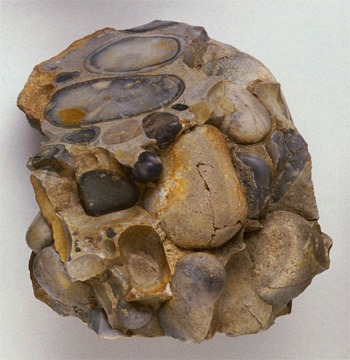
This rock was formed by smaller pieces of rock that settled at the bottom of a lake millions of years ago. What type of rock is this?
a)
Sedimentary
b)
Igneous
c)
Metamorphic
45.

Which of the following processes is one of the early steps in the formation of sedimentary rock?

a)

Weathering of existing rock

b)

Crystallization of molten minerals

c)

Melting of rock in volcanoes

46.
The gravitational attraction between two objects would increase if both masses are--
a)
Increased and the distance between them is increased
b)
increased and the distance between them is decreased
c)
decreased and the distance between them is decreased
47.
Why do planets orbit the Sun?
a)
The Sun is the only celestial object that has a gravitational pull
b)
Only celestial bodies that emit light can be at the center of an orbit
c)
The Sun is the most massive object in our solar system so it has the greatest gravitational pull
48.
Which of the following governs the motion of our solar system? 
a)
Magnetism
b)
Gravity
c)
Friction
49.
Objects with more _______ than Earth have stronger gravitational pulls, whereas objects with less _______ than Earth have weaker gravitational pulls.
a)
force
b)
mass 
c)
weight
50.
The path that planets take as they orbit the center of the solar system is a result of the interaction of what two things? 
a)
The forward motion of the planet and gravitational pull of the Sun
b)
The mass of the planet and the composition of its atomosphere
c)
The magnetic field generated by the planet and friction with the air
51.
What is unicellular? 
a)
one cell 
b)
many cells 
c)
no nuclues 
d)
DNA 
52.
What is multicellular? 
a)
one cell 
b)
no cells 
c)
many cells 
d)
no nucleus 
53.
True or False: I am an autotrophic organism, therefore, I cannot make my own food.
a)
True
b)
False
54.

Which is true?

a)

Prokaryotic cells are larger than eukaryotic cells

b)

Eukaryotic cells are larger than prokaryotic cells

c)

Cells are mostly the same size

55.

How can you tell if a cell is prokaryotic or eukaryotic?

a)

Take its temperature

b)

Use a telescope to look at it from far away

c)

Use a microscope to look for a nucleus in the cell

d)

Measure the cell's mass

56.

What type of cell is this?

a)

Prokaryotic cell

b)

Eukaryotic cell

57.

What identifies this cell as eukaryotic?

a)

presence of DNA

b)

presence of a cell membrane

c)

presence of a nucleus

d)

absence of DNA

58.

All organisms are composed of one or more

a)

bones

b)

cells

c)

DNAs

d)

cell membranes

59.
An organism that can make its own food
a)
Humans
b)
Heterotroph
c)
Autotroph
d)
Multicellular
60.
Sexual or asexual process of an organism producing more of its own kind
a)
Reproduction
b)
Sexual Reproduction
c)
Asexual Reproduction
d)
Autotrophic
61.
All forms of life are classified into three ________, or groups, based on their characteristics
a)
Taxonomy
b)
Cells
c)
Domains
d)
Organisms
62.
if something is multicellular, heterotrophic, and reproduces sexually what is it?
a)
Plantae
b)
Animalia
c)
Eubacteria
d)
Protista
63.
Plantae is different than fungi because
a)
plantae reproduces through sexual reproduction
b)
plantae can make their own food
c)
plantae are made up of one cell
d)
plantae are prokaryotes
64.
All cells that are bacteria 
a)
are made up of more than one cell 
b)
lack a nucleus 
c)
are related to fungi
d)
make their own food 
65.
members of the Plantae kingdom are always
a)
asexual
b)
autotrophic
c)
unicellular
d)
happy
66.

Which of the following is an example of a biotic part of an ecosystem?

a)

Boulder

b)

Cactus

c)

Sand

d)

Sunlight

67.

Which of the following describes an interaction between a biotic factor and an abiotic factor?

a)

A bird eats a fresh red berry

b)

A black bear uses a cave for a winter home

c)

Two male squirrels fight over a female squirrel

d)

A small beetle is on the trunk of a tree

68.

In the graphic organizer above, what word could we use to replace the word living?

a)

Abiotic

b)

Biotic

c)

Ecosystem

d)

Organism

69.
Temperature, light, air, water, and soil are all  _____  parts of the environment
a)
alive
b)
biotic 
c)
abiotic
d)
living
70.
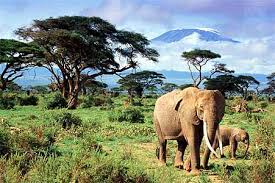
What are the biotic factors in this image?
a)
sunlight, elephants, and grasses
b)
sunlight, water,  and air
c)
elephants, plants, trees 
71.
A certain plant needs moisture, carbon dioxide, oxygen, light, and minerals to survive. This scenario shows that this particular living organism depends on .
a)
Biotic and Abiotc Factors
b)
Biotic Factors 
c)
Abiotic Factors 
d)
None of the Above
72.
The factors in an ecoysystem that have never had the ability to live.
a)
Biotic Factor
b)
Abiotic Factor
c)
Biome
d)
Community
73.
All the organisms of a particular type living in the same place at the same time is called a _______.  An example is a herd of deer.
a)
population
b)
community
c)
resource
d)
ecosystem
74.
Which of the following is not an abiotic factor?
a)
sun
b)
temperature
c)
soil
d)
grass
75.
A living or once-living organisms in an ecosystem is a
a)
population
b)
biotic factor
c)
abiotic factor
d)
community