
 Worksheets
Contact Forces
Total questions: 72
Worksheet time: 45mins
What is the difference between MASS and WEIGHT?
Mass DOES NOT change if the force of gravity changes. Weight DOES change if the force of gravity changes.
Mass DOES change if the force of gravity changes. Weight DOES NOT change if the force of gravity changes.
Mass is related to gravity while weight is not.
If an object is SMALLER, it always has more mass and less weight than a LARGER object.

The three examples pictured are of
Non-contact Forces
Contact Forces
When you drop a hammer and a feather, why does the feather fall slower?
air resistance causes the feather to slow down
gravity pulls harder on the hammer than the feather
gravity pulls harder on the feather than the hammer
air resistance causes the hammer to fall slower
The force that opposes motion because of resistance between bodies in contact
Tension
Applied
Friction
Spring
The sum of all forces acting on an object and direction is called the
Balanced Force
Net Force
Unbalanced Force
Contact Force

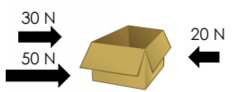
Are the forces balanced or unbalanced?
Balanced
Unbalanced
A rightward force is applied to a dresser to accelerate it to the right across the bedroom floor.


The same strength but act in opposite directions, so there is no change in motion.
balanced forces
unbalanced forces
net forces
army forves

When one force is stronger than the other and the forces act in different directions, they are _________.
balanced forces
unbalanced forces
net forces
gravity forces
Perla and Rital are pushing the same object. Perla pushes it to the right and Rital pushes it to the left. The object moves to the left. Explain what causes this.
Rital is pushing the object with a stronger force than Perla.
Perla is pushing with a stronger force than Rital.
Which of the following is an example of balancing forces?
A Book resting on the table.
A pencil is knocked off the desk.
How could you describe a force?
moving up and down
going in and out
a push or a pull
hot and cold
If the net force is equal to zero, the forces acting on the object are
balanced
unbalanced


Collision
When two objects almost come into contact
When two objects are about to come into contact
When two objects are in contact and are motionless
When two objects come into contact and one or both of them are moving
What is force?
The mass of an object
The energy of things that move
The amount that one object pushes another
The energy from the sun
A force is ____.
a push or pull that can cause movement
a magnet
when someone does not work
The things that anything that can change or be changed in an experiment
Variable
Questions
Hypothesis
Data
energy transfer is
The movement of energy from one object or material to another
What is needed to do work or cause change
Rate of motion
Change in position or location

Based on the model, how will the rope move?
The rope will not move because the forces are even
The rope will move to the right because there is more force
The rope will move to the left because there is more force
The amount of potential energy put into a system is equal to the amount of ________ that will be in the system.
Kinetic Energy
Mass
Friction
Applied Force
The more mass in a system the more amount of _____ energy in the system.
Potential
Kinetic
A force is ____.
a push or pull that can cause movement
a magnet
when someone does not work

This is an example of what force?
push
pull
magnetism

A falling apple, like in the picture, is an example of ... force.
magnetism
pulling
gravity

If the net force on an object at rest is zero Newtons. What can you conclude?
The object is in motion.
The object is not in motion.
There is an unbalanced force
There is acceleration

Isaac Newton developed these 3 laws concerning ______________.
Velocity.
Mass
Acceleration.
Motion
What explains why objects resist changes in their state of motion?
gravity
inertia
force
friction
The force that prevents a ball rolling on the ground from continuing on it's path forever is...
Friction
Gravity
Inertia


An inflated balloon released from rest moves horizontally.
The law that best explains this event is
Newton's 1st Law
Newton's 2nd Law
Newton's 3rd Law
Law of Gravity
A dictionary weighing 15 Newtons is placed on a desk.
What is the force that the desk exerts on the dictionary?
none
15 N
1.5 N
150 N
Isaac Newton stated for every action there is an
_________ and _________ reaction.
equal and same
equal and opposite
unequal and same
unequal and opposite
A soccer ball is sitting in the middle of a field. The ball will remain at rest until an outside force like a players foot or the wind acts upon it. Which of Newton's laws is represented by this?
1st
2nd
3rd
Sally jumps on her trampoline. She exerts a force on the trampoline and the trampoline exerts an equal but opposite force back on Sally. This represents
Law 1
Law 3
Law 2

What Newtons law does this picture represent
Newtons 1st law
Newtons 2nd law
Newtons 3rd law
Newtons 4th law

The reason a ball bounces up when it hits the ground:
The ball and ground repel each other.
The ball exerts a force on the ground, and the ground exerts a force on the ball.
When a student runs and kicks a ball, they have applied an ___________ force to move the ball.
Balanced
Magnetic
Spring
Unbalanced
What does the first part of Newton’s first law say about objects in motion?
Objects in motion speed will increase.
Objects in motion speed will decrease.
Objects will move at the same speed and direction unless force changes their motion.
Force does not affect the change in an objects motion.
What does the second part of Newton’s first law say about objects at rest?
They cannot move unless they have a lot of friction.
If they are heavy, they will stay at rest, but if they are light, they will move.
They will stay at rest unless an outside force makes them move.
They have more inertia than objects in motion.
Isaac Newton stated for every action there is an
_________ and _________ reaction.
equal and same
equal and opposite
unequal and same
unequal and opposite
What determines an object’s mass?
amount of matter
amount of friction
amount of force
amount of gravity
While you’re ice-skating with your friends, you push off from one end of the rink and slide forward. Based on Newton’s first law of motion, what is true?
You will lose your balance and fall over before your reach the middle of the ice rink.
You will continue to slide across the ice until a force makes you stop or change direction.
The force of gravity will make you keep your velocity until your friends make you stop.
The size of your ice skates will determine how quickly or slowly you travel across the ice.
Your friend kicks a soccer ball, and it stops a few feet from you. What needs to happen to it in order for it to return to your friend?
Friction has to be applied to the ball.
Force has to be applied to the ball.
Speed has to be applied to the ball.
Inertia has to be applied to the ball.
Every time your cat’s paw hits her toy string, it swings away from her. How does this demonstrate Newton’s third law of motion?
Objects with mass, such as your cat's paw and toy string, will require inertia.
Objects in action, such as the string toy, will experience force.
For every motion from your cat's paw, there is unbalanced inertia from the string.
For every action your cat makes, there is an equal and opposite reaction from the string.
A softball and a volleyball collide with equal speed, and then they accelerate at the same rate. What must be true about the masses of the objects?
The softball has more mass than the volleyball.
The softball and the volleyball have equal mass.
The volleyball has more mass than the softball.
It is impossible to compare the mass of the softball and the volleyball

