
 Worksheets
25-26 Fall Final Review
Total questions: 70
Worksheet time: 49mins
How do you determine the amount of atoms in a molecule of oxygen?
by the letter
verify the subscript following the letter.
count letters
by the number in front of the letter
C6H12O6
Using the formula above answer the following questions:
-How many atoms of hydrogen are in the equation?
-How many individual elements are in the formula?
There are 24 atoms of hydrogen.
There are 3 individual elements.
There are 18 atoms of hydrogen.
There are 3 individual elements.
There are 6 atoms of hydrogen.
There are 3 individual elements.
There are 12 atoms of hydrogen.
There are 3 individual elements.
What are the properties of a chemical change?
Does not form a new substance, but can change its state
A new substance is formed.
changes color
changes shape
What are the properties of a physical change?
Does not form a new substance, but can change its state
A new substance is formed.
changes color
changes shape
Physical change or chemical change?
BAKING A PIE
chemical change
physical change
Physical change or chemical change?
TEARING A PIECE OF PAPER
chemical change
physical change
Physical change or chemical change?
RUST FORMING ON A BYCICLE LEFT OUTSIDE
chemical change
physical change
Physical change or chemical change?
GLASS SHATTERING
chemical change
physical change
Physical change or chemical change?
SCRAMBLING AN EGG IN ABOWL
chemical change
physical change
Forming a gas
Change in temperature
Producing a precipitate
Color change
are signs of a physical or chemical change?
physical change
chemical change
A runner completes a 400-meter lap around a track in 50 seconds. What is the runner's speed in meters per second?
Speed = Distance * Time
400 meters * 50 seconds = 2000 m/s.
Speed = Distance / Time
400 meters / 50 seconds = 7 m/s.
Speed = Distance / Time
400 meters / 50 seconds = 8 m/s.
Speed = Distance * Time
400 meters * 50 seconds = 20,000 m/s.
A cyclist travels a distance of 20 kilometers in 1 hour and 15 minutes. What is the cyclist's average speed in kilometers per hour? HINT: convert second into hrs
First, convert 1 hour and 15 minutes to hours: 1 hour + (15 minutes / 60) = 1.25 hours. Speed = Distance / Time = 20 km / 1.25 hours = 16 km/h
First, convert 1 hour and 15 minutes to hours: 1 hour + (15 minutes / 60) = 1.15 hours. Speed = Distance / Time = 20 km / 1.15 hours = 17 km/h
First, convert 1 hour and 15 minutes to hours: 1 hour + (15 minutes / 60) = 1.25 hours. Speed = Distance / Time = 20 km / 1.25 hours = 18 km/h
First, convert 1 hour and 15 minutes to hours: 1 hour + (15 minutes * 60) = 1.25 hours. Speed = Distance * Time = 20 km * 1.25 hours = 25 km/h
A car travels 150 miles in 2.5 hours. Calculate the average speed of the car in miles per hour.
Speed = Distance / Time = 150 miles / 2.5 hours = 600 mph
Speed = Distance / Time = 150 miles / 2.5 hours = 60 mph
Speed = Distance / Time = 150 miles / 2.5 hours = 0.016 mph
Speed = Distance / Time = 150 miles / 2.5 hours = 375mph
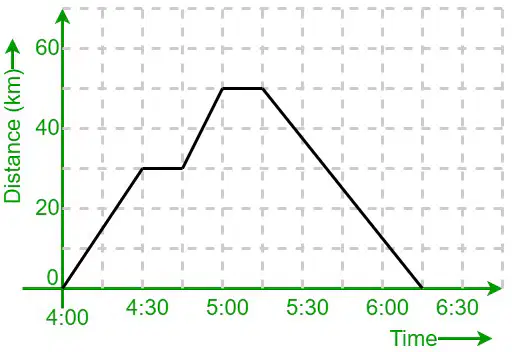
On a distance time graph,
What does this picture indicate from 4:30 to 4:45 and from 5:00 to 5:15?
speed is constant
time is increasing
there is no motion/movement
distance is increasing
On a distance time graph,
What does this picture indicate from 4:00 to 4:30?
distance is increasing constantly
time is stopped
there is no motion/movement
distance is decreasing
On a distance time graph,
What does this picture indicate from 5:15 to 6:15?
shows return to original starting point
time is stopped
there is no motion/movement
distance is decreasing
Heat moves from cooler objects to warmer ones through three main processes.
true
false
RADIATION
is heat transfer through direct contact between objects,
is heat transfer through the movement of a fluid (like air or water
heat transfer through electromagnetic waves
CONDUCTION
is heat transfer through direct contact between objects,
is heat transfer through the movement of a fluid (like air or water
heat transfer through electromagnetic waves
CONVECTION
is heat transfer through direct contact between objects,
is heat transfer through the movement of a fluid (like air or water
heat transfer through electromagnetic waves
Which of the following are element(s)?
H
Cl2
H2O
F2

What is the atomic number?
35
18
17
52

How many protons does this element have?
35
18
17
52

Which layer is the oldest?
5
3
2
1
Which layer is the newest?
5
3
2
1
The Himalayas are an example of what type of boundary?
Convergent: subduction
Convergent: collision
Divergent
Sliding/Transform
Where 2 plates slide past each other is called a ____________.
Convergent boundary
Divergent Boundary
Sliding/Transform Boundary
Where 2 plates slide past each other is called a ____________.
Convergent boundary
Divergent Boundary
Transform Boundary
When two plates move towards each other it is called a ___________.
Convergent boundary
Divergent Boundary
Sliding/Transform Boundary
When two plates move apart it is called a ___________.
Convergent boundary
Divergent Boundary
Transform Boundary
The Great Rift Valley in Africa is an example of what type of boundary?
Convergent: Subduction
Convergent: Collision
Divergent
Transform
When two plates slide past each other is called a ___________.
Convergent Boundary
Divergent Boundary
Transform Boundary
The San Andreas Fault is an example of which of the following boundaries?
Convergent: Collision
Convergent: Subduction
Divergent
Transform
in a region where a crustal plates move under another plate
SUBDUCTION
A chemical combination of two or more elements
element
liquid
solid
compound
A pure substance that cannot be broken down into simpler substance by a chemical reaction.
compound
element
solid
liquid
Two or more atoms chemically combined
compound
molecule
element
solid
The number before the compound formula: it represents the number of molecules that are present
element
subscript
coefficient
compound
The number to the lower right of an element symbol in a compound formula that represents the number of atoms for that element.
subscript
coefficient
element
molecule

Element
Compound
Mixture

calcium
(a)
H
(a)
Li
(a)
Distance ÷ Time =
velocity
speed
acceleration
direction
speed in a given direction
velocity
average speed
instantaneous speed
speed
What kind of force causes objects to move?
Balanced
Unbalanced
The more mass an object has, the _______ force it takes to accelerate it.
more
less
For every action, there is an equal and opposite reaction.
True
False

Jumping into the air is an example of _________.
Action-reaction forces
Momentum
electromagnetic fields
Mass
In the equation f=ma, "F" stands for _______.
force
mass
velocity
acceleration
According to Newtons Third Law of Motion, every action has an equal and opposite _________.
gravity
force
mass
reaction
How many Laws of Motion did Isaac Newton Create?
2
4
5
3

What is the term for water that collects in cracks and pores in underground soil and rock layers?
Surface water
Groundwater
Ocean systems
Watershed

Which term describes anything that brings a positive effect or makes an improvement?
Harmful
Beneficial
Influence
Impact

What is the term for all the water on Earth, including oceans, rivers, lakes, and even water in the air?
Hydrosphere
Watershed
Groundwater
Surface water

What is a watershed?
A man-made lake used to store water
An area of land where all the water drains into a specific body of water
An area of the ocean with low oxygen levels
A red growth of algae in a body of water

What is the term for all the water above the ground's surface, including lakes, rivers, and streams?
Groundwater
Surface water
Hydrosphere
Ocean systems

Which term describes anything that causes injury, sickness, or problems?
Beneficial
Harmful
Influence
Dependence

What does the term "human activity" refer to?
Events or processes that occur naturally
Anything that humans do that will have an effect
The power to produce a desired effect
A group of interacting items forming a complex whole


Which type of boundary forms a mid-ocean ridge?
transform
divergent
convergent

What evidence did Alfred Wegener use to support his theory of continential drift?
Fossil discoveries
The Himalayan Mountains
Ancient maps of the world
Charts of seismic activity

What is true of tectonics plates?
They are constantly moving
Earthquakes cause them to move
They don't move for centuries at a time
There are fewer & fewer of them

What is the underlying force that drives plate tectonics?
Ocean tides
Volcanic eruptions
The rock cycle
Convention currents

Which oceanic crust/rock would be older?
A
B
Same age

What structure is the arrow pointing to?
Subduction zone
Stratovolcano
Mid-ocean ridge
Pangea
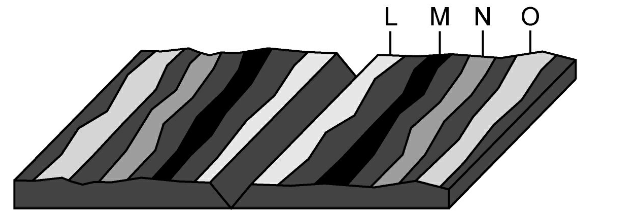
Where would the oldest rock be found?
L
M
N
O


