wayground logo

Free Printable Worksheets

NEW

Font size

S
M
L
XL
Worksheets

ASK Semester 2 Final Review FJ

Total questions: 35

Worksheet time: 46mins

Name
Class
Date
1.
This variable in an experiment is the one being changed by the scientist. 
a)
dependent variable
b)
independent variable
c)
data
d)
control group
2.
Will a construction paper air plane fly faster than an airplane made from notebook paper? Choose the best hypothesis.
a)
If I make a paper airplane from notebook paper, then it will fly faster than construction paper.
b)
Yes.
c)
No.
d)
I think the construction paper air plane will fly faster.
3.
The change that happens because of your experiment is called the ___________ variable.
a)
independent
b)
dependent
c)
controlled
4.
Mass & weight are different because
a)
Weight depends on the force of gravity
b)
Mass depends on the force of gravity
c)
Weight depends on the amount of matter an object contains
d)
Mass does not depend on the amount of matter an object contains
5.
When collecting data, where do we put it first?
a)
data table
b)
graph
c)
anywhere on the paper
d)
we just memorize it
6.
On what axis should the independent variable always be?
a)
X
b)
Y
7.

What scientific instrument is used to measure the mass of an object?

a)

Triple beam balance

b)

Graduated cylinder

c)

Meter stick

d)

Sonic screwdriver

8.

________________________ means the amount of matter contained within a given volume.

a)

Density

b)

Temperature

c)

Mass

d)

Volume

9.

Which of the following would be a valid conclusion for this experiment?

a)

Rose bushes grow tallest in blue light

b)

Rose bushes grow in white light

c)

Rose bushes grow in no light

d)

Rose bushes grow in green light

10.
How is data from an investigation organized and displayed?
a)
SI Units
b)
metric system
c)
reports and essays
d)
tables and graphs
11.
What is the volume of the rock? The water level is displaced from 20 mL to 23 mL with the rock.
a)
3 mL
b)
23 mL
c)
20 mL
d)
43 mL
12.
What would be the best way to measure the volume of a small rock?
a)
L x W x H with a ruler
b)
Put on triple beam balance
c)
Mass ÷ Volume
d)
Displacement method using graduated cylinder
13.
Which statement is true?
a)
Oil is the most dense substance.
b)
Corn syrup is less dense than water.
c)
Oil is less dense than water.
d)
Oil and corn syrup have the same density but different masses.
14.
matter
a)
Anything that has weight and takes up space
b)
anything that has a smell and you can feel it
c)
only a few things have matter
d)
the longest distance running
15.
Mass, relative density, solubility, color, texture, state of matter, conductivity, etc.
a)
Physical state
b)
Insulators
c)
Physical Properties 
d)
Inferences
16.
Which box has a higher density?  
a)
Box A
b)
Box B
c)
cannot be determined
d)
they are the same
17.
What is a physical property of matter?
a)
Solubility
b)
Acidity
c)
Basicity
d)
Reactivity
18.
What is the difference between a physical and a chemical property of matter?
a)
A physical property does not change the identity of a substance, and a chemical property does change something into a new substance.
b)
A chemical property does not change the identity of a substance, and a physical property does change something into a new substance.
c)
A physical property means an object cannot be changed, but a chemical property can change an object.
d)
A chemical property means an object cannot be changed, but a physical property can change an object.
19.
Which of the following is NOT a physical property?
a)
Combustibility
b)
Boiling point
c)
Solubility
d)
Shape
20.
Flammability is an example of what property?
a)
Chemical property
b)
Physical property
21.
When you break a cracker into pieces it is a 
a)
Chemical change
b)
Physical change
c)
Chemical Weathering
d)
Physical Weathering
22.

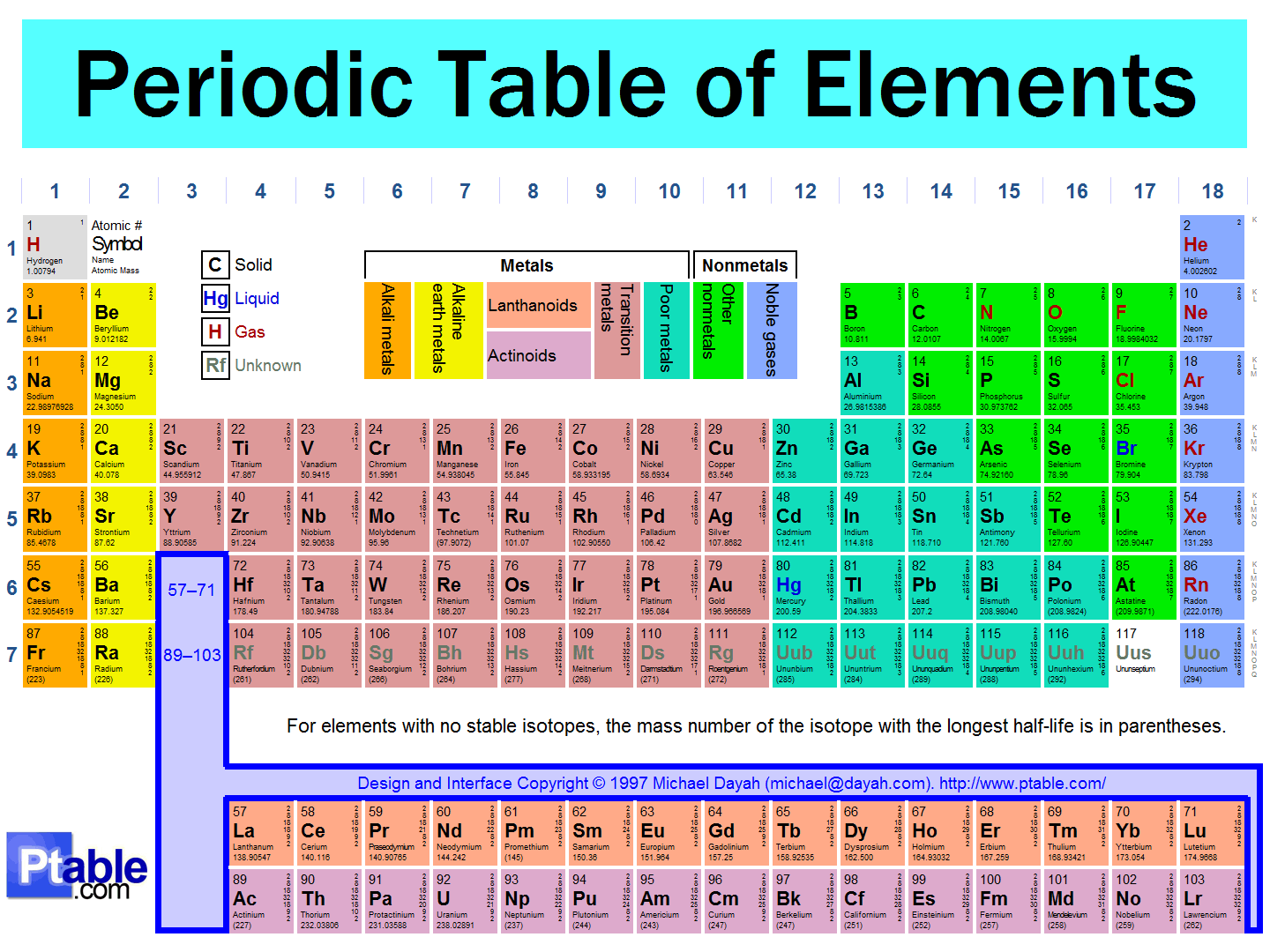
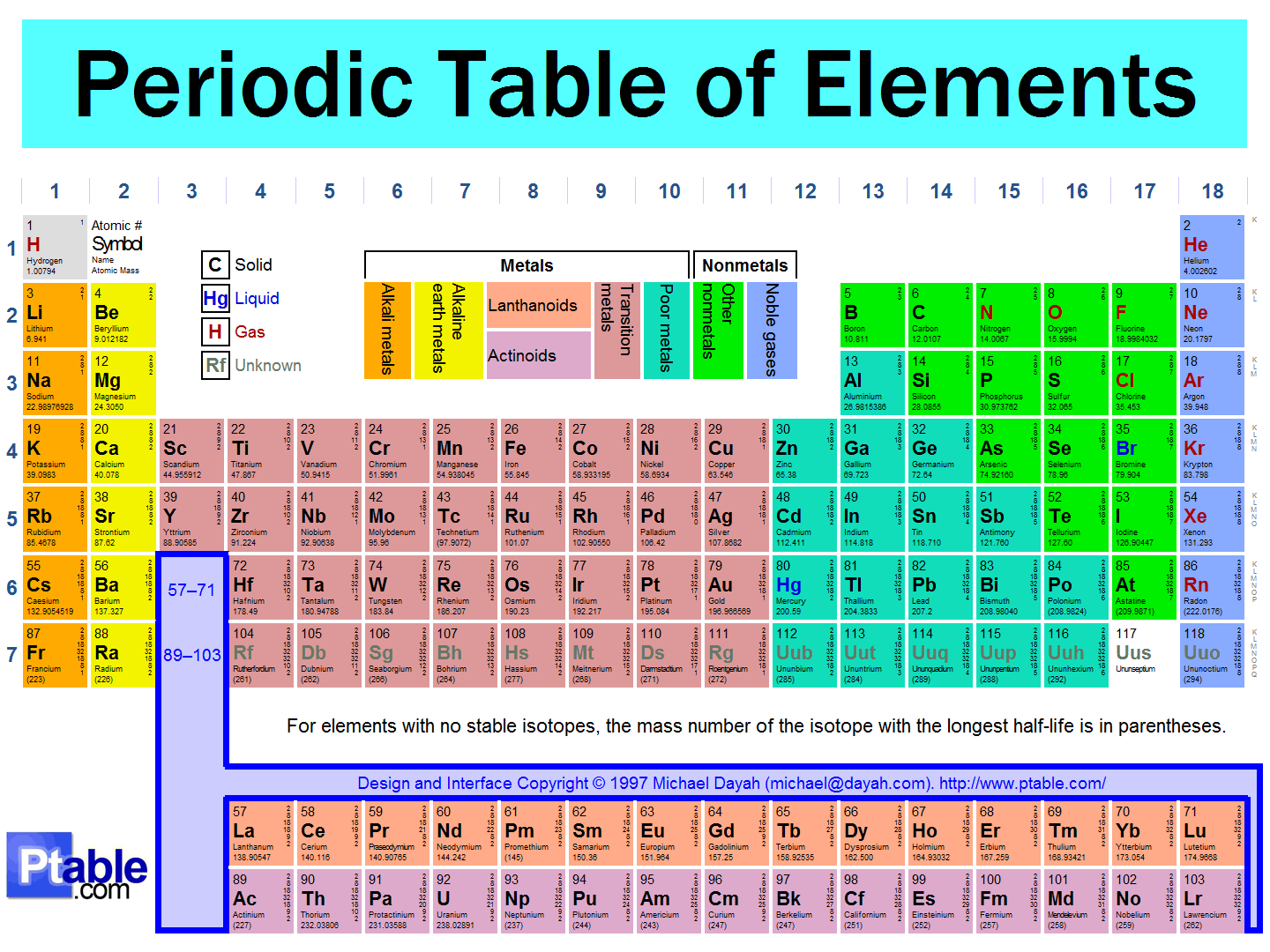
The vertical (up and down) columns in the Periodic Table are called

a)

groups

b)

towers

c)

periods

d)

atomic numbers

23.
The Modern Periodic Table of Elements is arranged by
a)
atomic mass
b)
atomic number
c)
valence electrons
d)
number of isotopes
24.

The horizontal (side to side) rows in the Periodic Table are called

a)

groups

b)

families

c)

periods

d)

atomic numbers

25.

what is the biggest group on the table

a)

metals

b)

nonmetals

c)

metaloids

d)

halogens

26.

how many groups/families are on the table

a)

15

b)

16

c)

17

d)

18

27.
In the modern periodic table elements are arranged by:
a)
atomic mass
b)
atomic number
c)
valence electrons
d)
number of isotopes
28.
An element is made up of only one kind of _____.
a)
isotope
b)
plastic
c)
atom
d)
metal
29.
An element is made up of only one kind of _____.
a)
isotope
b)
plastic
c)
atom
d)
metal
30.
The atoms along the staircase are called 
a)
metals
b)
nonmetals
c)
metalloids
d)
noble gases
31.

The Russian scientist who created one of the first periodic tables by using atomic mass was:

a)

Bohr

b)

Rutherford

c)

Mendeleev

d)

Thomson

32.
Is water an element or a compound?
a)
Element
b)
Compound
33.
Which of the following an element?
a)
Carbonic Acid
b)
Copper
c)
Iron and Copper
d)
Water
34.
Which best describes a compound? 
a)
found on the periodic table 
b)
made from two or more elements
c)
a pure substance 
d)
only 100 in the world 
35.

A scientist wanted to see if the amount of garbage that Americans threw away changed over time. He collected information and then showed his results in the graph below.


Based on this graph, what could the scientist say about the amount of garbage that each person threw away?

a)

It increased over time

b)

it decreased over time

c)

it increased the most in 1980

d)

It decreased the most in 1990