

wayground logo

Free Printable Worksheets

NEW

Font size

S
M
L
XL
Worksheets

Biodiversity-Remedial

Total questions: 26

Worksheet time: 25mins

Name
Class
Date
1.
What is a vertabrate?
a)
An animal that has a spinal cord or backbone
b)
An animal that has lungs
c)
A human that can play Soccer
d)
An animal that has bones
2.
What is a invertabrate?
a)
An animal lacking a backbone
b)
An animal that has a spinal cord
c)
A person that has a jaw
d)
An animal or person that has lungs
3.
Body covering of a mammal?
a)
Fur
b)
Scales
c)
Fur and skin
d)
Skin and Scales
4.
How do Amphibians breath?
a)
Gills
b)
Blow Hole
c)
Gills and Lungs
d)
Lungs
5.
Where does the energy from an ecosystem come from?
a)
Trees
b)
Sun
c)
Plants
d)
Water
6.
The scientific name for a wolf is Canis lupus. What does the first word in the name represent?
a)
Species
b)
Kingdom
c)
Genus
d)
Domain
7.
Which option is abiotic?
a)
Plants
b)
Bacteria
c)
Water
d)
Fungi
8.
What does biodiversity mean?
a)
Only one species in an area.
b)
The different amount of species in an area
c)
All abiotic life
d)
Nitrogen fixation
9.

High biodiversity ensures that many different ecological niches (jobs, roles) are filled, which helps the ecosystem function well.

a)

True

b)

False

10.

High biodiversity in an ecosystem makes it less likely that an animal or a plant will get a disease.

a)

True

b)

False

11.

High biodiversity is a sign of a healthy ecosystem.

a)

True

b)

False

12.
A tick and a dog have this type of relationship.
a)
mutualism
b)
commensalism
c)
neutralism
d)
parasitism
13.
The snake is a predator to what prey in this food chain?
a)
frog
b)
grass
c)
grasshopper
d)
hawk
14.
Why is a deer classified as a herbivore?
a)
A deer makes its own food.
b)
A deer eats only plants.
c)
A deer eats only animals.
d)
A deer eats plants and animals.
15.
Which are decomposers?
a)
humans
b)
trees
c)
red wolves
d)
worms
16.
What is the role of a producer?
a)
Use sunlight to make food
b)
Gain energy from eating other organisms
c)
Keep other species from overpopulating
d)
Breaking down dead stuff 
17.
What is the role of decomposers in a food chain?
a)
Use sunlight to make food
b)
Eat other organisms to gain energy
c)
Make the food for the whole food chain
d)
Break down dead organisms and add nutrients to the soil
18.
Which organisms are the consumers?
a)
deer and squirrel
b)
flowers and deer
c)
deer and mushrooms
d)
squirrel and mushrooms
19.

What would happen if the grizzly bear decreased in this food web?

a)

There would be less red tail hawks.

b)

There would be more deer.

c)

There would be a decrease in chipmunks.

d)

There would be increase in butterflys.
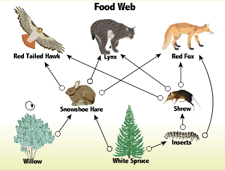
20.
What may happen if the snowshoe hare was removed from the food web pictured?
a)
The insects in the habitat would increase.
b)
The shrew population would decrease due to being only hawk food source.
c)
The willow tree population would decrease.
d)
Foxes would dies due to no food source. 
21.

A population is

a)

a group of similar species in different areas

b)

a group of the same species in the same geographic area.

c)

a group of several species in the same geographic area

d)

a group of several species along with their abiotic factors in a small area.

22.
What two human activities contribute the most to global warming?
a)
a. Burning fossil fuels and deforestation
b)
b. Mining and vehicle exhaust
c)
c. Burning fossil fuels and agriculture
d)
d. Deforestation and agriculture
23.
What affect will continued rise in global temperature most likely have on worldwide biodiversity?
a)
a. It will have no effect as there is plenty of time for organisms to adapt
b)
b. It will increase due to warmer temperatures
c)
c. It will increase due to greater plant production from more CO2
d)
d. It will decrease due to massive habitat destruction
24.
Which of the following results in the breakdown of the ozone layer?
a)
a. CFCs
b)
b. Acid Rain
c)
c. Carbon Dioxide
d)
d. Nitrogen Oxides
25.
Environments always have both living and _________.
a)
nonliving factors
b)
bio-geochemical cycles
c)
nutrients
d)
ecosystem
26.
Which of the following is NOT a type of  biodiversity?
a)
species
b)
genetic
c)
ecosystem
d)
individual