wayground logo

Free Printable Worksheets

Font size

S
M
L
XL
Worksheets

CFE Q1 and Q2 Standards Honors

Total questions: 61

Worksheet time: 2hrs 40mins

Name
Class
Date
1.

Which is the opposite of condensation? (a)  

Choose from the below words
runoff
evaporation
precipitation
transpiration
2.

What is is called when water turns into a vapor? (a)  

Choose from the below words
EVAPORATION
PRECIPITATION
TRANSPIRATION
3.
What follows evaporation during the water cycle? How does this occur?
a)
Water evaporates into water vapor
b)
Water vapor condenses and forms a  cloud
c)
Water precipitates to the ground
d)
Water runs down into the hydrosphere
4.

What is it called when plants give off water vapor as a waste product? (a)  

Choose from the below words
condensation
evaporation
sublimation
transpiration
5.

When tiny droplets of water form in the air its called- (a)  

Choose from the below words
precipitation 
evaporation
condensation
6.

Which one of these does not add CO2 to the atmosphere? (a)  

Choose from the below words
cooking with gas
planting trees
burning wood
riding in a bus
7.

What does not produce carbon dioxide? (a)  

Choose from the below words
Photosynthesis
Burning Fossil Fuels
Animal respiration
Plants decaying
8.

How do living organisms return carbon to the atmosphere in the carbon cycle? (a)  
Choose from the below words
respiration and photosynthesis
 decomposition and respiration
9.
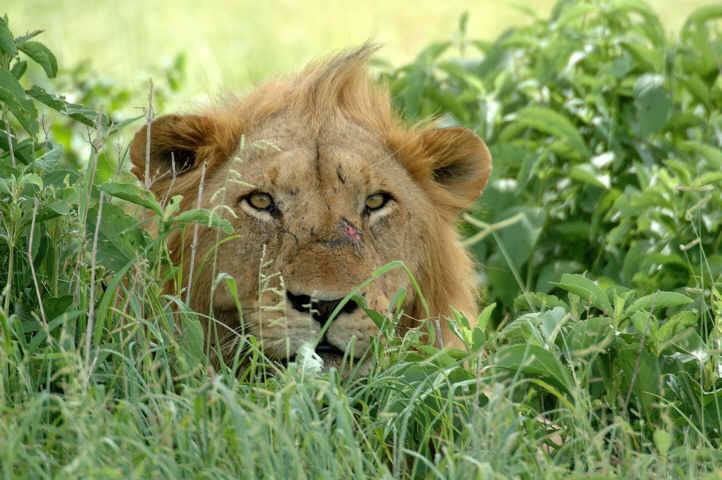
How does the carbon in grass become part of a lion?
a)
The lion eats the grass
b)
Carbon from grass doesn't end up in a lion. 
c)
The carbon ends up in the lion's food chain. 
d)
The lion breathes in carbon given out by the plant
10.

Which of the following is NOT a storage of carbon (a)  

Choose from the below words
Primary Consumers
Decomposition
Atmosphere
Detritus
11.

What is the largest sink of carbon on the planet? (a)  

Choose from the below words
Atmosphere
Animals
Coal
Oceans
12.

(a)   causes surface currents.

Choose from the below words
The Coriolis Effect
gravity
density differences
wind
13.

(a)   causes deep ocean currents

Choose from the below words
The Coriolis Effect
gravity
wind
density differences
14.

Decreasing ocean temperature causes the density of the water to (a)   .

Choose from the below words
decrease
increase
stay the same
fluctuate
15.

Nutrients are brought to the surface for phytoplankton to use at (a)   .

Choose from the below words
gyres
eddies
upwellings
the equator
16.

(a)   causes the Coriolis Effect

Choose from the below words
Earth's rotation
gravity
wind
density
17.

Gyres in the southern hemisphere are surface currents that turn (a)   due to the Coriolis Effect.

Choose from the below words
clockwise
counterclockwise
toward the right
toward the bottom of the ocean
18.

(a)   and (b)   affect the ocean's density and cause the Global Conveyor Belt to travel

Choose from the below words
gravity and the Coriolis Effect
temperature and salinity
wind and climate
temperature and the Coriolis Effect
19.

In ocean, the permanent boundary boundary that separates warmer water above from colder water below. (a)  

Choose from the below words
halocline
pycnocline
doldrums
thermocline
20.

A layer in an ocean or other body of water in which water density increases rapidly with depth. (a)  

Choose from the below words
halocline
thermocline
pycnocline
sverdrups
21.

Due to the Coriolis Effect, water in the northern hemisphere moves (a)  

Choose from the below words
clockwise
counter clockwise
both
neither
22.

Warm ocean currents generally come from (a)  

Choose from the below words
The North Pole
The South Pole
The Equator
Both A and B
23.

Where is ocean water the densest. (a)  

Choose from the below words
The surface
The middle
The bottom
Lake Michigan
24.

Water evaporating from the surface of a lake moves from the (a)  

Choose from the below words
Atmosphere to the geosphere 
Geosphere to the hydrosphere 
Hydrosphere to the atmosphere 
Atmosphere to the hydrosphere 
25.

When carbon dioxide dissolves from the air into the ocean- the interaction is between (a)  

Choose from the below words
The atmosphere and geosphere 
The atmosphere and hydrosphere 
The atmosphere and biosphere 
The atmosphere and atmosphere 
26.

When volcanoes erupt, dust and ash particles spread through much of the air blocking the sun.  Which two spheres are interacting?  (a)  

Choose from the below words
Hydrosphere and atmosphere 
Geosphere and atmosphere 
Biosphere and atmosphere 
Atmosphere and atmosphere 
27.

Coastlines often do not have extreme winters as areas inland. Why?

a)

Warm ocean waters transfer heat to the air above them, this warm air flows over coastal areas, but cannot reach areas inland.

b)

Warm ocean currents only flow east to west and cannot reach inland areas.

c)

Cold ocean currents only flow east to west and cannot reach inland areas.

d)

Cold ocean waters cool the air above them, the cool air flows over coastal areas, but cannot reach the areas inland.

28.

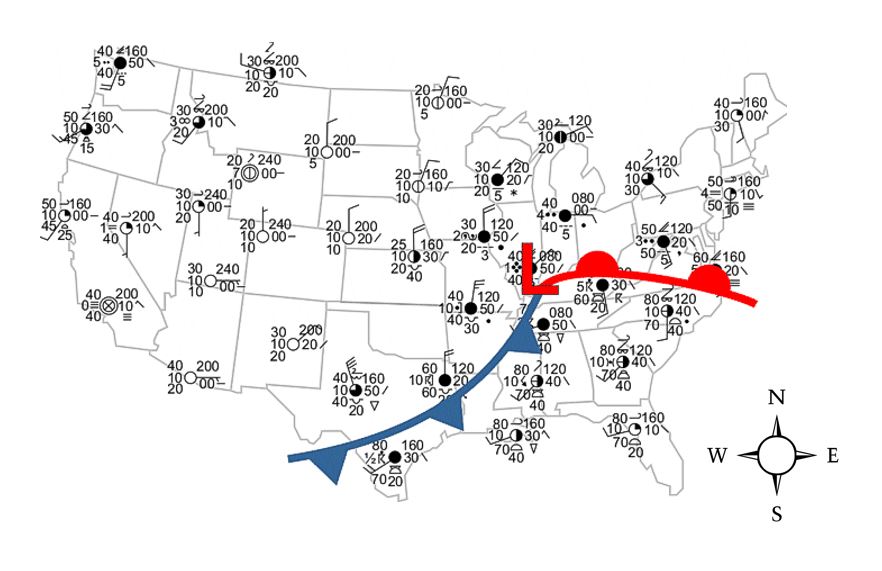
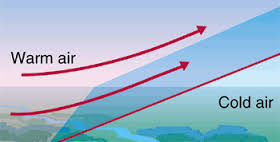
Which front is this? (a)  

Choose from the below words
Warm front
Cold front
Occluded front
Stationary front
29.

A body of air that has the same temperature and moisture levels throughout is called what?  (a)  
Choose from the below words
Fronts
Air Masses
A cold front
A warm front
30.

What direction is the warm front moving on the map?  (a)  

Choose from the below words
North
South
East
West
31.

Nice weather (a)  

Choose from the below words
High pressure
low pressure
32.

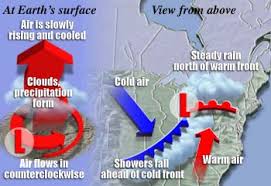
Which condition usually means cloudy, stormy weather? (a)  
Choose from the below words
high pressure
low pressure
33.

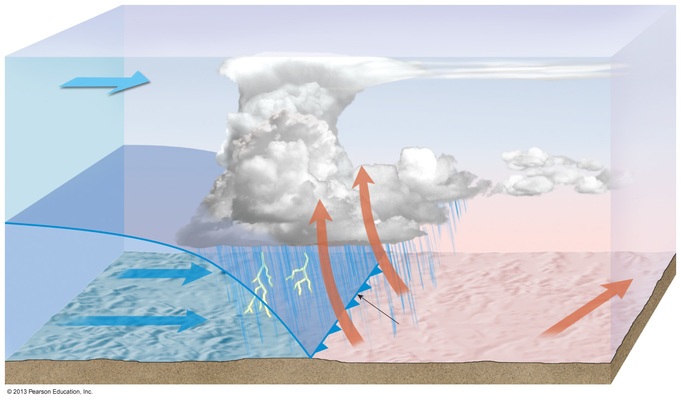
What type of storm front is this?  (a)  

Choose from the below words
warm front
cold front
stationary front
occluded front
34.
A front is
a)
where warm air is cooling at earth's surface
b)
a line where hot and cold air are separating
c)
a line where two different air masses meet
d)
where cold air is rising and forming rain clouds
35.

Which most likely produces clear, cool weather? (a)  
Choose from the below words
zero air pressure
stable air pressure
a low pressure system
a high pressure system
36.

Which type of front is pictured? (a)  

Choose from the below words
Cold front
Warm front
Occluded front
Stationary front
37.

Which system results in rainy or stormy weather? (a)  

Choose from the below words
high pressure
low pressure
hurricane
weather system
38.

Heat is the (a)   of energy.

Choose from the below words
Transfer
Measure
39.

Temperature is the (a)   of energy.

40.

Cold Pack on Person

a)

Heat is transferred from the cold pack to the person.

b)

Heat is transferred from the person to the cold pack

c)

The cold pack is getting colder. The person is getting warmer.

41.

In heat transfer, heat always flows from the (a)   substance to the (b)   substance.

Choose from the below words
hotter to colder
colder to hotter
hotter to hotter
colder to colder
42.

Which is an example of heat being transferred by conduction?

a)

a furnace blowing hot air through vents

b)

an ice cube melting in a person’s hand

c)

boiling water transferring heat to noodles

d)

the sun heating water in a swimming pool

43.

An experiment is performed on plants to see how different liquids affect plant growth. Each plant in the experiment is given a different liquid; water, apple juice, or milk. Each plant has the same amount of soil, sunlight, and listens to the same music. In this investigation, the independent variable is (a)  

Choose from the below words
The type of plant
The amount of sunlight
The type of music
The type of liquid
44.
An experiment is performed on plants to see how different liquids affect plant growth. Each plant in the experiment is given a different liquid; water, apple juice, or milk. Each plant has the same amount of soil, sunlight, and listens to the same music. In this investigation, what are the controlled variables?
a)
Type of plant, amount of music, and sunlight
b)
Water, apple juice, milk
c)
Plant growth
45.

An experiment is performed on plants to see how different liquids affect plant growth. Each plant in the experiment is given a different liquid; water, apple juice, or milk. Each plant has the same amount of soil, sunlight, and listens to the same music. In this investigation, what is the dependent variable? (a)  

Choose from the below words
Type of plant
Water, apple juice, milk
Plant growth
46.
A student is planning an experiment to find out how the height from which he drops a ball affects how high the ball bounces. The dependent variable is the _____.
a)
Diameter of the ball
b)
Force acting on the ball
c)
Height that the ball bounces
d)
Height from which the ball is dropped
47.

Mr. S set up an experiment to see how the mass of a ball affects the distance it rolls off a ramp. What is the controlled variable? (a)  

Choose from the below words
Distance traveled by the ball
Height of the ramp
Mass of the ball
48.

What are the three types of investigations?

a)

Procedure, Experiment, Results

b)

Descriptive, Comparative, Experimental

c)

Hypothesis, Variables, Experiment

d)

Research, Constants, Control

49.

Which type of investigation does not have a hypothesis? (a)  

Choose from the below words
Descriptive
Comparative
Experimental
50.

Which type of investigation has a control group? (a)  

Choose from the below words
Descriptive
Comparative
Experimental
51.

In which type of investigation would you look for similarities between 2 different plants? (a)  

Choose from the below words
Descriptive
Comparative
Experimental
52.

In which type of investigation would you compare the growth of pants given different amounts of fertilizer to a plant that was not given any fertilizer? (a)  

Choose from the below words
Descriptive
Comparative
Experimental
53.

Students identify types of organisms eaten by a praying mantis. (a)  

Choose from the below words
Descriptive
Comparative
Experimental
54.

According to the map, which city is likely experiencing warmer weather? (a)  

Choose from the below words
Seattle
Chicago
Boston
San Diego
55.

Which type of weather is Dallas, Texas, likely experiencing? (a)  

Choose from the below words
Thunderstorms
Clear skies
Cold temperatures
Gentle precipitation for days
56.

Which type of front is near Seattle? (a)  

Choose from the below words
cold front
warm front
occluded front
stationary front
57.

This weather tool measures wind speed  (a)  

Choose from the below words
thermometer
barometer
anemometer
psychrometer
58.

Which weather tool measures air pressure? (a)  

Choose from the below words
thermometer
barometer
anemometer
psychrometer
59.
What is evaporation?
a)
The part of the water cycle when the sun heats up water, turning it from a liquid into water vapor or steam. It rises from the ground into the air.
b)
The part of the water cycle when the water vapor in the air gets cold. The water turns back into a liquid and forms clouds.
c)
The part of the water cycle when clouds get heavy and can no longer hold the liquid water. This causes the water to fall from the sky to the earth as rain, snow, sleet, or hail.
60.
What is condensation?
a)
The part of the water cycle when the sun heats up water, turning it from a liquid into water vapor or steam. It rises from the ground into the air.
b)
The part of the water cycle when the water vapor in the air gets cold. The water turns back into a liquid and forms clouds.
c)
The part of the water cycle when clouds get heavy and can no longer hold the liquid water. This causes the water to fall from the sky to the earth as rain, snow, sleet, or hail.
61.

What is the process that occurs when water vapor is cooled and changes from a gas to a liquid?

a)

evaporation

b)

condensation

c)

transpiration

d)

precipitation