

wayground logo

Free Printable Worksheets

Font size

S
M
L
XL
Worksheets

Roaring 20's and Great Depression

Total questions: 100

Worksheet time: 2hrs 20mins

Name
Class
Date
1.
 What were the most popular types of music in the 1920’s.
a)
Rap
b)
Classical
c)
Jazz and Blues
d)
Country
2.
The most direct result of the 18th Amendment(Prohibition) was that ________
a)
people were mostly in support of the amendment.
b)
organized crime in America increased
c)
organized crime in America decreased
d)
people stopped drinking alchohol
3.
During the 1920s people lives changed because they began listening to the what? 
a)
mass media 
b)
movies 
c)
radio 
d)
music 
4.
What was the name given to secret bars where people acquired alcohol illegally?
a)
Speakeasies
b)
Top Secret Bars
c)
Secret Saloons
d)
Quiet Places
5.
This man is one of the most famous criminals in U.S. History. He was rumored to have made $60 million a year during Prohibition. What was the name of the most famous bootlegger during Prohibition?
a)
Baby Face Nelson
b)
Al Capone
c)
George Harris
d)
James Jones
6.
Many believe this author captured the spirit of the "Roaring Twenties" with his novel Titled The Great Gatsby.
a)
Paul Lawrence Dunbar
b)
F. Scott Fitzgerald
c)
Ernest Hemingway
d)
Louis Armstrong
7.
_______________ were young women who rebelled against traditional ways of thinking and acting.
a)
Expatriates
b)
Jazzers
c)
Flappers
d)
Scats
8.
The Harlem Renaissance was focused on the writing and music related to
a)
African Americans
b)
Communists
c)
Anarchists
d)
Immigrants
9.
What was Prohibition?
a)
A complete ban on the sale of food
b)
A complete ban on the sale of clothes
c)
A complete ban on the sale of alcohol
d)
A complete ban on the sale of cars
10.
Trial of a Tennessee public school biology teacher for teaching the theory of evolution.
a)
Scope's Trial
b)
Red Scare
c)
Fundamentalism
d)
Sacco and Vanzetti Trial
11.
_________________ were criminals that took over the alcohol business.
a)
Carpet baggers
b)
Bootleggers
c)
Prohibitionist
d)
Senators
12.
Led an idea that African Americans should move “Back to Africa” to end Racial tensions.
a)
Martin Luther King
b)
W.E.B. Dubois
c)
Marcus Garvey
d)
Malcom X
Booker T. Washington
13.
Millions of Black Americans migrated North during the early 1900s and into the 1920s. This is known as: 
a)
The Big Move
b)
The Great Migration 
c)
The Great Agitation 
d)
The Great Separation 
14.
Henry Ford’s main contribution to the US industry was the idea of the assembly line and __________.
a)
automobile
b)
mass production
c)
sports car
d)
transportation
15.
The Red Scare in America was a result of the spread of _______ overseas.
a)
disease
b)
Democracy
c)
Communism
d)
immigrants
16.
 What coincided with the Great Migration to the north from the South by African Americans, as well as an increase in education by these same people.
a)
Socialism
b)
Evolution
c)
Native Americans
d)
 Harlem Renaissance
17.

This Amendment outlawed alcohol in the United States

a)

15th

b)

21st

c)

19th

d)

18th

18.

What were some of the reasons prohibition failed? Check all that apply

a)

unenforceable law

b)

people drank illegally

c)

the police did not enforce the law

d)

resulted in more crime

19.

Women gained voting rights in the

a)

1920s

b)

1900s

c)

1880s

d)

1960s

20.

How would you describe a flapper

a)

Short hair, makeup, revealing clothes

b)

Long dresses, conservative, debutante

c)

Bootlegger, criminal

d)

Rich, wore expensive clothing, highly educated

21.

What time period is the Great Gatsby set in?

a)

Gilded Age- 1880s-1900s

b)

Progressive Era- 1900-1910s

c)

Roaring 20's- 1920s

d)

Great Depression- 1930s

22.
During the 20's what form of transportation became readily available to the average American?
a)
Commercial airplanes
b)
Automobiles
c)
Subways/Cable cars
d)
Jet packs
23.

Someone who illegally sold or transported alcohol is a

a)

flapper

b)

bootlegger

c)

bondsman

d)

bartender

24.

The fear of immigrants from Europe led to a worker revolution to overthrow the government in Russia. This is referred to as -

a)

The Palmer Raids

b)

The Red Scare

c)

A General Strike

d)

Great Migration

25.

In the __________ __________, African Americans left the South during WWI to the North for jobs in factories that produced war materials.

a)

Big Move

b)

Great Migration

c)

Great Immigration

d)

Emergency Worker Act

26.

What is Prohibition

a)

Allowed women the right to vote

b)

Outlawed drugs and opiods

c)

Outlawed the distribution and manufacturing of alcohol

27.
When did the Stock Market crash?
a)
October 31, 1929
b)
September 29, 1931
c)
August 29, 1991
d)
October 29, 1929
28.
What is another name for the Stock Market Crash?
a)
Black Friday
b)
Taco Tuesday
c)
Black Tuesday
d)
Throwback Thursday
29.
What event valued stocks lower than their worth and caused people to panic, lose their jobs, homes and life savings?
a)
Black Friday
b)
Stock Market Crash
c)
The First Day of School
d)
The Solar Eclipse
30.
Who was President of the US when the stock market crashed and Depression began?
a)
Theodore Roosevelt
b)
Franklin D. Roosevelt
c)
Herbert Hoover
d)
William McKinley
31.
Who was elected president because he had a plan to pull America out of the Great Depression?
a)
William McKinley
b)
Woodrow Wilson
c)
Theodore Roosevelt
d)
Franklin D. Roosevelt
32.
What was the name of FDR's plan to reconstruct America following the Great Depression?
a)
No Deal
b)
New Deal
c)
Reconstruction
d)
FDR's Plan
33.
During the Great Depression, there was a severe drought in the Great Plains. Strong prairie winds picked up the topsoil and spread dust everywhere. Many farm families packed everything up and moved west. What was this event called?
a)
Dust Bowl
b)
Salad Bowl
c)
Great Plains Panic
d)
Depressing Dust
34.
Charities that provided bread and soup to homeless and jobless people during the Depression were called _______?
a)
Priest Palace
b)
Soup and Salad Bowls
c)
Soup Kitchens
d)
Goodwill
35.
Which New Deal program gave jobs to young men between the ages of 18-25? The employees built roads, planted forests, and worked on irrigation and national park projects.
a)
CCC
b)
UGA
c)
WPA
d)
TVA
36.
Which New Deal program had workers build roads, parks, bridges, airports, and buildings? This program also hired artists to paint murals and build sculptures.
a)
CCC
b)
WWW
c)
WPA
d)
TVA
37.
Which New Deal program helped to build dams to control flooding and provide electricity throughout 7 states?
a)
TVA
b)
COP
c)
COM
d)
WPA
38.
People who could no longer afford their homes were forced to live in cardboard shacks that they built in public parks. What were these shacks called?
a)
Shantyshacks
b)
Town Homes
c)
Tenement Housing
d)
Hoovervilles
39.
True or False: The New Deal plan completely fixed the broken American economy.
a)
True
b)
False
40.
What event did America take part in beginning in 1942 following the Great Depression?
a)
WWI
b)
Great Depression 2.0
c)
The Election
d)
WWII
41.

Unemployment is the number of people without.....

a)

money

b)

children

c)

jobs

d)

food

42.

Which event occurred on Black Tuesday?

a)

many factories closed

b)

many banks closed

c)

many people lost their homes

d)

the stock market crashed

43.

What was the "New Deal" of the 1930s?

a)

a government program that gave free land to homesteaders

b)

a government program that helped women get the vote

c)

a government program that spread civil rights throughout the country

d)

a government program designed to help people during the depression
44.
President Franklin Roosevelt won the election of 1932. The country was in the Great Depression, and Roosevelt introduced the New Deal. Which was the MOST important goal of President Franklin Roosevelt's New Deal programs?
a)
to strengthen the economy 
b)
to avoid going to war 
c)
to improve public education 
d)
to end racial discrimination 
45.
President Franklin Roosevelt asked Congress to pass a series of acts called the New Deal. Which is one way the New Deal helped people during the Great Depression?
a)
It gave all people the right to vote. 
b)
It created programs to put people back to work.    
c)
It let all new immigrants become American citizens. 
d)
It let people travel around the country freely. 
46.
The Great Depression was an economic slowdown in the 1920s and 1930s. Which of the following was one cause of the Great Depression in the United States?
a)
the end of the gold rush 
b)
the crash of the stock exchange 
c)
the ending of World War II 
d)
the high price of oil 
47.
The Great Depression that began in 1929 hit farmers especially hard. Farmers had not been doing well in the 1920s and several years of severe drought turned the land into a "dust bowl." What was an immediate result of this?
a)
Many farmers decided to grow crops that did not use as much water. 
b)
The government built large dams in the West for irrigation. 
c)
Many farmers and their families lost their farms and moved west. 
d)
The government helped farmers by buying their land and equipment. 
48.
When the stock market crashed in 1929, Herbert Hoover was president of the United States. The president who followed President Hoover began the New Deal, a program to help people during the Great Depression. This president was
a)
Warren Harding
b)
Calvin Coolidge
c)
Franklin Roosevelt
d)
Herbert Hoover
49.
Who was the President of the United States when the Stock Market crashed?
a)
Franklin D. Roosevelt
b)
Herbert Hoover
c)
Woodrow Wilson
d)
Theodore Roosevelt
50.
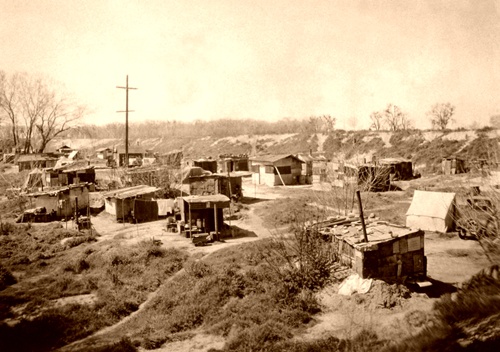
What was the main reason for the emergence of “Hoovervilles” like the one shown in the photograph?
a)
Many Americans had lost jobs during the Great Depression.
b)
Thousands of homes had been destroyed by the effects of the Dust Bowl.
c)
Housing projects could not keep up with the demand for homes needed by the poor.
d)
Preparations for World War I had created a shortage of building materials.
51.
During the 1930s, poor land management and severe drought conditions across parts of the Midwest resulted in the
a)
formation of the United States Department of Agriculture
b)
creation of wheat surpluses
c)
growth of the Populist movement
d)
development of Dust Bowl conditions on the Great Plains
52.
The Civilian Conservation Corps (CCC) and the Works Progress Administration (WPA) were both New Deal programs developed to address the problem of
a)
excessive stock market speculation
b)
high unemployment
c)
increased use of credit
d)
limited income of senior citizens
53.
The TVA is significant because it hired people to 
a)
deliver food to the poverty-stricken Dust Bowl residents
b)
build dams and generators that provided electricity
c)
work on farms to help stabilize agriculture
d)
publish important facts about businesses
54.
A drought in the Great Plains that affected farmers greatly.
a)
Drought
b)
Dust Bowl
c)
Angel's Grave
d)
Texas Cattle Storm
55.
These places helped to feed people in Hooverville.
a)
Kicthens
b)
Shelters
c)
Micro Kitchens
d)
Soup Kitchens
56.
a)
CCC
b)
WPA
c)
TVA
d)
BCA
57.
What was created to protect bank deposits up to $5,000?
a)
WPA
b)
CCC
c)
TVA
d)
FDIC
58.
FDR addressed the American public in weekly broadcasts known as:
a)
FDR Hour
b)
Hangin' With Franklin
c)
Fireside Chats
d)
Around the Fire
59.
What was the name of FDR's plans and programs designed to meet the needs and problems of the Great Depression?
a)
New Deal
b)
Great Deal
c)
Social Security
d)
the New Liberalism
60.
What were the major goals of the New Deal?
a)
no gold standard and free coinage of silver
b)
abolition and suffrage
c)
relief, recovery, and reform
d)
expanding the size and economic influence of the United States
61.
What New Deal program was an answer to demands for a pension for the elderly as put forward by Dr. Francis Townsend?
a)
National Labor Relations
b)
Tennessee Valley Authority
c)
Works {rogress Administration
d)
Social Security
62.
It provided jobs for single males on conservation projects like planting trees and building roads. 
a)
Civilian Conservation Corp 
b)
Public Works Administration 
c)
National Youth Administration 
d)
Tennessee Valley Authority 
63.
It aided farmers and regulated crop production during the Great Depression. 
a)
Food, Drug, and Cosmetic Act 
b)
Tennessee Valley Authority 
c)
Agricultural Adjustment Act 
d)
Civilian Conservation Corp 
64.
It provided electricity for rural areas in the United States. 
a)
Social Security Act 
b)
Rural Electrification Administration 
c)
Federal Deposit Insurance Corporation 
d)
Public Works Administration 
65.
The Great Depression was a time when:
a)
when people felt sad about loved ones who have died in World War I.
b)
millions of people in the United States were unemployed and homeless.
c)
the economy expanded and more workers were hired and prices were higher.
d)
factories could not keep up with consumer demand for products.
66.
The main goal of the New Deal was to:
a)
increase worker wages and benefits.
b)
expand Unions into right-to-work states.
c)
put people to work and end the Great Depression.
d)
end child labor practices.
67.
The Rural Electrification Administration helped bring electricity to 
a)
farming communities.   
b)
urban areas. 
c)
suburban areas.
d)
major cities. 
68.
The Civilian Conservation Corps hired and gave educational opportunities to
a)
young men.
b)
women.
c)
married men.
d)
non-pensioned senior citizens
69.
The New Deal program that is still in operation today is the 
a)
Social Security Administration.
b)
Civilian Conservation Corps.
c)
National Recovery Act.
d)
Works Progress Administration.
70.
Which New Deal agency was responsible for building forest trails and roads, planting trees, and improving national parks?
a)
AAA
b)
CCC
c)
FERA
d)
WPA
71.
Agency that protected the price of crops. 
a)
AAA
b)
CCC
c)
CWA
d)
FDIC
72.
Largest agency that employed over 9 million workers in construction and even performing arts. 
a)
CCC
b)
WPA
c)
TVA
d)
NRA
73.
The New Deal program which primarily employed single, young men and worked to preserve parks and forests
a)
Works Progress Administration
b)
Tennessee Valley Authority
c)
Civilian Conservation Corps
d)
Bureau of Land Management
74.
The New Deal pulled America out of its economic mess!  Several New Deal agencies, such as the CCC, WPA, and the TVA, were important because ____________________.
a)
they built bridges, dams, and other useful projects
b)
they helped create jobs and put Americans back to work
c)
they offered assistance to farmers
d)
they provided electricity to a poor region
75.
What is the TVA program?
a)
Tennessee Valley Authority
b)
Telluride Venture Accelerator
c)
Texas Valley Association
d)
Tennessee Venture Association
76.
What is the FDIC?
a)
Federal Demographic Insurance Commission
b)
Fire Department Instructor's Conference
c)
Federal Distance Interstate Committee
d)
Federal Deposit Insurance Corporation
77.
Which New Deal program was chiefly designed to correct abuses in the stock market?
a)
Civilian Conservation Corps
b)
Federal Deposit Insurance Corporation
c)
Securities and Exchange Commission
d)
National Recovery Administration
78.
What was Roosevelt’s goal in creating the Securities and Exchange Commission and the Federal Deposit Insurance Corporation?
a)
Restore the public’s faith in financial institutions
b)
Stimulate demand for manufactured goods
c)
Provide jobs for the unemployed
d)
Help farmers pay back their loans
79.
During the New Deal, how did the government attempt to improve conditions for farmers?
a)
By ending the practice of sharecropping
b)
By raising tariffs on farm imports
c)
By paying farmers to grow fewer crops
d)
By training farmers for jobs in a new field
80.
Which event marked the beginning of the Great Depression?
a)
The End of Prohibition
b)
The New Deal
c)
The Stock Market Crash
d)
The Election of Herbert Hoover
81.
Which government agency gives benefits to people when they are retired or unemployed?
a)
Federal Deposit Insurance Corporation
b)
Securities and Exchange Commission
c)
Tennessee Valley Authority
d)
Social Security Admistration
82.
What problem were both the Civilian Conservation Corps and the Works Progress Administration developed to address?
a)
Excessive stock market speculation
b)
High unemploment
c)
Increased use of credit
d)
Overproduction of goods
83.
A major reason for creating the Tennessee Valley Authority in 1933 was to-
a)
Provide health care benefits to southerners
b)
Encourage African-Americans to settle in the valley
c)
Improve economic conditions in a poor rural region
d)
Evacuate farmers from the impoverished region
84.
■subsidized farmers
a)
TVA
b)
CCC
c)
AAA
d)
WPA
85.
FDR addressed the American public in weekly broadcasts known as:
a)
FDR Hour
b)
Hangin' With Franklin
c)
Fireside Chats
d)
Around the Fire
86.
What was the name of FDR's plans and programs designed to meet the needs and problems of the Great Depression?
a)
New Deal
b)
Great Deal
c)
Social Security
d)
the New Liberalism
87.
What were the major goals of the New Deal?
a)
no gold standard and free coinage of silver
b)
abolition and suffrage
c)
relief, recovery, and reform
d)
expanding the size and economic influence of the United States
88.
What New Deal program was an answer to demands for a pension for the elderly as put forward by Dr. Francis Townsend?
a)
National Labor Relations
b)
Tennessee Valley Authority
c)
Works {rogress Administration
d)
Social Security
89.
It provided jobs for single males on conservation projects like planting trees and building roads. 
a)
Civilian Conservation Corp 
b)
Public Works Administration 
c)
National Youth Administration 
d)
Tennessee Valley Authority 
90.
It aided farmers and regulated crop production during the Great Depression. 
a)
Food, Drug, and Cosmetic Act 
b)
Tennessee Valley Authority 
c)
Agricultural Adjustment Act 
d)
Civilian Conservation Corp 
91.
The Great Depression was a time when:
a)
when people felt sad about loved ones who have died in World War I.
b)
millions of people in the United States were unemployed and homeless.
c)
the economy expanded and more workers were hired and prices were higher.
d)
factories could not keep up with consumer demand for products.
92.
The Civilian Conservation Corps hired and gave educational opportunities to
a)
young men.
b)
women.
c)
married men.
d)
non-pensioned senior citizens
93.
The New Deal program that is still in operation today is the 
a)
Social Security Administration.
b)
Civilian Conservation Corps.
c)
National Recovery Act.
d)
Works Progress Administration.
94.
Which New Deal agency was responsible for building forest trails and roads, planting trees, and improving national parks?
a)
AAA
b)
CCC
c)
FERA
d)
WPA
95.
Agency that protected the price of crops. 
a)
AAA
b)
CCC
c)
CWA
d)
FDIC
96.
Largest agency that employed over 9 million workers in construction and even performing arts. 
a)
CCC
b)
WPA
c)
TVA
d)
NRA
97.
The New Deal program which primarily employed single, young men and worked to preserve parks and forests
a)
Works Progress Administration
b)
Tennessee Valley Authority
c)
Civilian Conservation Corps
d)
Bureau of Land Management
98.
Which New Deal program was chiefly designed to correct abuses in the stock market?
a)
Civilian Conservation Corps
b)
Federal Deposit Insurance Corporation
c)
Securities and Exchange Commission
d)
National Recovery Administration
99.
During the New Deal, how did the government attempt to improve conditions for farmers?
a)
By ending the practice of sharecropping
b)
By raising tariffs on farm imports
c)
By paying farmers to grow fewer crops
d)
By training farmers for jobs in a new field
100.
Which government agency gives benefits to people when they are retired or unemployed?
a)
Federal Deposit Insurance Corporation
b)
Securities and Exchange Commission
c)
Tennessee Valley Authority
d)
Social Security Admistration
