
 Worksheets
Dr. Wright's Digestive System
Total questions: 62
Worksheet time: 45mins
Name
Class
Date
1.
Kenneth is moving at a speed of 50 km/h. How many kilometers does he travel in 2.5 hours?
a)
100 km
b)
150 km
c)
200 km
d)
250 km
2.
If you travel 720 meters in 30 seconds, what is your speed. Remember speed = distance divided by time.
a)
20 meters/second
b)
24 meters/second
c)
200 meters/second
d)
240 meters/second
3.
Type of digestion in the stomach:
a)
Mechanical
b)
Chemical
c)
Both
4.
Where chemical digestion starts.
a)
Small intestine
b)
Oesophagus
c)
Mouth
d)
Stomach
5.

Nutrients from digested food are absorbed in which digestive organ?
a)
Small Intestine
b)
Stomach
c)
Large Intestine
d)
Gallbladder
6.

As waste moves through the digestive system, the ______ absorbs water before storing waste in the rectum.
a)
Small intestine
b)
Stomach
c)
Esophagus
d)
Large intestine
7.
Which is an example of radiant energy to thermal energy transformation?
a)
a greenhouse
b)
an electric stovetop
c)
an electric stove
d)
a car's brakes
8.
Which of the following converts electrical energy to radiant energy?
a)
candle
b)
light bulb
c)
coal power plant
d)
nuclear power plant
9.
Unlike mitosis, meiosis in male mammals results in the formation of
a)
one haploid gamete
b)
three diploid gametes
c)
four diploid gametes
d)
four haploid gametes
10.

This picture shows which process?
a)
mitosis
b)
meiosis
c)
the cell cycle
11.
Human eggs and sperm are _____, and each has ____ chromosomes.
a)
diploid, 23
b)
diploid, 46
c)
haploid, 23
d)
haploid, 46
12.
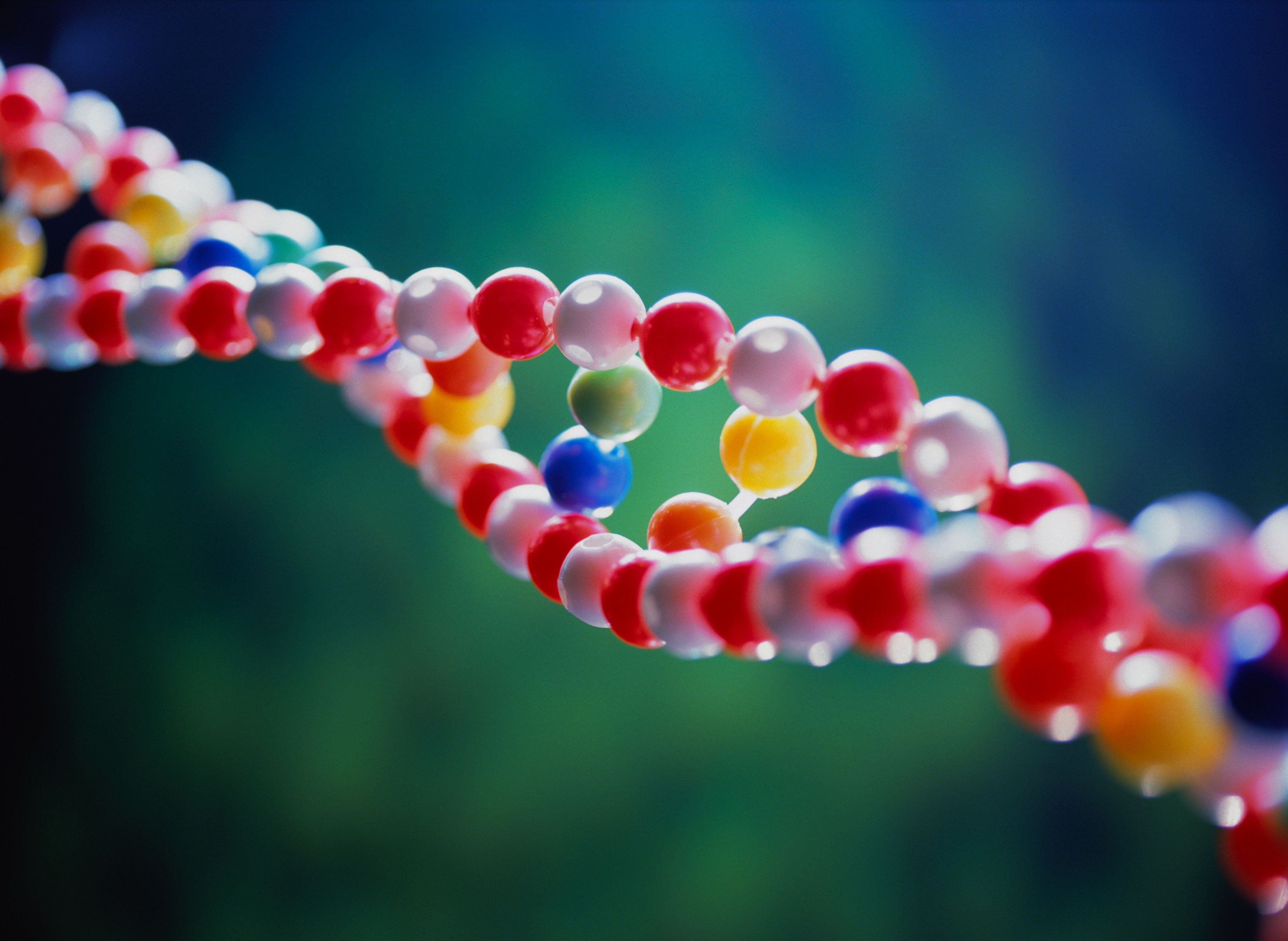
Why is DNA important?
a)
it is very small and very complicated
b)
it's in everything
c)
it serves as the blueprint for traits of all living things
d)
because we eat it every day for energy
13.
Where, in the eukaryotic cell, is DNA located?
a)
ribosomes
b)
nucleus
c)
E.R.
d)
cytoplasm
14.

Name this protist?
a)
Volvox
b)
Euglena
c)
Amoeba
d)
Paramecium
15.

Fission, budding, and regeneration are all examples of what kind of reproduction?
a)
Asexual Reproduction
b)
Sexual Reproduction
16.
Which organ system includes the esophagus, pancreas, and large intestine?
a)
digestive
b)
excretory
c)
integumentary
d)
lymphatic
17.
When you eat a cheeseburger, your digestive _______ digests the cheeseburger.
a)
glands
b)
organ
c)
system
d)
tissue
18.
During the production of yogurt, specific _______ are used to ferment the milk. In turn the same ______ are beneficial to our digestive system when we eat the yogurt.
a)
algae
b)
bacteria
c)
fungi
d)
protozoan
19.
The bacteria species E-coli is actually beneficial to humans. It plays an important role in which body function?
a)
digestion
b)
excretion
c)
metabolism
d)
reproduction
20.
Bacteria are very small single-celled organisms that lack a nucleus. Although bacterial cells are less complex than the cells that make up the human body, bacteria are very important to human health. Which statement best summarizes how bacteria affect human health.
a)
Bacteria cause disease in humans.
b)
Bacteria are beneficial to humans.
c)
Bacteria rarely affect human cells because they are so much smaller.
d)
Some bacteria are beneficial to humans and some are harmful.
21.
Humans cannot digest food without the aid of small single-celled organisms that live in our digestive tract. Which common name is associated with these single-celled organisms that help humans digest food?
a)
algae
b)
bacteria
c)
protozoa
d)
virus
22.
Which organ is part of the digestive system?
a)
blood
b)
brain
c)
pancreas
d)
spleen
23.
Mouth to stomach to intestines. What system helps the digestive system move food until it becomes waste?
a)
circulatory
b)
immune
c)
muscular
d)
skeletal
24.
What is the organ where water is absorbed from the digested food and returned to the bloodstream?
a)
mouth
b)
small intestine
c)
esophagus
d)
large intestine
25.
Which organ is made of three layers of muscles that continue mechanical digestion?
a)
stomach
b)
liver
c)
anus
d)
esophagus
26.
Which organ is a secondary organ that stores bile?
a)
stomach
b)
gallbladder
c)
pancreas
d)
liver
27.
Which organ does most of the chemical digestion of food and allows nutrients to be absorbed into the body?
a)
stomach
b)
esophagus
c)
small intestine
d)
liver
28.
Digestion in animals begins in the ______.
a)
intestines
b)
mouth
c)
stomach
d)
throat
29.
Predict the next digestive system organ in the following sequence: mouth, pharynx, esophagus, stomach, ______
a)
liver
b)
kidneys
c)
small intestines
d)
large intestines
30.
We think of our muscular system as the system that helps us move around. It also functions on an internal level by helping food movement in the _____ and _____, both parts of the digestive system.
a)
stomach; liver
b)
stomach; pancreas
c)
stomach: gallbladder
d)
stomach; small intestines
31.
What is the short tube that stores solid waste until it is eliminated from the body through the anus?
a)
rectum
b)
liver
c)
esophagus
d)
stomach
32.
Which secondary organ produces insulin and other digestive juices to further break down the food in the small intestines?
a)
liver
b)
gallbladder
c)
mouth
d)
pancreas
33.
Which type of digestion produces physical change to the food by breaking food into smaller pieces?
a)
chemical
b)
peristalsis
c)
mechanical
d)
saliva
34.
Something that takes up space and has mass.
a)
volume
b)
matter
c)
mass
d)
density
35.
The amount of space something takes up
a)
density
b)
volume
c)
mass
d)
matter
36.
What are the three states of matter?
a)
solid, volume, mass
b)
density, volume, mass
c)
solid, liquid, gas
d)
density, gas, volume
37.
__________ are the building blocks of life.
a)
solids
b)
gases
c)
atoms
d)
nutrients
38.
Gasoline is a ________________.
a)
liquid
b)
solid
c)
gas
39.
Sand is a ___________________.
a)
liquid
b)
solid
c)
gas
40.
Helium is a ____________.
a)
liquid
b)
solid
c)
gas
41.
I am the smallest whole particle of matter.
a)
atom
b)
compound
c)
molecule
d)
mixture
42.
I am two or more atoms chemically bonded.
a)
atom
b)
compound
c)
molecule
d)
mixture
43.
I am 2 or more elements chemically bonded.
a)
atom
b)
molecule
c)
compound
d)
mixture
44.
Which 2 kinds of particles make up the nucleus of an atom?
a)
electrons and neutrons
b)
electrons and nuclei
c)
protons and neutrons
d)
protons and kryptons
45.
Which particle carries a negative charge?
a)
protons
b)
neutrons
c)
electrons
46.
A pure substance that cannot be broken down into any other substance by chemical or physical means. There are about 100 of us shown in the Periodic Table
a)
compound
b)
mixture
c)
molecule
d)
element
47.

How can you describe this picture?
a)
liquid
b)
solid
c)
gas
48.
What is an example of gas?
a)
crayons
b)
paper
c)
soda
d)
air
49.
Type of matter made of two or more elements...
a)
element
b)
mixture
c)
compound
50.
What kind of charge do protons have?
a)
positive
b)
negative
c)
neutral
51.
Neutrons have a ________ charge.
a)
positive
b)
negative
c)
neutral
52.

A habitat is home to a tangle of food chains called ___
a)
a nutrient hub
b)
an energy chain
c)
a food web
d)
the carbon cycle
53.
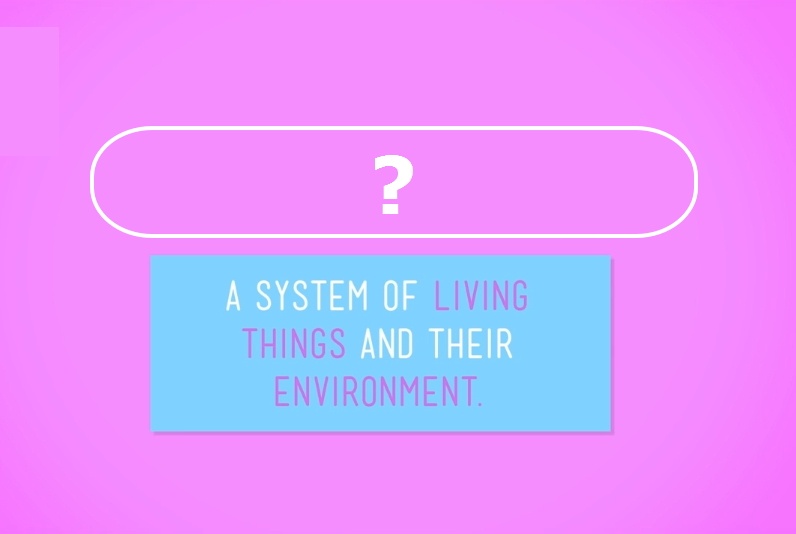
The interaction of living and non-living things in a habitat is called ___
a)
an environment
b)
an ecosystem
c)
a food web
d)
a food chain
54.

The things in an ecosystem are all ___
a)
separate
b)
connected
c)
scattered
d)
unrelated
55.

Spider monkeys eat mostly ___
a)
leaves
b)
toucans
c)
nuts
d)
fruit
56.

What is distributed by spider monkeys as they travel throughout the forest?
a)
whole fruit
b)
fruit seeds
c)
dried leaves
d)
insects
57.
What is distributed by spider monkeys as they travel throughout the forest?
a)
whole fruit
b)
fruit seeds
c)
dried leaves
d)
insects
58.
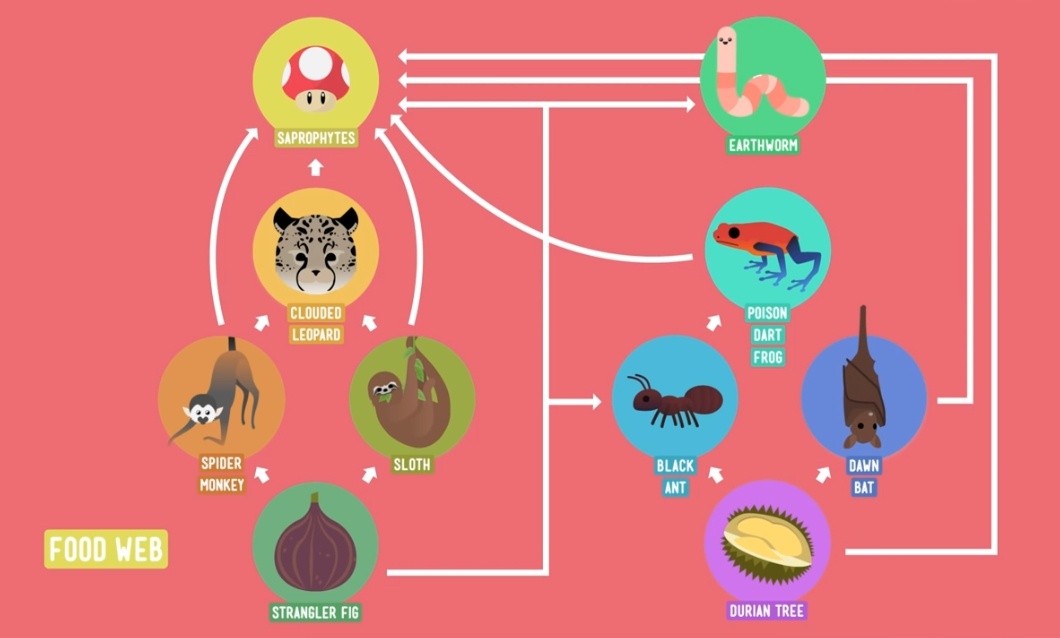
Leopards dine on ___
a)
figs and spider monkeys
b)
sloths and strangler figs
c)
sloths and spider monkeys
d)
ants and bats
59.
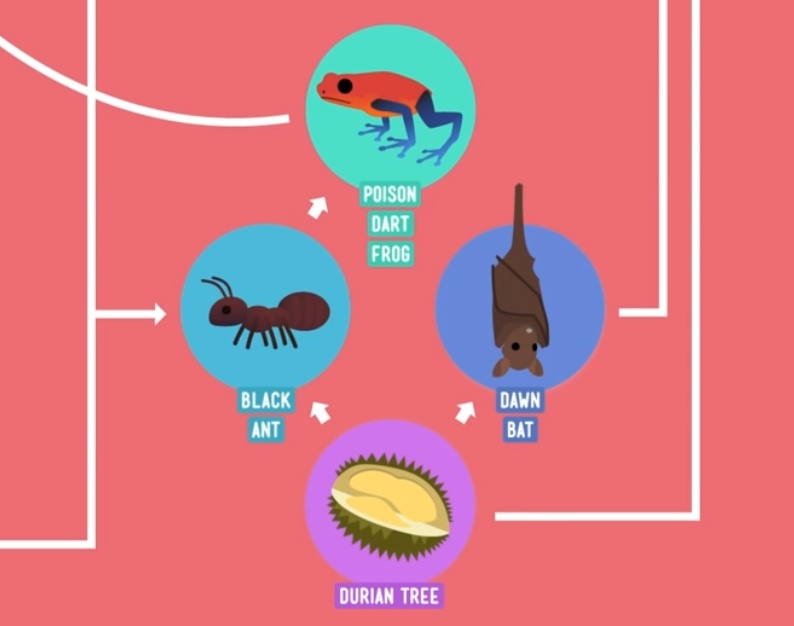
Frogs eat ___
a)
bats
b)
insects
c)
spider monkeys
d)
strangler figs
60.
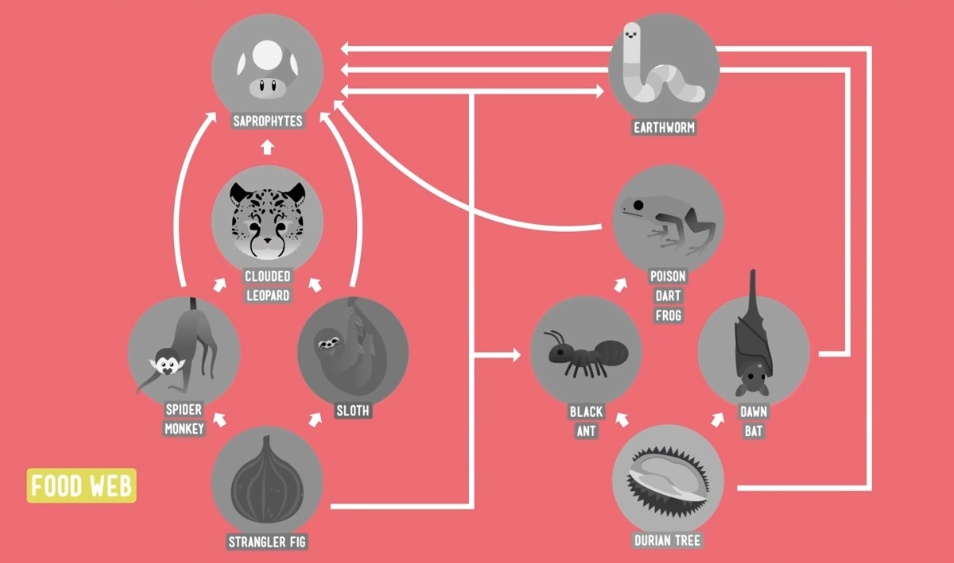
In the example, none of the animals had enough to eat, all because of the loss of ___
a)
one species
b)
two species
c)
three species
d)
several species
61.

In every ___, the plants and animals are connected.
a)
ecosystem
b)
organization
c)
entanglement
d)
spider web
62.

The good news is that ecosystems tend to be ___
a)
in decline
b)
out of balance
c)
delicate
d)
in balance
100 %

