wayground logo

Free Printable Worksheets

NEW

Font size

S
M
L
XL
Worksheets

Q4 Test Review

Total questions: 38

Worksheet time: 19mins

Name
Class
Date
1.
As the thermal energy of a substance increases, its particles spread out and the substance expands.
a)
True
b)
False
2.
Which of the following are kinds of heat transfer.
a)
Conduction
b)
Convection
c)
Radiation
d)
All of the above
3.
The liquid in a thermometer ______________ as the temperature increases.
a)
expands
b)
disappears
c)
freezes
d)
explodes
4.
The most common temperature scale used in the physical sciences where temperatures are 273 degrees more than temperatures on the Celsius scale is called the _______________ scale.
a)
Fahrenheit
b)
Kelvin
c)
Pound
d)
Celsius
5.
Takes two small nuclei and combines them into a larger nucleus
a)
fission
b)
fusion
6.
This is an example of...
a)
Fission  reaction
b)
Fusion reaction
c)
Decomposition reaction
d)
Combustion
7.
What is an advantage  of nuclear energy?
a)
radioactive waste
b)
no air pollution
c)
we will never run out
d)
it is the safest way to make energy
8.
Energy is stored in the ___ of an atom.
a)
proton
b)
neutron
c)
electron cloud
d)
nucleus
9.
Copper, silver, and the human body are examples of 
a)
conductors
b)
insulators
c)
resistors
10.
What type of circuit is this?
a)
series
b)
parallel
11.
The picture shows an electrical circuit. This circuit is a series circuit because: 
a)
It has 3 light bulbs.
b)
The same amount of current flows through all three light bulbs.
c)
It uses a single battery.
d)
Each bulb gets less energy than the one before it.
12.
In a parallel circuit if one of the light bulbs burns out the rest _________.
a)
will become brighter
b)
 will still light up
c)
 will not light up
d)
will burn out due to too much energy
13.

A buildup of electric charges on an object is known as

a)

Electron Clouds

b)

Static Electricity

c)

Resistance

d)

I do not know and do not wish to guess.

14.

An electric current that can reverse the direction in which it flows is known as a/an

a)

direct curent

b)

alternating current

c)

switch-a-roo

d)

I do not know and do not wish to guess.

15.
What do the lines around this magnet represent?
a)
North Pole
b)
South Pole
c)
Magnetic Declination
d)
Magnetic Field
16.
If you cut a magnet in half, what happens to the poles?
a)
One half gets the North Pole, the other half gets the South Pole
b)
Both halves get only a North Pole
c)
Both halves get only a South Pole
d)
Both halves get a North pole and a South Pole
17.
What kind of magnet can be turned on and off?
a)
refridgerator magnet
b)
electromagnet
c)
magnetite
d)
iron
18.
A coil of wire with an electric current in it is called a(n)
a)
A. transformer.
b)
B. electric generator.
c)
C. electric motor.
d)
D. solenoid.
19.

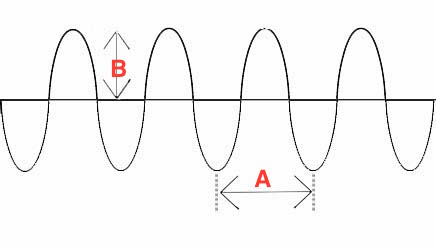
What property of the wave is represented by the letter "A"?

a)

amplitude

b)

crest

c)

trough

d)

wavelength

20.
Which of the following is NOT a mechanical wave?
a)
sound
b)
light
c)
ocean
d)
seismic
21.

The highest point on a wave is:

a)

the crest

b)

the trough

c)

the top

d)

the coast

22.
Which wave has a greater frequency?
a)
A
b)
B
23.

You can't hear sounds in outer space because there is no

a)

medium

b)

light

c)

energy

d)

heat

24.

All waves carry ________ as they travel from one place to another.

a)

matter

b)

space

c)

energy

d)

water

25.
A sound with a high frequency has a _____ pitch. A sound with a ____ frequency has a low pitch.
a)
high, low
b)
low, high
c)
medium, high
d)
high, medium
26.
how high or low a sound is
a)
frequency
b)
volume
c)
vibration
d)
pitch
27.
Why is sound able to travel faster through a solid than a gas?
a)
Gas molecules are packed tightly.
b)
Sound does not travel faster through a solid than a gas.
c)
Solid molecules are packed tightly.
d)
Gas molecules move slowly.
28.
A wave in which the vibration is in the same direction as that in which the wave is traveling; sound waves
a)
longitudinal wave
b)
ocean wave
c)
transverse wave
d)
mechanical wave
29.
The part of a longitudinal wave where the particles of the medium are close together.
a)
rarefaction
b)
compression
c)
crest
d)
trough
30.
Which portion of the electromagnetic spectrum includes the range of light that can be detected by the human eye? 
a)
ultraviolet light
b)
visible light
c)
infrared light
d)
x-rays
31.
Which of the following electromagnetic waves is given off as heat? 
a)
ultraviolet light
b)
x-rays
c)
gamma rays
d)
infrared rays
32.
This color has the shortest wavelength
a)
Indigo
b)
red
c)
Yellow
d)
violet
33.
A sound wave is an example of a 
a)
transverse wave
b)
longitudinal wave
34.

What type of lens creates the image seen in the eyeglasses?

a)

convex

b)

concave

c)

reflection

d)

plane

35.

A lens that is thicker in the middle than on the outside is called ___.

a)

diverging

b)

concave

c)

convex

d)

achromatic

36.
Law of reflection state that - The angle of incidence is .................. to the angle of reflection.
a)
equal
b)
double
c)
half
37.
A tuning fork starts to vibrate when a certain note is played on the piano, This is an example of _______.
a)
resonance
b)
refraction
c)
diffraction
d)
reflection
38.
This image is representing what wave interaction?
a)
Refraction
b)
Diffraction
c)
Reflection
d)
Interference