wayground logo

Free Printable Worksheets

Font size

S
M
L
XL
Worksheets

Byzantine Empire and Islam

Total questions: 106

Worksheet time: 3615secs
Name
Class
Date
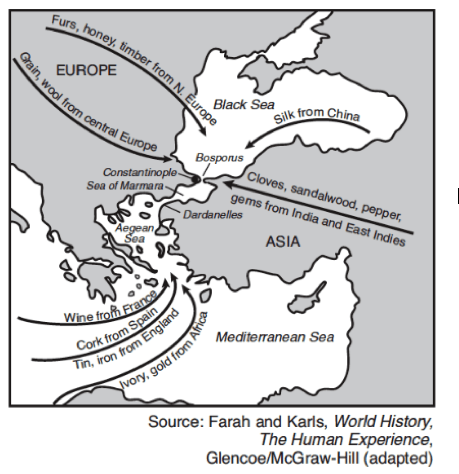
1.

What can you conclude about the city of Constantinople?
a)
Constantinople is a difficult city to travel to
b)
Constantinople is located in Asia.
c)
Constantinople located at the center of major trade routes
d)
Constantinople is on the Mediterranean Sea.
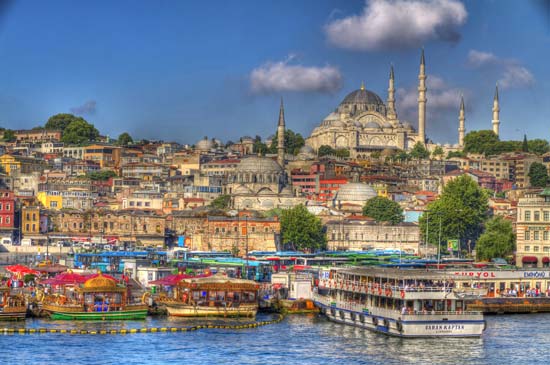
2.
What is this a picture of?
a)
The Hippodrome
b)
The Hagia Sofia
c)
Justinian's Palace
d)
The Forum
3.

What can be assumed about the location of Constantinople?
a)
It would be easy to defend.
b)
It would be easy to conquer.
c)
It would be difficult to travel to.
d)
It would be difficult to defend.
4.
Based on your knowledge of Justinian I what was his opinion of women’s rights?
a)
Women were considered property of their fathers or husbands.
b)
Women should have some rights and could own property
c)
Women who divorced their husbands had no rights.
d)
Women had no rights of guardianship over their children.
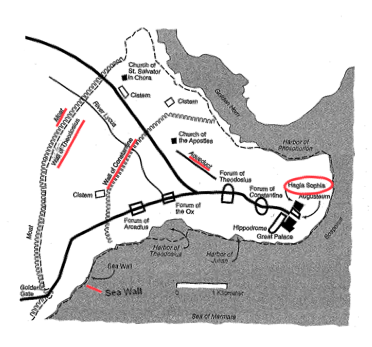
5.

What made Constantinople an easily fortified site?

a)

It was on a peninsula bordered by natural harbors.

b)

It was an island surrounded by the Aegean Sea.

c)

It was located on top of a mountain.

d)

It was in a valley surrounded by mountains.

6.

Which statement best describes the strategic location of Constantinople?

a)

It was located on an island and therefore free from invasions.

b)

It bordered the Mediterranean Sea.

c)

It was close to the city of Rome.

d)

It was located at the crossroads of the Asian and European continents.

7.

The Byzantine Empire preserved the cultural heritage of which empires?

a)

Egypt and Mesopotamia

b)

China and Persia

c)

Greece and Persia

d)

Greece and Rome

8.

Justinian was the ruler of the —

a)

Egyptian Empire

b)

Carthaginian Empire

c)

Byzantine Empire

d)

Persian Empire

9.

One of the greatest contributions of Justinian’s Code was it —

a)

was solely dependent upon Christian principles

b)

included all of Rome’s laws

c)

provided the framework for western law today

d)

improved the status of women

10.

The best reason for Emperor Justinian's codification of Roman law was to —

a)

abolish Roman law and establish a new set of laws

b)

grant Emperor Justinian complete control over his subjects

c)

clarify and change Roman law to better fit Byzantine society

d)

abolish the system of slavery used during the Roman Empire

11.

All of the following were controversies between the Church of Rome and the Byzantine Church EXCEPT —

a)

the language of the Church

b)

the role of women in the Church

c)

the role of the Pope

d)

the religious icons

12.

The major cause of the split between the Roman Catholic Church and the Greek Orthodox Church was the —

a)

belief in the doctrine of the New Testament

b)

use of the Ten Commandments to guide behavior

c)

use of religious icons in church services

d)

belief in one God versus many gods

13.

The split of the Christian church into two churches was known as the —

a)

Crusades

b)

Eastern Split

c)

Roman Crusade

d)

Great Schism

14.

Where was the center of the Eastern Orthodox Church?

a)

Rome

b)

Moscow

c)

Constantinople

d)

Jerusalem

15.

Which language was used by the Byzantine Church?

a)

Italian

b)

Greek

c)

Latin

d)

Russian

16.

The issue that most divided the Church of Rome and the Byzantine Church was the —

a)

role of the Byzantine missionaries

b)

building of the Hagia Sophia

c)

role of the Pope

d)

use of mosaics in Church art

17.

What caused the Schism, the split that divided the Christian religion into the Roman Catholic and Greek Orthodox Churches?

a)

the role of women in the Church

b)

a dispute over the authority of the Pope over icons

c)

the influence of the emperor

d)

the use of private homes as churches

18.

The Schism that split Christianity into the Roman Catholic and Greek Orthodox Churches was caused by disagreement over –

a)

the role of the Pope.

b)

the nature of sin.

c)

petitions by Arabs to live in the Roman Empire.

d)

the value of excommunication.

19.
What is a wet, fertile area in a desert?
a)
Lake
b)
Oasis
c)
Sharia
d)
Hajj
20.
How many times do Muslims pray per day?
a)
1
b)
2
c)
12
d)
5
21.
Which of these is NOT one of the five pillars of Islam?
a)
There is no god but god.
b)
The pilgrimage to Mecca must be made.
c)
Fasting must be done every day.
d)
Donations to charity must be made annually.
22.
What is a major holiday in Muslim culture?
a)
Ramadan
b)
Christmas
c)
Kwanzaa
d)
Hannukah
23.
Why did the followers of Islam spilt into two groups?
a)
They had different beliefs about religion.
b)
They had a disagreement over who should take leadership.
c)
They had a disagreement about the five pillars of Islam.
d)
They ran out of food.
24.
Who created Islam?
a)
Jesus
b)
Moses
c)
God
d)
Muhammad
25.
Where was Muhammad born?
a)
Medina
b)
Mecca
c)
Jerusalem
d)
Baghdad
26.
What is a caravan?
a)
A business
b)
A group of thieves
c)
Trade points
d)
A group of travelers that travel together
27.
What is the holy book of Islam?
a)
Bible
b)
Torah
c)
Qur'an
d)
Quora
28.
What is the Muslim building for prayer?
a)
Church
b)
Synagogue
c)
Mecca
d)
Mosque
29.
Where did Muhammad move?
a)
Medina
b)
Kaaba
c)
Mecca
d)
mosque
30.

The term “caliph” refers to:

a)

a dried up riverbed often used by Arab armies to ambush enemies.

b)

a kind of swift camel used by Arabs.

c)

The book of revelations received by Muhammad.

d)

the successor to the prophet (the person that would lead the Muslims in Muhammad’s absence).
31.
What was the name of the code that unifed Byzantine and western Roman empire?
a)
Hammurabi's Code
b)
Justinian's Code
c)
Theodora's Code
d)
Byzantine's Code
32.
What was the primary language of the Byzantine Empire?
a)
Greek 
b)
Roman
c)
Latin
d)
Turkish
33.
Constantinople served as a center for what two cultures?
a)
Greece and Rome
b)
Persia and Rome
c)
Phoenicia and Rome
d)
Greece and Hebrew
34.
Why was Constantinople such a prosperous city?
a)
Trade hub for Europe, Asia, and Africa
b)
Great architecture 
c)
Autocratic rulers 
d)
The pope lives there
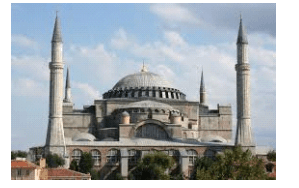
35.
Identify this Byzantine Church that was commissioned by Justinian.
a)
Hagia Sophia
b)
National Cathedral
c)
Notre Dame
d)
Taj Mahal
36.

Which of the following issues divided the Western and Eastern Churches?

a)

practices of animal sacrifices

b)

practices such as scalping

c)

authority of the pope

d)

belief in Jesus

37.

What church was found in the Byzantine Empire?

a)

Eastern Orthodox

b)

Roman Catholic

c)

Lutheran

d)

Methodist

38.
Who was the famous lady that influenced her husband to increase some legal rights of women?
a)
Irene
b)
Theodora
c)
Joan of Arc 
d)
Eleanor of Aquitaine 
39.
Why is Justinian's Code of laws so important today?
a)
It established all rules regarding. taxation.
b)
It established codes regarding the Eastern Orthodox Church.
c)
It established the basis for legal codes in Western World.
d)
It established what entertainment acts were at Hippodrome.
40.
Which groups had the most influence on the government, culture and beliefs of the Byzantine Empire? 
a)
Arians, Huns and Vandals 
b)
Muslims and Persians 
c)
Jews and Visigoths 
d)
Romans, Greeks and Christians 
41.
Which groups had the most influence on the government, culture and beliefs of the Byzantine Empire? 
a)
Arians, Huns and Vandals 
b)
Muslims and Persians 
c)
Jews and Visigoths 
d)
Romans, Greeks and Christians 
42.
What was the capital city of the Byzantine Empire? 
a)
Rome 
b)
Athens 
c)
Constantinople 
d)
Italy 
43.

One economic advantage of naming Constantinople as the capital of the Eastern Roman Empire was that it __________

a)

was surrounded by protective walls.

b)

was a center of religious power.

c)

had shrunk in size.

d)

was located near trade routes between Europe and Asia.

44.

Which group conquered Constantinople?

a)

Persians

b)

Huns

c)

Ottoman Turks

d)

Carthage

45.
Who was the leader of the church in the Byzantine empire?
a)
The pope
b)
The patriarch
c)
The emperor
d)
The people
46.
In 1054, the Eastern Orthodox Church and the Roman Catholic Church formally split. This is a:
a)
Liturgy
b)
Patriarch
c)
Icon
d)
Schism
47.
Why was Constantinople a great site for a capital?
a)
The site was easy to defend as a peninsula. 
b)
It was a crossroads of east and west trade routes. 
c)
It was a walled city. 
d)
All of the above. 
48.
What emperor had the law code re-written and organized?
a)
Charlemagne
b)
Justinian
c)
Theodora
d)
Constantine
49.

The Byzantine Empire is the name we call

a)

The Eastern Roman Empire after the West fell

b)

The Western Roman Empire after the East fell

c)

Constantinople

d)

The Hagia Sophia

50.

What are the similarities between the Roman Catholic and the Eastern Orthodox Church?

a)

Both united the people

b)

Both are monotheistic and worship the same god

c)

Both are forms of Christianity

d)

All of the above

51.
Where did Islam originate?
a)
Arabian peninsula
b)
China
c)
North Africa
d)
India
52.
What holy city are Muslims expected to make a pilgrimage to in their lifetime?
a)
Medina
b)
Mecca
c)
Jerusalem
d)
Damsacus
53.
Where did the Islamic Empire expand?
a)
all around the world
b)
the entire continent of Africa
c)
across Asia and Africa and into Spain
d)
into Australia
54.
Islam is a _______________ religion.
a)
pagan
b)
cult
c)
monotheistic
d)
polytheistic
55.
Who was the founder of Islam?
a)
Muhammad
b)
Moses
c)
Martin Luther
d)
Jesus Christ
56.
What is the Arabic word for God?
a)
Yahweh
b)
Allah
c)
Jesus
d)
Quran
57.
Whereas Christians believe in the Bible and Jesus, Muslims believe in the ___ and ____.
a)
Torah, Moses
b)
Mandate, Confucius
c)
Quran, Muhammad
d)
Umayads, Saladin
58.
What forms the basis of Islamic faith?
a)
Four Noble Truths
b)
Five Pillars
c)
Eightfold path
d)
Three Wise Sayings
59.
Which sect of Islam believes that Caliphs must be related to Muhammad?
a)
Sunni
b)
Shi'ia
c)
Sufi
d)
Ulama
60.
What is a major holiday in Muslim culture?
a)
Ramadan
b)
Christmas
c)
Kwanzaa
d)
Hannukah
61.
Many of the traditions of Islam were influenced by which other religions? 
a)
Hinduism and Judaism
b)
Buddhism and Judaism
c)
Christianity and Judaism
d)
Zoronastrianism and Judaism
62.
During Ramadan Muslims are expected to:
a)
Refrain from almsgiving
b)
Make a pilgrimage to Mecca
c)
Fast from sunrise to sunset
d)
All of the above
63.
What is the name of the holy book of Islam?
a)
Bible
b)
Torah
c)
Qu'ran 
d)
Sunna
64.
What city do Muslims need to face when they pray?
a)
Timbuktu
b)
Mecca
c)
Rome
d)
Sumer
65.
What is the Islamic house of worship called?
a)
church
b)
mosque
c)
temple
d)
synagogue
66.
1.  After the death of Muhammad, what led to the split between the Sunni and Shia? 
a)
They could not agree on who should become leader.
b)
They could not agree if they were allowed to eat pork.
c)
They could not agree on how many times they should pray each day.
d)
They could not agree on how to make Greek fire.
67.
Like Christians and Jews, the Islamic religion is -
a)
monotheistic
b)
polytheistic
c)
nontheistic 
68.
Muslims beliefs are centered around the -
a)
Five Pillars
b)
Eightfold Path
c)
Ramadan
69.
Which of the following is NOT one of the 5 Pillars of Islam?
a)
Holy wars against Christians
b)
Allah is the one God
c)
Give money to the poor
d)
Fast during Ramadan
70.
Which of the following IS one of the Five Pillars of Islam?
a)
Pray five times a day facing Mecca
b)
Muhammad is a god to be worshipped
c)
Make a pilgrimage to Jerusalem
71.
Islam spread through all of the following methods except -
a)
Skillful Arab fighters conquering new lands
b)
Peaceful Muslim traders traveling to new lands
c)
Muslim priests forcing people to convert
72.
One of the Five Pillars of Faith is prayer ______ times daily facing Mecca.
a)
1
b)
10
c)
3
d)
5
73.
One of the Five Pillars of Faith is give money to the ________.
a)
church
b)
poor
c)
true believers
d)
descendants of Muhammad
74.
One of the Five Pillars of Faith is to take a pilgrimage to Mecca, which is called a ______.
a)
hajj
b)
medina
c)
Ramadan
d)
Muhammad's walk
75.
Islam spread quickly to Asia, North Africa, and ports along the Mediterranean Sea through
a)
trade and military conquest
b)
the sharing of Muhammad's teachings by his apostles
c)
Christians being forced to convert
d)
missionaries sent by the Byzantine emperor
76.

Which of the following is the central teaching of Islam?

a)

Allah will grant life in paradise to all who obey him

b)

Allah is the only God and Muhammad is his prophet

c)

On the final day, Allah will judge all people

d)

Muslims must wash before praying to be pure before Allah

77.

Where did Islam originate?

a)

The Arabian Peninsula

b)

The Balkan Peninsula

c)

The Italian Peninsula

78.

What is essential to Islam?

a)

The 5 pillars

b)

The 4 noble truths

c)

The 3 Desk tops

d)

Ten Commandments

79.

-Faith

-Prayer

-Charity

-Fasting

-Pilgrimage


What is being described?

a)

Eightfold Path

b)

Five Pillars of Islam

c)

Four Nobel Truths

d)

Ten Commandments

80.

The followers of Islam are divided into two groups, Shia and Sunni. What makes them different?

a)

They are located in different areas of Saudi Arabia

b)

They disagreed on who should lead Islam after Muhammad died

c)

The Shia follow the 5 Pillars of Islam, while the Sunni do not

d)

The Sunni honor the holy month of Ramadan, while the Shia do not

81.

In what area did Muslim scholars make advancements?

a)

algebra

b)

aqueducts

c)

alphabets

d)

anatomy

82.

How is the Qur'an similar to the Bible and the Torah?

a)

It describes guidelines for moral behavior of its followers

b)

It states that Islam is the only true monotheistic religion

c)

It prohibits the sale and ownership of slaves in Arabia

d)

It describes the life and achievements of Muhammad

83.

Why do geographers refer to the Arabian Peninsula as a "crossroads" location?

a)

It is a vast desert that is occupied by few people

b)

It is an intersection of trade routes between three continents

c)

It is located between two major rivers

d)

It straddles the Bosporus Strait

84.

What is the holy month of Islam called?

a)

Qur'an

b)

Ramadan

c)

Hajj

d)

Zakat

85.

How are the Five Pillars of Islam and the Ten Commandments similar?

a)

Both support the belief of reincarnation

b)

Both provide a guide to moral and ethical behavior

c)

Both encouraged the worship of many gods

d)

Both promoted the ownership of slaves

86.

Which of the following was a major contribution of Islamic culture to western civilization?

a)

development of the first writing system

b)

creation of the first monotheistic relgion

c)

created representative democratic government

d)

advancement of mathematics and science

87.
This is a group of traders that traveled together.
a)
Pilgramage
b)
Oasis
c)
Caravan
d)
Salesman
88.
A follower of Islam is called a???
a)
Christian
b)
Jew
c)
Jihad
d)
Muslim
89.

The main point of disagreement between Sunnis and Shias is

a)

Whether the Qu'ran should be the holy text of Islam

b)

The use of the 5 pillars as major tenets of Islam

c)

Whether caliphs need to be descendants of Muhammad (through Ali) or not

d)

Whether Allah is the only and true God

90.

Why did Arabia become important place for trade?

a)

Two major rivers came together there

b)

It had fertile farmland

c)

It connected Asia, Africa, and Europe

d)

It was in the central Nile Valley

91.

Which statement describes the Arabian Peninsula?

a)

The Arabian Peninsula receives an abundance of rain each year

b)

Most early inhabitants of the Arabian Peninsula made a living through farming.

c)

No cities were developed in the Arabian Peninsula

d)

Almost all of the Arabian Peninsula is a desert.

92.

On what belief did Muhammad base the religion of Islam?

a)

The belief that there were many gods

b)

The belief that conquered people should convert to Islam

c)

The belief that there is only one God

d)

The belief that all Muslims had to worship in Mecca

93.

Shia Muslims believed that Caliph Succession should be...

a)

traced to the roots of Abraham.

b)

awarded to the most qualified candidate.

c)

continued on by blood relatives of Muhammad.

d)

chosen by a lottery.

94.

Sunni Muslims believed that Caliph Succession should be...

a)

given to the most qualified candidate.

b)

a blood relative of Muhammad.

c)

chosen by lottery.

d)

traced to the tribe of Abraham.

95.
What is a mosaic?
a)
Gold Statue
b)
Art created with pieces of glass or stone
c)
Humanist artwork
d)
Type of Column
96.
What is a pilgrimage?
a)
a journey to a holy site
b)
A trip to a favorite spot.
c)
A journey to the other side of the world.
d)
The medicine that has super healing powers.
97.

{HOW?} Which of the following choices is NOT a reason why Islam spread so fast and caused a Golden Age where it started (in Arabia & Persia)?

a)

Commerce & Trade

b)

Powerful Military

c)

Tolerance of Jews & Christians if they paid the Jizya tax

d)

Belief in many gods (polytheism)

98.

True or False? Islam is a monotheistic religion, meaning Muslims (followers of Islam) believe in one God (Allah).

a)

True

b)

False

99.

ASTRONOMY: What invention allowed Muslim scientists to measure one's position on the planet as well as the position of various stars in the universe?

a)

Astrolabe

b)

Compass

c)

Seismometer

d)

Steel

100.

Calligraphy describes the art of beautiful ___________________.

a)

Handwriting

b)

Bookbinding

c)

Map-making

d)

Pottery-making

101.

Mathematics: The word ______________ has an Arabic word root.

a)

Algebra

b)

Mathematics

c)

Geometry

d)

Optometry

102.

Although a powerful military is often required for a Golden Age to begin, the achievements of a Golden Age are overwhelmingly ________________.

a)

Peaceful, Artistic, & Scientific

b)

Warlike

c)

Useless to the Modern World

d)

Artistic, but not Scientific

103.
Unlike the emperor of the western empire, the Byzantine emperor
a)
was elected by a council of citizens.
b)
held only ceremonial powers and not political power
c)
was the head of the church as well as the political ruler
d)
worked in partnership with the pope
104.
What role did Constantinople's location play in its development?
a)
Being located between two seas protected it from attack and offered the perfect spot to control trade between Europe and Asia
b)
The city was cut off from the Roman Empire and therefore never grew
c)
Without fertile cropland nearby, the city could not support a large population.
d)
It was surrounded by water and therefore very difficult to defend.
105.
Which event marked the end of the 1,000-year history of the eastern Roman Empire?
a)
the death of Constantine
b)
Constantinople conquered by the Ottoman Turks
c)
the renaming of Constantinople to Istanbul
d)
the writing of the Justinianic Code
106.

How were Jews and Christians treated by Muslims?

a)

as equals

b)

they were forced to convert

c)

They were allowed to practice their own religion but had to pay a special tax.

d)

They were forced to move out of the area.