wayground logo

Free Printable Worksheets

NEW

Font size

S
M
L
XL
Worksheets

Earth Science Spring EOC review

Total questions: 80

Worksheet time: 57mins

Name
Class
Date
1.
Upwelling is most likely to occur in what area?
a)
in a deep sea trench
b)
in a shallow gulf
c)
along a coastline
d)
in open ocean
2.
Seawater is typically denser than freshwater due to seawaters-
a)
greater depth
b)
smaller mass
c)
higher salinity
d)
lower freezing point
3.
What part of the ocean floor would be the most difficult to explore due to pressure?
a)
continental slope
b)
sea mount
c)
trench
d)
abyssal plain
4.
What major feature of the ocean floor circumnavigates the Earth?
a)
mid oceanic ridge
b)
continental slope
c)
trench
d)
sea mount
5.
A trench is formed at what zone?
a)
subduction
b)
divergent
c)
convergent
d)
strike-slip
6.
What first accurately mapped the ocean floor?
a)
The Spanish armada
b)
Chinese army
c)
Magellan
d)
sonar
7.
An estuary is an area where-
a)
there is only fresh water
b)
there is only salt water
c)
pond water and river water mix
d)
fresh water and salt water mix
8.
The ocean floor 
a)
is always a flat bed of sand 
b)
has mountains, plains, and ridges like land surfaces
c)
is covered by the same amount of water everywhere
d)
covers less area than land
9.
The Gulf Stream is 
a)
a stream behind the school 
b)
a current in the Atlantic Ocean that flows on the eastern coast of North America 
c)
a boat 
d)
part of the ocean floor 
10.
What causes the tides to change?
a)
rotation of the Earth
b)
magic
c)
gravitational pull from the moon
d)
ocean currents
11.
What do the arrows represent in the picture?
a)
waves
b)
currents
c)
tides
12.
Which of these increases as a submarine dives deeper into the ocean?
a)
The number of plants in the water
b)
the freshness of the water
c)
the water temperature
d)
the water pressure
13.
What causes surface currents to move in circular paths?
a)
strong winds
b)
the Coriolis effect
c)
salinity
d)
the Global Ocean Conveyor
14.
Deep currents are caused by differences in the _______________ ocean water.
a)
 eutrophication of
b)
sun's effect on
c)
density of
d)
 salinity of 
15.
The effect of Earth’s rotation on the direction of winds and currents is called the _______________ .
a)
La Niña
b)
 El Niño
c)
Coriolis effect
d)
Currents
16.
Which of the following is caused by differences in ocean water density?
a)
surface currents
b)
 deep currents
c)
waves
d)
Coriolis effect
17.
Upwelling is associated with
a)
a decrease in access to nutrients for phytoplankton
b)
cooler, nutrient-rich waters being pushed up from deeper ocean waters
c)
temperature gradients moving water from the equator to the poles
d)
an increase in human fatalities
18.
Warm ocean currents generally come from
a)
The North Pole
b)
The South Pole
c)
The Equator
d)
Both A and B
19.
A measure of how much mass is contained in a given unit of volume (=mass/volume) is called:
a)
salinity
b)
density
c)
current
d)
thermohaline
20.
A horizontal movement of ocean water that is caused by wind and that occurs at or near the ocean’s surface is called:
a)
ocean current
b)
deep current
c)
convection current
d)
surface current
21.
What three things affect surface currents?
a)
coriolis effect, deep currents, upwelling
b)
upwelling, continental deflections, salinity
c)
coriolis effect, continental deflections, global winds
d)
global winds, the equator, deep currents
22.
How do deep currents form?
a)
Changes in density (salinity and temp.) cause surface water to be less dense and sink
b)
Changes in surface winds cause surface water to be more dense and sink
c)
Changes in density (salinity and temp.) cause surface water to be more dense and sink
d)
Changes in density (salinity and temp.) cause surface water to be more dense and rise
23.
Explain the importance of upwelling to ocean life.
a)
brings nutrients from the deep ocean to the surface
b)
it allows animals to find new homes
c)
causes density changes that circulate temperature
d)
brings nutrients from the surface to the deep ocean
24.
What happens to particles as they are heated?
a)
move faster and farther apart
b)
become more dense
c)
more slower and closer together
d)
they sink
25.
How do salinity and temperature affect the density of ocean water?
a)
salinity increase = density increase, temp decrease = density increase
b)
salinity decrease = density increase, temp. decrease = density decrease
c)
salinity increase = density increase, temp increase = density increase
d)
salinity decrease = density increase, temp increase = density increase 
26.
What weather instrument is this?
a)
Radar
b)
weather satellite
c)
barometer
d)
anemometer
27.
At which humidity is it more likely to rain?
a)
50%
b)
20%
c)
77%
d)
99%
28.
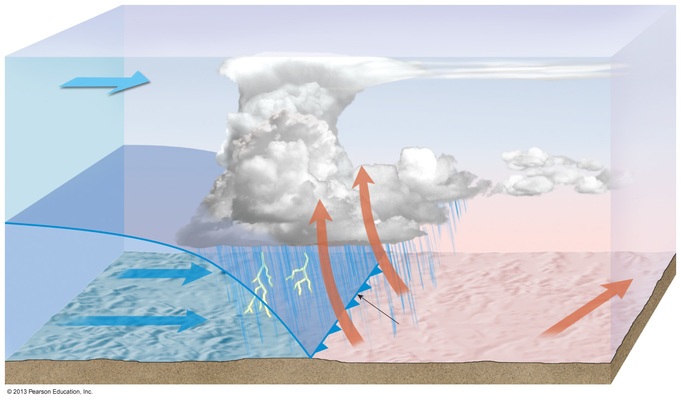
What type of storm front is this? 
a)
warm front
b)
cold front
c)
stationary front
d)
occluded front
29.
A severe storm that involves strong winds and forms over warm water is:
a)
tornado
b)
thunderstorm
c)
hurricane
d)
blizzard
30.
A severe storm which involves a funnel cloud forming from a cumulonimbus cloud:
a)
hurricane
b)
tornado
c)
thunderstorm
d)
blizzard
31.
What is the most abundant gas found in the atmosphere?
a)
Carbon Dioxide
b)
Nitrogen
c)
Oxygen
d)
Water Vapor
32.
Humidity is the...
a)
Amount of Water Vapor in the Air
b)
Amount of Wind in the Air
c)
Amount of Precipitation in the Air
d)
Amount of Pressure in the Air
33.
Warm air near the Earth’s surface rises and then cools and drops, this creates a _________________ in the atmosphere.
a)
run-off
b)
Greenhouse Effect
c)
convection current
d)
water cylce
34.
Because the earth is spinning on its axis, the global winds appear to curve. This is known as the __________ ________.
a)
Coriolis Effect
b)
Greenhouse Effect
c)
Climate Effect
d)
Atmosphere Effect
35.
What kind of weather is usually associated with a low pressure system?
a)
Sunny weather
b)
Precipitation (rain, snow, etc.)
36.
What kind of weather is usually associated with a high pressure system?
a)
Sunny weather
b)
Precipitation (rain, snow, etc.)
37.
What layer does weather occur in?
a)
mesosphere
b)
troposphere
c)
thermosphere
d)
stratosphere
38.
Where is the ozone layer located?
a)
Thermosphere
b)
Troposphere
c)
Stratosphere
d)
Mesosphere
39.
What characteristic do all renewable resources share?
a)
Produced by waste products
b)
Form underground from dead organisms.
c)
Replaced in a short period of time
d)
Allow energy to pass through them easily
40.
Which of the following is a fossil fuel?
a)
Wind
b)
Coal
c)
Solar
d)
Biomass
41.
Petroleum and natural gas form from...
a)
strong winds
b)
cooled magma
c)
radioactive materials
d)
remains of plants and animals 
42.
Hydroelectric power produces electricity using.....
a)
Wind
b)
Sunlight
c)
Moving water
d)
Dung
43.
 Energy from the sun is known as......... 
a)
hydroelectric energy
b)
geothermal energy
c)
solar energy
d)
wind energy
44.
The type of energy that cattle create is ________? 
a)
biomass
b)
solar
c)
natural gas
d)
nuclear
45.
What are two advantages of geothermal energy?
a)
cheap and a lot pollution
b)
expensive and a lot of pollution
c)
cheap and little pollution
d)
expensive and little pollution
46.
Wind energy 
a)
is less expensive than fossil fuels
b)
is difficult to utilize in areas with low wind availability
c)
is a renewable source of energy
d)
utilizes small or large areas of land not previously used
47.
Which is an advantage of installing solar panels?
a)
Reduced amount of air polllution
b)
High cost to install
c)
Number of cloudy days
d)
Use of nonrenewable resources
48.
Oil, Natural Gas, Nuclear, Coal - What do these items have in common?
a)
They are examples of inexhaustible energy resources.
b)
They are examples of renewable energy resources.
c)
They are examples of energy resources that do not cause pollution.
d)
They are examples of nonrenewable energy resources.
49.
Based on the data collected, which source of alternative energy is most efficient?
a)
Coal
b)
Wind
c)
Natural gas
d)
Solar
50.
The sun's rays are least direct
a)
near the poles
b)
near the equator
c)
at high altitude
d)
far from the ocean
51.
Increased carbon dioxide may cause global warming by trapping more ____________ in the atmosphere.
a)
water
b)
gases
c)
heat
d)
water vapor
52.
Scientists observe the thickness of a tree's _________ to learn about past climate conditions.
a)
rings
b)
branches
c)
roots
d)
bark
53.
Some scientists theorize that continental movements may cause climate changes by
a)
changing patterns of winds and ocean currents
b)
shifting the equatorial and temperate zones
c)
altering the makeup of the troposphere
d)
redistributing Earth's vegetation
54.

Which zones are polar zones?

a)

Zones A and B

b)

Zones A and E

c)

Zones E and D

d)

Zones A, E, and C

55.

What is the direct cause of rising sea levels?

a)

Melting Sea Ice

b)

Melting Land Ice

c)

Climate Change

56.

Melting land ice...

a)

causes sea levels to rise because it adds water to the ocean.

b)

does not cause sea levels to rise because the water fills the space left by the melted sea ice.

57.
Which of the following is the best conclusion that can be made from this graph?
a)
atmospheric carbon dioxide levels have been decreasing since 1960
b)
Hawaii has a lot of carbon dioxide
c)
humans have been working hard to decrease carbon dioxide levels
d)
atmospheric carbon dioxide levels have increased steadily since 1960
58.

Which of the following have been changed or altered due to climate change ?

a)

droughts

b)

flooding

c)

melting of polar ice caps

d)

all of the above

59.

The main human activity that releases greenhouse gases is

a)

using public transportation and there by reduce the affects of greenhouse gases.

b)

burning fossil fuels

c)

texting on cellphones

d)

eating meat

60.

Which of the following is contributing to an INCREASE in carbon dioxide in the atmosphere?

a)

deforestation

b)

photosynthesis

c)

oceans

d)

all of the above

e)

the loss of animal species

61.
What gas from the list below is a cause for global warming?
a)
Urethane
b)
Oxygen
c)
Carbon Dioxide
62.
Which natural process removes carbon dioxide from the atmosphere?
a)
forest fires
b)
volcanic eruptions
c)
cellular respiration
d)
photosynthesis
63.
How does the concentration of carbon dioxide in the atmosphere affect climate?
a)
As carbon dioxide concentrations increase, temperatures increase
b)
As carbon dioxide concentration increase, temperatures decrease.
c)
Carbon dioxide concentrations have no affect on climate
d)
As carbon dioxide concentrations increase, temperatures become more random.
64.
El Nino occurs when the tropical ocean waters are warmer in which ocean?
a)
Atlantic
b)
Indian
c)
Pacific
d)
Arctic
65.

During a(n) ____ event, trade winds are much stronger than usual.

a)

El Nino

b)

La Nina

c)

Normal

d)

Partly sunny

66.

During an El Nino, trade winds are typically...

a)

about average

b)

stronger

c)

weaker

67.
Which best explains why El Niño could cause an increase in precipitation in California?
a)
Which best explains why El Niño could cause an increase in precipitation in California?
b)
Warmer ocean water allows for warm air to be blown toward the United States and cause droughts.
c)
Cooler ocean water causes the air to cool, and brings high air pressure to the United States.
d)
Warmer ocean water allows for warmer, wet air to travel east toward the United States.
68.
One consequence of El Nino is _______ on the US West Coast
a)
stronger Tradewinds
b)
flooding
c)
strong winter storms
d)
drought
69.
Ocean acidification begins with 
a)
pollution from ships
b)
carbon dioxide released from combustion
c)
dumping of waste from cities into the ocean
70.
Carbon dioxide and seawater combine to form
a)
calcium carbonate
b)
carbon monoxide
c)
carbonic acid 
71.
Marine organisms make their shells from calcium and
a)
chloride
b)
carbonate
c)
seawater
72.

What do some marine creatures do with the carbonate ion?

a)

use it as a food source

b)

use it as a defense mechanism

c)

use it to build shells and exoskeletons

d)

use it to cool body temperatures

73.

Ocean acidification can..

a)

help shellfish

b)

dissolve plastic

c)

cause coral acidification

d)

make it rain more often

74.

Winds blowing across the surface of the oceans and seas cause them to move in ripples called ________

a)

tides

b)

waves

c)

current

d)

motion

75.

Water with intermediate salinity, such as the water you would find in an estuary is called

a)

haline

b)

brackish

c)

fresh

d)

saline

76.
The ocean usually looks blue because
a)
the sky is blue.
b)
blue light has a low frequency
c)
blue light is reflected from the water
d)
 blue light is absorbed near the surface
77.
The salinity of ocean water is about 
a)
35 parts per thousand
b)
3.5 parts per thousand
c)
0.35 percent
d)
35 percent
78.
The transmission of sound by water can best be described by which of the following statement:
a)
It is more efficient than transmission by air
b)
Sound does not travel in water - a property known as incompressibility
c)
It is the same as by air.
d)
It is inefficient as compared with transmission by air.
79.
The ocean is slow to heat and slow to cool. This is related to a property of water known as
a)
boiling point.
b)
residence time.
c)
density.
d)
heat capacity.
80.
The ocean's deep sound channel (sofar layer) is characterized as a zone in which
a)
sound is horizontally concentrated rather than diffused as it moves through the water
b)
acoustical energy losses are relatively large.
c)
sound velocity is at a maximum.
d)
light waves travel great horizontal distances.