Wayground logo

Free Printable Worksheets

Font size

S
M
L
XL
Worksheets

Tectonic Plates!

Total questions: 50

Worksheet time: 41mins

Name
Class
Date
1.

The long tube in the ground that connects the magma chamber to Earth's surface is called the _____________.

a)

Crater

b)

Pipe

c)

Vent

d)

Magma Chamber

2.

Once magma reaches the Earth's surface it is called.......

a)

Silica

b)

Lava

c)

Rock

d)

Molten

3.

What provides the force that causes a volcano to become explosive?

a)

Mafic flows

b)

Magma density

c)

Dissolved gases trapped in magma

d)

Extreme heat

4.

Describe the most likely relationship between these mountains and nearby tectonic plates.

a)

The mountains are probably formed by earthquakes

b)

The mountains are probably formed by the movement of glaciers

c)

The mountains are probably located near the edge of 2 tectonic plates.

d)

The mountains are probably formed by running water.

5.

Is there a pattern to the locations of earthquakes and volcanoes around the globe?

a)

No, earthquakes and volcanoes are random.

b)

Yes, earthquakes and volcanoes usually occur near the boundaries of tectonic plates.

c)

yes, earthquakes and volcanoes usually occur in the middle of tectonic plates.

d)

No, earthquakes and volcanoes usually occur under water.

6.

Most earthquakes tend to occur at which location?

a)

The central regions of very large continents

b)

Groups of islands farthest from any continents

c)

The boundaries between continents and oceans

d)

The steep slopes of the very oldest mountains

7.
Name the boundary
a)
divergent
b)
convergent
c)
transform
d)
sergent
8.
Name this boundary
a)
Convergent
b)
Divergent
c)
Transform
d)
Sergent
9.
Name the boundary
a)
convergent
b)
transform
c)
divergent
d)
sergent
10.
Which of the following is where one plate slides under another plate?
a)
submarine zone
b)
divergence zone
c)
subduction zone
d)
lower zone
11.
Which of the following is associated with transform boundary?
a)
volcanoes
b)
mountains
c)
trenches
d)
earthquakes and fault line
12.
Mountains form from....
a)
Plates sliding past one another
b)
collision of plates
c)
plates moving away from each other
d)
none of these
13.
Oceanic crust is.....
a)
Younger and less dense than continental crust
b)
Thinner, younger, and more dense than continental crust
c)
older, thicker, and less dense than continental crust
d)
Bigger and younger than continental crust
14.
Earth's plates are....
a)
Constantly moving and changing the face of the Earth
b)
Never moved
c)
Move seldom and very fast
d)
move when they feel like it
15.
What was the name given to all the continents when they were joined as one super continent?
a)
Supreme Continent
b)
Eurasia
c)
Plate tectonics
d)
Pangea
16.
Plate movement is caused by _____
a)
The rotation of the Earth
b)
Ocean tides
c)
Convection current in the mantle
d)
The moon's gravity
17.
According to scientists, both Earth and moon are...
a)
About 1.6 Billion Years Old
b)
About 4.6 Billion Years Old
c)
About 9.6 Billion Years Old
d)
About 14 Billion Years Old
18.
After water vapor condensed to form rain and then gradually accumulated, which of the following was formed?
a)
Earth's First Atmosphere
b)
Earth's Second Atmosphere
c)
Earth's Oceans
d)
Earth's Continents
19.
Which of the following is not an important part of Earth's second atmosphere?
a)
Helium
b)
Oxygen
c)
Water Vapor
d)
Carbon Dioxide
20.
The earliest form of life known on Earth was...
a)
Leafy Plants
b)
Bacteria
c)
Fossils
d)
Single-Celled Organisms
21.
According to scientists, Earth began as a ball of dust, rock, and __________.
a)
Ice
b)
Gases
22.
___________ pulled this mass together
a)
Gravity
b)
Big Bang Theory
23.
An environment that is lacking in free oxygen is called:
a)
Oxic
b)
Anoxic
c)
Aerobic
d)
Anerobic
24.
What are stromatolites made of?
a)
fossils
b)
rock
c)
cyanobacteria
d)
mud
25.
how is igneous rock formed?
a)
fossilized bone
b)
from outer space
c)
cooling molten rock
26.
What was the first life on Earth?
a)
prokaryotic cells
b)
Archaea
c)
microbes
d)
nucleotide 
27.
How was early  Earth like?
a)
Earth was HUGE.
b)
It had a mild climate.
c)
It had extremely low temperatures. 
d)
It had extremely high temperatures .
28.
Why was Archaea the first life on Earth? 
a)
Because it can withstand the cold temperatures on Earth.
b)
Because it could withstand the hot temperatures on Earth.
c)
Because Arachaea usually lives in lava.
d)
Because an asteroid that contained Archaea hit early Earth. 
29.
Where do scientists usually get their evidence from when talking about this topic?
a)
They don't have evidence, therefore they just make educated guesses.
b)
They usually get their evidence from fossils.
c)
They get their evidence from looking at animals.
d)
They get their evidence from the internet ONLY.
30.
A radioisotope's _________________ is the time it takes for one half of the mass of the radioisotope to change into another substance.
a)
half-twist
b)
day-life
c)
half-life
d)
change over
31.
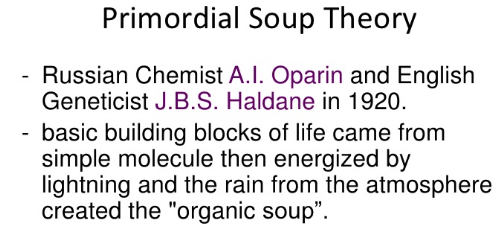
The idea that Earth's early oceans had organic molecules that became the first life is called.
a)
primordial soup
b)
bubble hypothesis
c)
Miller-Urey Experiment
d)
radioactive dating theory
32.
The first eukaryotic cells are more likely to have evolved from ______________ than eubactria (true bacteria).
a)
exocytosis
b)
endosymbiosis
c)
organelles
d)
Archaebacteria
33.
Which type of cell came first?
a)
Eukaryotic
b)
Prokaryotic
c)
Plant
d)
Both Eukaryotic and Prokaryotic cells evolved around the same time
34.

Which of the following was probably not present in the atmosphere of the primitive Earth?

a)

Methane

b)

Oxygen

c)

Water

d)

Carbon dioxide

35.
What gas were we missing in Earth's early atmosphere?
a)
carbon dioxide
b)
oxygen
c)
water vapor
d)
sulfur oxides
36.
Which statement best describes conditions on early Earth?
a)
hot with volcanic activity and electrical storms
b)
dry land covered with volcanic dust
c)
cold oceans
d)
dark and dusty with abundant water
37.

After water vapor condensed to form rain and then gradually accumulated, which of the following was formed?

a)

Earth's First Atmosphere

b)

Earth's Second Atmosphere

c)

Earth's Oceans

d)

Earth's Continents

38.
Which of the following is NOT an example of a fossil?
a)
a petrified dinosaur bone
b)
a footprint captured in mud
c)
a seashell found on the beach
d)
an insect stuck in amber
39.
Which of the following is NOT something you could learn from a fossil?
a)
The size of the animal
b)
What the animal ate
c)
The color of the animal
d)
Where the animal lived
40.
In which kind of rock do we usually find a fossil?
a)
sedimentary  rock
b)
metamorphic rock
c)
igneous rock
41.
In order for a fossil to form, which of the following events must happen FIRST?
a)
Slowly, minerals in the water replace the bone.
b)
Sediment covers the bone.
c)
An animal dies.
d)
The bone is no longer a bone, but a rock copy.
42.
Why don't we know what many ancient plants looked like? 
a)
They had too many soft parts.
b)
They were all eaten by dinosaurs.
c)
There weren't ancient plants.
d)
They had too many hard parts.
43.

How are fossils created?

a)

Traces of organisms get turned into stone.

b)

Dead organisms are quickly buried for millions of years.

c)

Animals get trapped.

d)

All of the above

44.
Which layer formed first?
a)
Rock Layer W
b)
Rock Layer X
c)
Rock Layer Y
d)
Rock Layer Z
45.

What does Ms Tenedora do after school? (2 answers)

a)

Bake cookies

b)

Learn how to code

c)

Train for boxing competitions

d)

Study for Masters Degree

46.

What are the names of Ms Tenedora's dogs?

a)

Timone and Pumba

b)

Jafar and Iago

c)

Jeep and Ted

d)

Hakuna and Matata

47.

What is an astronauts favourite key on a keyboard?

a)

Letter "a"

b)

Letter "z"

c)

Space bar

d)

Shift key

48.

How does the ocean say hello?

a)

"Hola!"

b)

It dances

c)

It waves

d)

"Yo!"

49.

A neutron walks into a cafe and asks how much for a coffee. The barista replies:

a)

"For you, $2"

b)

"For you, $50"

c)

"For you, it's free."

d)

"For you, no charge!"

50.

What's special about plankton

a)

They proliferate to help the climate of the planet

b)

The plankton use CO2 from the atmosphere to grow

c)

When they come together, they can be seen from space

d)

All of the above