
Font size
 Worksheets
Transport in plants !
Total questions: 38
Worksheet time: 27mins
The green substance in plant that makes it possible for them to make food from sunlight, carbon dioxide, and water
Xylem
Phloem
Chlorophyll
Lignin
Vascular tissue that forms tubes that transport dissolves food throughout a plant
Nonvascular plant
Xylem
Phloem
Root hair
Process by which plants capture sunlight to use its energy to transform carbon dioxide and water into glucose and oxygen
Transpiration
Photosyntesis
Respiration
The_____________________absorbs nutrients from the ground.
Leaves
Roots
Stem

WHAT’S THE NAME OF THE LITTLE PORES WHERE THE GASSES ARE EXCHANGED?
Chloroplast
Stomata
cell vacuoles
chloroplasts
phloem
xylem

The diagram shows part of a cross section through a leaf. Which arrow shows the direction of water during transpiration?
A
B
C
D


Select the correct term for the following definition:
"The water transport system in plants."
Guard cells
Phloem
Xylem
Select which of the following statements are true for xylem. (multiple options)
Tubular shape with no end walls.
Transportation of food and nutrients.
Elongated, tubular shape with thin walled sieve tubes.
Occupy the center of the vascular bundle.
Water and mineral transport from roots to other parts of the plant.
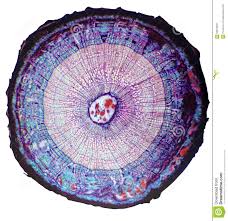
Recall what substance is used to thicken and strengthen xylem walls in woody plants.
Protein
Mineral ions
Lignin
Glucose

Select the correct term for the following definition:
"The nutrient transport system in plants."
Xylem
Guard cells
Phloem
Select which of the following statements are true for phloem. (multiple options)
Translocation (up and down stem).
Elongated, tubular shape with thin walled sieve tubes.
Transportation of sucrose and nutrients.
Made up of dead cells.
Water and mineral transport from roots to other parts of the plant.

Recall which of the following form part of the phloem. (multiple options)
Sieve-tube elements
Trachieds
Vessels
Companion cells
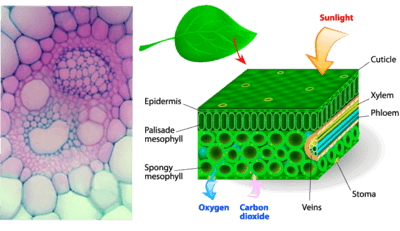
Recall that the movement of food in the phloem is called.
Translocation
Transpiration stream
Evaporation
Respiration

The diagram shows the internal structure of a leaf.
Which region contains cells that are responsible for the transport of manufactured food?
A
B
C
D
Are phloem cells alive or dead?
Alive
Dead
Where does sugar transport begin?
Roots
Leaves
Root hairs
Vascular bundles
increase
decrease
not change
What is DIFFUSION?


The openings on the surface of the leaf are called (a) . (lower case letters)
Xylem vessels...
contain no cytoplasm
contain no nuclei
contain no cytoplasm or nuclei
contain cytoplasm and nuclei
Companion cells are found along with sieve tube elements in the phloem.
FALSE
TRUE
Water moves into a root hair by...
diffusion and active transport
active transport
osmosis
diffusion
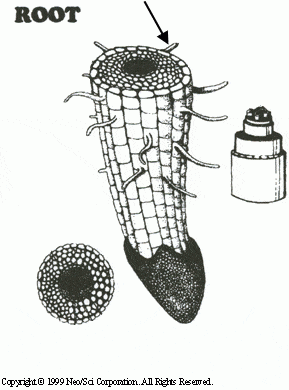
What is the name of the part of the root that allows water and minerals to enter?
root hairs
epidermis
phloem
xylem
Which of the following indicates the pathway of water through a plant?
root hair cell --> xylem --> stomata
stomata --> root hair cell --> xylem
xylem --> stomata --> root hair cell
What is the function of waxy cuticle on the leaves surface?
Provide water for the plant through the leaves
Reduce the loss of water from the plants by evaporation
Protect the plants from danger
A group of xylem vessels and phloem tubes is called a ............ ............ ( in lower case)
(a)
which of these is seen in the xylem ?
end plate
sieve tube element
lignin
nucleus
More water is lost from which part of the plant?
upper surface of leaf
flowers
stem
lower surface of leaf

What do the guard cells do?
Control active transport
control nutrient moving into the cell
Controls loss of water through the leaf

diagram show the cross section of
stem
root
leaf

what is A
xylem
cambium
phloem
cortex

diagram shows cross section of a
leaf
root
stem

