wayground logo

Free Printable Worksheets

Font size

S
M
L
XL
Worksheets

Foundations 2 - Semester 2 Final Review

Total questions: 89

Worksheet time: 6hrs 29mins

Name
Class
Date
1.
a)
A
b)
B
c)
C
d)
D
2.
a)
A
b)
B
c)
C
d)
D
3.
a)
A
b)
B
c)
C
d)
D
4.
Find x round to the nearest tenth.
a)
46.1
b)
4.9
c)
16.4
d)
26.9
5.
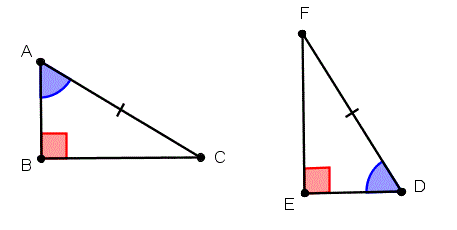
Find the measurement of the missing side indicated
a)
4.39
b)
3.21
c)
2.19
d)
2.05
6.
Choose the correct ratio.
a)
cos(33)=x/14
b)
sin(33)=x/14
c)
cos(33)=14/x
d)
sin(33)=14/x
7.
Solve for x.
a)
24.20
b)
4.92
c)
290.4
d)
29.75
8.
Find the measure of the indicated angle.
a)
9.39
b)
55.2
c)
20.2
d)
19.4
9.
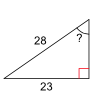
Solve for the missing angle
a)
50
b)
0.053
c)
36.9
d)
95
10.
                                                                                                                                                                                                       
Find m∠S
a)
21
b)
69
c)
23
d)
67
11.
Find the length of the missing side.
a)
20 in.
b)
68 in.
c)
16 in.
d)
80 in.
12.
Find the missing side
a)
9
b)
41
c)
6.4
d)
3
13.

A line is named by...

a)

Any 2 points on the line, or a lowercase script letter.

b)

Any 3 points on the line.

c)

Any 1 point on the line.

d)

Any 3 points on the line, or a uppercase script letter.
14.
A plane is named by...
a)
Any 1 point on the plane.
b)
Any 3 collinear points on the plane or a lowercase script letter.
c)
Any 3 non-collinear points on the plane or an uppercase script letter.
d)
All points on the plane that aren't part of a line.
15.
Two lines intersect at a ....
a)
angle
b)
point
c)
line
d)
intersection
16.
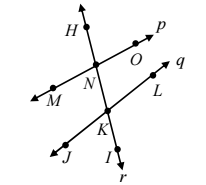
Name 4 collinear points
a)
HMNO
b)
IKNO
c)
MJOL
d)
HNKI
17.
A line that contains point M.
a)
Line q
b)
Line p
c)
Line r
d)
Line NH
18.
An example of 2 non-collinear points.
a)
D, E
b)
C, B
c)
M, E
d)
F, B
19.
Name 3 coplaner points.
a)
ZRW
b)
VZX
c)
VWX
d)
WYZ
20.
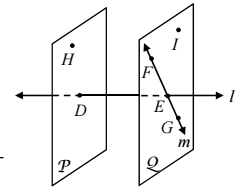
Give another name for plane Q.
a)
Plane FEGI
b)
Plane FEG
c)
Plane m
d)
Plane FGI
21.
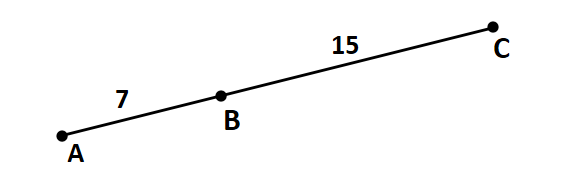
Find AC
a)
7
b)
8
c)
22
d)
23
22.
Use the figure to write and solve an equation for x.
a)
5
b)
6
c)
7
d)
8
23.
a)
MQ=4, PQ=8
b)
MQ=4, PQ=4
c)
MQ=8, PQ=4
d)
MQ=8, PQ=8
24.
Find HG.
a)
8
b)
9
c)
10
d)
11
25.
Solve for x
a)
x = 2
b)
x = 4
c)
x = 6
d)
x = 8
26.
Find the value of ∠A.
a)
25°
b)
30°
c)
35°
d)
90°
27.
Find the value of ∠A.
a)
39 degrees
b)
49 degrees
c)
51 degrees
d)
59 degrees
28.
Find m∠JKL
a)
80o
b)
55o
c)
25o
d)
300
29.
What is the measure of the missing angle?
a)
76
b)
86
c)
166
d)
156
30.
Solve 
a)
x = 5
b)
x = 11
c)
x = 33
d)
x = 55
31.
Name this angle.
a)
acute
b)
right
c)
obtuse
d)
none of the above
32.
Name this angle.
a)
acute
b)
right
c)
obtuse
d)
none of the above
33.
Name this angle.
a)
acute
b)
right
c)
obtuse
d)
none of the above
34.
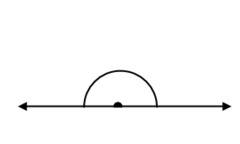
What type of angle is shown?
a)
acute
b)
obtuse
c)
right
d)
straight
35.
a)
x=67
b)
x=43
c)
x=55
d)
x=12
36.
a)
m∠GHK=26, m∠KHJ=26
b)
m∠GHK=26, m∠KHJ=52
c)
m∠GHK=52, m∠KHJ=52
d)
m∠GHK=52, m∠KHJ=26
37.

Find the value of x.

a)

15

b)

16

c)

18

d)

19

38.

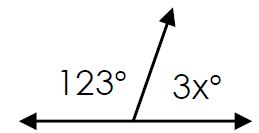
Tell whether the angles are complementary or supplementary. Then find the value of x.

a)

Complementary; x=25

b)

Complementary; x=5

c)

Supplementary; x=25

d)

Supplementary; x=5

39.

What are complementary angles?

a)

Angles that add up to 180°

b)

Angles that add up to 90°

c)

Angles that are equal to each other

d)

Angles that are opposite of each other when lines intersect.

40.

What are supplementary angles?

a)

Angles that add up to 180°

b)

Angles that add up to 90°

c)

Angles that are equal to each other

d)

Angles that are opposite of each other when lines intersect

41.

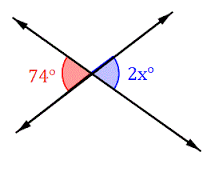
Solve for x

a)

20

b)

25

c)

120

d)

180

42.

Solve for x

a)

5

b)

90

c)

25

d)

10

43.

Choose all that apply: Which angle measurements below are supplementary to each other?

a)

144 and 36

b)

36 and 54

c)

40 and 50

d)

126 and 54

e)

21 and 159

44.

Choose all answers that apply: Find the angle measurements that are complementary to each other.

a)

75 and 105

b)

75 and 15

c)

25 and 65

d)

34 and 146

e)

38 and 52

45.
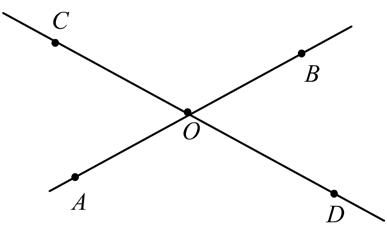
Which are pairs of vertical angles?
a)
∠COB & ∠COA
b)
∠AOD & ∠AOC
c)
∠COB & ∠AOD
d)
∠BOD & ∠AOD
46.
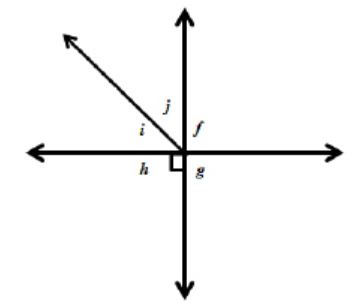
Name the vertical angle to
∠h.
a)
∠f
b)
∠i
c)
∠g
d)
∠j
47.
Vertical angles are always
a)
acute
b)
total 180 degrees
c)
congruent (equal measures)
d)
adjacent angles
48.
What is the value of x?
a)
37
b)
72
c)
108
d)
18
49.
If m∠1 = 30°, then m∠3 = 
a)
30°
b)
60°
c)
150°
d)
undetermined
50.
If the measure of ∠2 is 83°, what is the measure of ∠3?
a)
b)
17°
c)
83°
d)
97°
51.
Which names a pair of adjacent angles?
a)
∠CXD and ∠FXE
b)
∠CXF and ∠DXE
c)
∠CXD and ∠DXE
52.
∠A ≅∠?
a)
∠B
b)
∠E
c)
∠D
d)
∠F
53.
∆ABC≅∆XYZ
which is true?
a)
AB≅XY
b)
AB≅YX
c)
AB≅XZ
d)
BC≅CB
54.
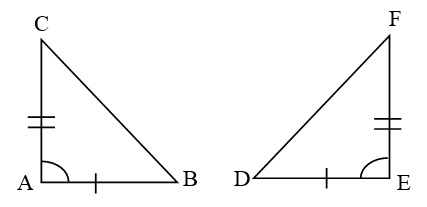
Name the postulate, if possible, that makes the triangles congruent.
a)
SSS
b)
SAS
c)
ASA
d)
AAS
55.
Name the postulate, if possible, that makes the triangles congruent.
a)
SAS
b)
ASA
c)
AAS
d)
Not Possible
56.
Name the postulate, if possible, that makes the triangles congruent.
a)
SAS
b)
ASA
c)
AAS
d)
Not Possible
57.
Name the postulate, if possible, that makes the triangles congruent.
a)
SSS
b)
ASA
c)
AAS
d)
Not Possible
58.
Name the postulate, if possible, that makes the triangles congruent.
a)
SSS
b)
SAS
c)
AAS
d)
Not Possible
59.
a)
HL
b)
SAS
c)
not congruent
d)
AAS
60.
a)
CA≅WX
b)
CB≅XW
c)
AC≅XV
d)
XV≅CB
61.
a)
MK≅MK
b)
HM≅ML
c)
HK≅KL
d)
KM≅LK
62.
a)
DE≅WV
b)
DE≅DF
c)
FE≅XV
d)
XV≅WX
63.
Name the property described:
∠B≅∠B
a)
Reflexive
b)
Symmetric
c)
Transitive
d)
Addition
64.
Name the property described:
If PQ = RS then RS = PQ
a)
Reflexive
b)
Symmetric
c)
Transitive
d)
Addition
65.
Name the property described:
If ∠A≅∠B and ∠B≅∠C, then ∠A≅∠C
a)
Reflexive
b)
Symmetric
c)
Transitive
d)
Addition
66.
Name the property described
If m∠1=m∠4, then m∠1 - 30⁰ = m∠4 - 30⁰
a)
Addition
b)
Subtraction
c)
Substitution
d)
Division
67.
Name the property described
If LM = NP, then 2⋅LM = 2⋅NP
a)
Addition
b)
Subtraction
c)
Multiplication
d)
Division
68.
Name the property described
If XY = EF, then XY + 7 = EF + 7
a)
Addition
b)
Subtraction
c)
Multiplication
d)
Division
69.
Name the property described
If CD = 4, then CD + 12 = 4 + 12
a)
Addition
b)
Subtraction
c)
Substitution
d)
Division
70.
Find the midpoint of the segment with the endpoints:  (-4, 5) and (7, -9) 
a)
(-1.5, 2)
b)
(5.5, -7)
c)
(-2, 1.5)
d)
(1.5, -2)
71.
Find the midpoint of the segment with the endpoints: (4, 12) and (-6, 14)
a)
(-1, 13)
b)
(13, 1)
c)
(13, -1)
d)
(5, 13)
72.
Segment AB has midpoint M. Find the coordinates for endpoint B if M(5, 3) and A(1, 6)
a)
(1, 3)
b)
(-4, 6)
c)
(5, 2)
d)
(9, 0)
73.
What's the distance between (-3,4) and (-3, -10)?
a)
14
b)
-14
c)
6
d)
-6
74.

Find the distance between (4, -5) and (5, -1)

a)

2.24

b)

4.12

c)

10.82

d)

3.87

75.
Name the transformation.
a)
Translation
b)
Reflection
c)
Rotation
76.
When you translate, (x-4,y) will move _____.
a)
4 units right
b)
4 units left
c)
4 units up
d)
4 units down
77.
Write a rule for the translation.
a)
 (x -1, y  + 2)
b)
 (x -2, y  + 1)
c)
 (x +2, y  - 1)
d)
(x +1, y  -  2)
78.
Identify the transformation from ABC to A'B'C'.
a)
90o clockwise rotation
b)
90o counter clockwise rotation
c)
Reflection across the y-axis
d)
Reflection across the x-axis
79.
Identify the transformation from ABCD to A'B'C'D'.
a)
Translation
b)
Reflection across the y-axis
c)
Reflection across the x-axis
d)
90o counter clockwise Rotation
80.
Point (-5,2) is reflected over the y axis.  Where is the new point located?
a)
(5,2)
b)
(-5,-2)
c)
(-5,2)
d)
(5,-2)
81.
Which rule would result in a translation of 2 units left and 3 units up?
a)
(x, y) → (2x, 3y)
b)
(x, y) → (x - 2, y + 3)
c)
(x, y) → (-x, -y)
d)
(x, y) → (x + 2, y - 3)
82.
What is this picture an example of? 
a)
An angle
b)
A cat vertex 
c)
Rotation 
d)
Dilation
83.
Triangle B is rotated 90° counterclockwise with the origin as the center of rotation to create a new figure. Which triangle shows the new location?
a)
A
b)
B
c)
C
d)
D
84.
Which answer shows a reflection across the x-axis?
a)
a
b)
b
c)
c
d)
d
85.
C(-6, 2) and B(-1, -1)
Rotate 90 degrees counterclockwise.
a)
C' (-6, 2), B' (-1, -1)
b)
C' (6, 2), B' (1, -1)
c)
C' (2, -6), B' (-1, -1)
d)
C' (-2, -6), B' (1, -1)
86.
A(-2, 2) and B(3, 2)
Rotate 180 degrees 
a)
A' (-2, 2), B' (3, 2)
b)
A' (-2, -2), B' (-3, -2)
c)
A' (2, -2), B' (-3, -2)
d)
A' (2, -2), B' (2, 3)
87.
How many lines of symmetry does this square have?
a)
1
b)
3
c)
4
d)
8
88.
How many lines of symmetry does this regular hexagon have?
a)
3
b)
6
c)
9
d)
12
89.
How many lines of symmetry does this trapezoid have?
a)
0
b)
1
c)
2
d)
3