wayground logo

Free Printable Worksheets

Font size

S
M
L
XL
Worksheets

ADVANCED SCIENCE SEM1 2019

Total questions: 250

Worksheet time: 9hrs 28mins
Name
Class
Date
1.

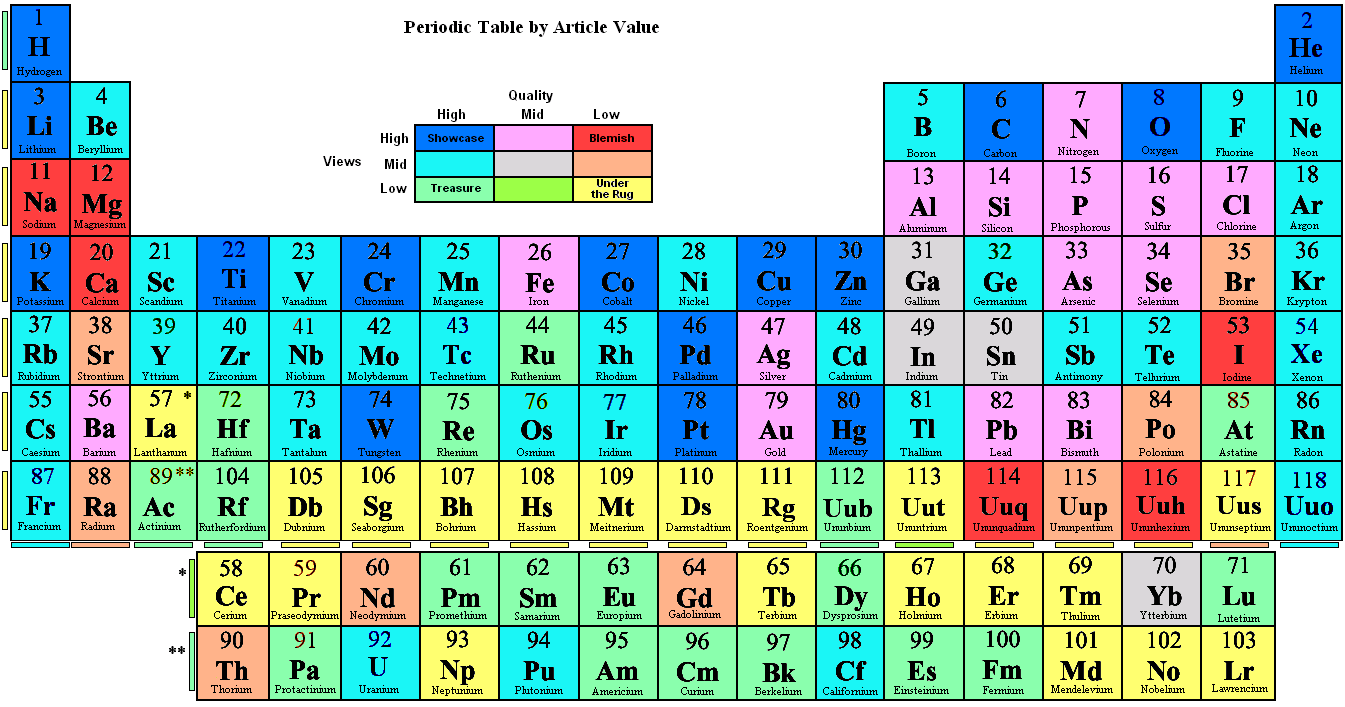
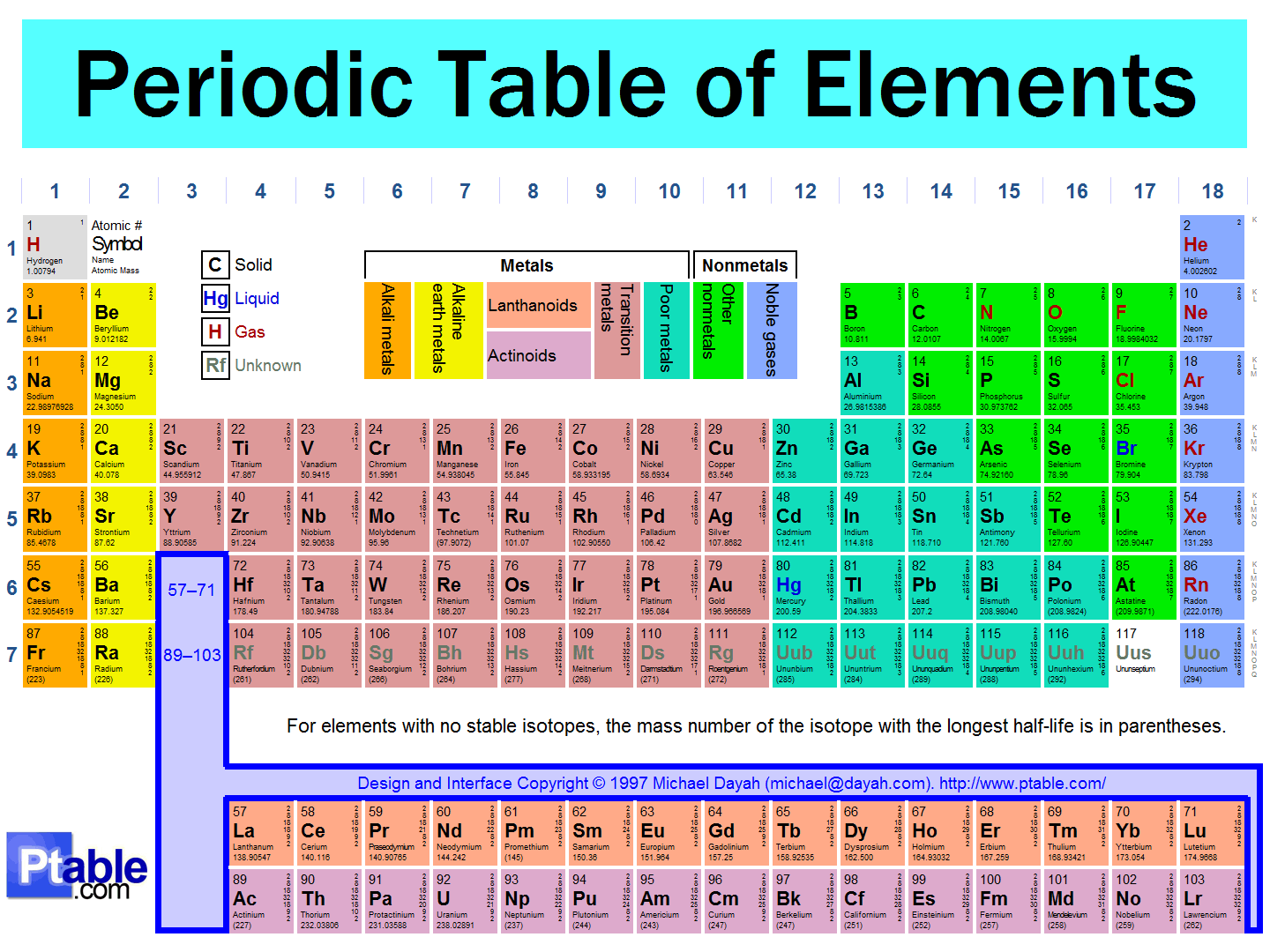
The vertical (up and down) columns in the Periodic Table are called

a)

groups

b)

towers

c)

periods

d)

atomic numbers

2.
The Modern Periodic Table of Elements is arranged by
a)
atomic mass
b)
atomic number
c)
valence electrons
d)
number of isotopes
3.
Sodium (Na) is found in period 
a)
3
b)
2
c)
4
d)
1
4.
The atomic number tells you what?  READ THE ANSWERS CAREFULLY
a)
only the number of electrons
b)
 only the number of protons
c)
only the number of neutrons
d)
the number of both electrons and protons in an atom.
5.
What does the atomic mass tell you? 
a)
Basically,the number of electrons and protons
b)
The number of neutrons
c)
Basically, the number of protons and neutrons
d)
The number of protons.
6.
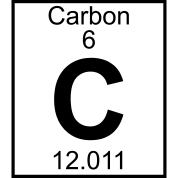
What does the 6 represent?
a)
atomic mass
b)
atomic number
c)
element name
d)
chemical symbol 
7.
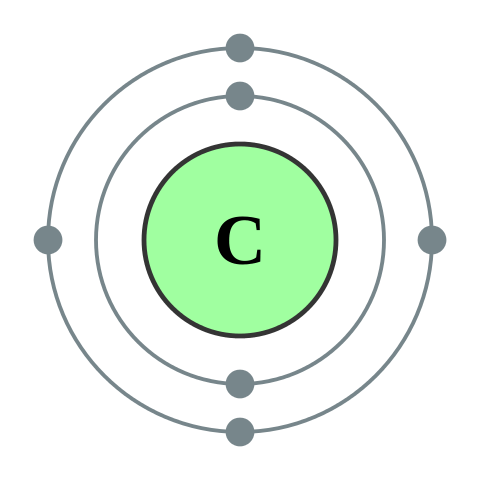
Which is an electron?
a)
A
b)
B
c)
C
8.
How many valence electrons are in an atom of Ba?
a)
2
b)
8
c)
4
d)
1
9.
How many valence electrons are found in atoms of group 15?
a)
4
b)
5
c)
2
d)
3
10.
How many valence electrons are found in atoms of Calcium?
a)
4
b)
5
c)
2
d)
3
11.
Valence electrons are the...
a)
Innermost electrons
b)
Middle electrons
c)
Outermost electrons
d)
Any electrons
12.

How many valence electrons does carbon have?

a)

4

b)

5

c)

6

d)

7

13.

USE THE PERIODIC TABLE

How many valence electrons does sodium have?

a)

1

b)

2

c)

3

d)

4

14.

Which of the following is false about covalent bonds?

a)

Forms by sharing electrons

b)

Forms between 2 nonmetals

c)

Represented by a line between atoms

d)

Forms by transferring electrons

15.
Covalent bonds are between...
a)
Metal and Non-metal
b)
Non-metal and Non-metal
c)
Metal and Metal
16.
Ionic bonds are between...
a)
Metal and Non-metal
b)
Non-metal and Non-metal
c)
Metal and Metal
17.
Atoms are most stable when their outer shell is complete.
a)
true
b)
false
18.
Covalent bonds actually "share" electrons?
a)
true
b)
false
19.
How are ionic bonds formed?
a)
Transfer of electrons
b)
Sharing of electrons
20.
Is this ionic bond drawn correctly?
a)
Yes
b)
No
21.
Group numbers on the periodic table help us determine 
a)
The number of valence electrons
b)
Color of the elements
22.
Gain or lose electrons
a)
Ionic Bonds
b)
Covalent Bonds
c)
Both bonds
d)
Neither bond
23.
NaCl
a)
Ionic Bond
b)
Covalent Bond
c)
Both bonds
d)
Neither bond
24.
What is a cation
a)
a metal with a negative (-) charge
b)
a non-metal with a negative (-) charge 
c)
a metal with a positive (+) charge 
d)
a non-metal with a positive (+) charge
25.
What is a anion
a)
a metal with a negative (-) charge
b)
a non-metal with a negative (-) charge 
c)
a metal with a positive (+) charge 
d)
a non-metal with a positive (+) charge
26.
Covalent Compounds HAVE a positive (+) or negative (-) charge 
a)
True
b)
False
c)
Que onda, Hagerman? 
d)
What was that now? 
27.
Why does K become positive when it bonds to Cl to form KCl?
a)
Because it loses an electron to have a full valence shell 
b)
Because it gains an electron to have 2 valence electrons
c)
Because it loses an electron to become negatively charged
d)
Because Cl gives away its 7 electrons to Na to form an equal charge 
28.
The octet rule means that all valence shells want to have the number...... 
a)
1
b)
9
c)
8
d)
16
29.
All atoms/elements bond in order to ....
a)
Have a full valence shell
b)
Give away electrons or take electrons
c)
Only share electrons
d)
To create electrical currents for human use 
30.
How many valence electrons does hydrogen have?
a)

4

b)
3
c)
2
d)
1
31.
What is the Law of Conservation of Mass?
a)
It states that no matter can be created or destroyed.
b)
It states that no energy can be created or destroyed.
c)
It states that matter can be created or destroyed.
d)
It states that no sound can be created or destroyed.
32.
What is a coefficient?
a)
The small number on the right of the chemical symbol.
b)
The large number in front of a chemical formula.
c)
The number in between the chemical symbols.
d)
The number behind a chemical formula.
33.
What is the part of the chemical equation in green called? 
Fe + S --> FeS
a)
products
b)
reactants
c)
yield
d)
chemical formula
34.
What is the little number after an element in a chemical equation called.
Example: H2
a)
Coefficient 
b)
Subscript
c)
Atom
d)
Equation
35.
What coefficient should be used to make the following equation balanced?
N2+O2--> _NO 
a)
1
b)
2
c)
3
d)
4
36.
How many elements are in C6H12O6?
a)
1
b)
2
c)
3
d)
4
37.
How many HCl molecules do you need to balance this equation? 
Mg +  __HCl --->  MgCl2 + H2
a)
1
b)
2
c)
3
d)
4
38.
How many Oxygens are in this molecule? 
(OH)2
a)
4
b)
1
c)
2
d)
3
39.
What are the smaller numbers that you CANNOT change in a chemical equation? 
a)
Coefficient
b)
Products
c)
Reactants
d)
Subscript
40.

The coefficient in 3H2O is

a)

6

b)

5

c)

2

d)

3

41.
The location of a place or an object is called its....
a)
position
b)
motion
c)
speed
d)
reference point
42.
The measure of how quickly something moves or the distance it moves in a given amount of time is called
a)
motion
b)
position
c)
speed
d)
location
43.
Speed is equal to the distance divided by
a)
position
b)
time
c)
height
d)
motion
44.
The unit speed is measured in is
a)
m/s
b)
ft/min
c)
m/hr
d)
m/s^2
45.
A wheelchair racer completes a 100 meter course in 20 seconds. What is his speed?
d= 100 m
t= 20 s
a)
10 m/s
b)
5 m/s
c)
2 m/s
d)
0 m/s
46.
Carlos lives 100 meters from his friend's house. What is his average speed if he reaches his friends house in 50 seconds?
Distance= 100 m
time = 50 seconds
a)
1 m/s
b)
2 m/s
c)
3 m/s
d)
4 m/s
47.
A soccer ball is kicked from 40 meters out. It takes 5 seconds to reach the goal. What speed was the ball traveling?
d= 40 m
t= 5 s
a)
6 m/s
b)
7 m/s
c)
8 m/s
d)
9 m/s
48.
A bird flies from tree to tree. It leaves on branch and flies 100 meters to another branch. It takes him 10 seconds to get there. What is his speed?
d= 100 meters
t= 10 seconds
a)
1 m/s
b)
10 m/s
c)
100 m/s
d)
1000 m/s
49.
In a distance time graph, the steeper the line the...
a)
greater the speed
b)
slower the speed
c)
speed has reached zero
d)
speed has not changed
50.
Speed in a specific direction is called
a)
speed
b)
acceleration
c)
position
d)
velocity
51.
A vector is a quantity that has both size and 
a)
speed
b)
altitude
c)
acceleration
d)
direction
52.
Stating that a man is traveling north at 30 m/s is an statement of his
a)
speed
b)
velocity
c)
accleration
d)
endurance
53.
A man drives south for 100 km over the course of 20 hours. Find his velocity
d=100 km
t= 20 h
a)
4 km/h
b)
4 km/h to the south
c)
5 km/h
d)
5 km/h to the south
54.
Lexi runs west for 1600 meters over the course of 400 seconds. What is Lexi's velocity
d = 1600 meters
t = 400 seconds
a)
4 m/s
b)
4 m/s to the west
c)
40 m/s
d)
40 m/s to the west 
55.
During which interval is the object not moving?
a)
B to C
b)
C to D
c)
D to E
d)
only at point A
56.
During which interval is the object traveling at a constant velocity?
a)
B to C
b)
D to E
c)
F to G
d)
it traveling at a constant velocity during all of the intervals shown.
57.
During which interval is the object speeding up?
a)
A to B
b)
B to C
c)
D to E
d)
E to F
58.
During which interval is the object slowing down?
a)
A to B
b)
D to E
c)
E to F
d)
G to H
59.
During which interval are the forces on the object BALANCED (Net Force= 0 N)?
a)
A to B
b)
B to C
c)
D to E
d)
F to G
60.
What is the formula for force?
a)
F=M/A
b)
F=A/M
c)
F=M*A
d)
F=M*F
61.
The Law of Inertia
a)
Newton's
1st
Law of Motion
b)
Newton's
2nd
Law of Motion
c)
Newton's
3rd
Law of Motion
62.
F=ma
a)
Newton's
1st
Law of Motion
b)
Newton's
2nd
Law of Motion
c)
Newton's
3rd
Law of Motion
63.
For every action, there is an equal and opposite reaction.
a)
Newton's
1st
Law of Motion
b)
Newton's
2nd
Law of Motion
c)
Newton's
3rd
Law of Motion
64.
An automobile you are riding in suddenly stops, but you continue to go forward.
a)
Newton's
1st
Law of Motion
b)
Newton's
2nd
Law of Motion
c)
Newton's
3rd
Law of Motion
65.
When the force on a car is doubled, the acceleration is doubled.
a)
Newton's
1st
Law of Motion
b)
Newton's
2nd
Law of Motion
c)
Newton's
3rd
Law of Motion
66.
A stationary bumper car is set in motion by the outside force of another bumper car colliding with it.
a)
Newton's
1st
Law of Motion
b)
Newton's
2nd
Law of Motion
c)
Newton's
3rd
Law of Motion
67.
A magician pulls a table cloth from under a table of dishes.
a)
Newton's
1st
Law of Motion
b)
Newton's
2nd
Law of Motion
c)
Newton's
3rd
Law of Motion
68.
A skater pushes another skater forward, but the one pushing moves backwards.
a)
Newton's
1st
Law of Motion
b)
Newton's
2nd
Law of Motion
c)
Newton's
3rd
Law of Motion
69.
The harder you hit a baseball, the faster it accelerates.
a)
Newton's
1st
Law of Motion
b)
Newton's
2nd
Law of Motion
c)
Newton's
3rd
Law of Motion
70.
The acceleration of a 4 kg bowling ball will be greater than the acceleration of a 6 kg bowling ball if the same force is applied to both.
a)
Newton's
1st
Law of Motion
b)
Newton's
2nd
Law of Motion
c)
Newton's
3rd
Law of Motion
71.
You step from a boat to a dock.  The boat moves backwards as you move forwards and you fall in the water.
a)
Newton's
1st
Law of Motion
b)
Newton's
2nd
Law of Motion
c)
Newton's
3rd
Law of Motion
72.

Which unit would be BEST when measuring the acceleration of a falling object?

a)

kilograms

b)

miles per hour

c)

grams per milliter

d)

meters per second per second

73.
Mary runs 1500 meters around the school track.  What does she need to know in order to find out her speed?
a)
her time from start to finish
b)
the number of steps she took
c)
her heart rate at the finish line
d)
the direction she began running
74.

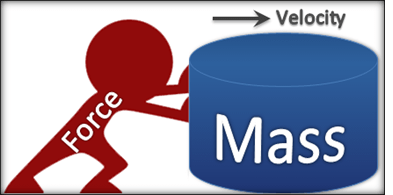
Velocity is-

a)

Tells us the objects speed and direction

b)

How far the object travels, regardless of direction

c)

Difference between starting and ending points
75.
a)
1st
b)
2nd
c)
3rd
76.
a)
1st
b)
2nd
c)
3rd
77.
Action/Reaction
a)
1st
b)
2nd
c)
3rd
78.
Rockets are launched into space using jet propulsion where exhaust accelerates out from the rocket and the rocket accelerates in an opposite direction.
a)
The Law of Inertia
b)
The Law of Acceleration
c)
The Law of Conservation of Momentum
79.
A person not paying attention while skateboarding hits a rock. The skateboard stops...they don't.
a)
The Law of Inertia
b)
The Law of Acceleration
c)
The Law of Conservation of Momentum
80.
Acceleration is due to a force put on an objects mass. 
a)
1st
b)
2nd
c)
3rd
81.

When an unbalanced force acts on an object, the force ______________________.

a)

changes the motion of the object

b)

is cancelled by another force

c)

does not change the motion of an object

d)

is equal to the weight of the object

82.

When two equal forces act in opposite directions on an object, they are called ______________________.

a)

frictional force

b)

balanced force

c)

centripetal force

d)

gravitational force

83.

The resistance of an object to any change in its motion is called ______________________.

a)

inertia

b)

friction

c)

gravity

d)

weight

84.
According to the graph how far does the person travel in the first 5 seconds?
a)
2 m
b)
10 m
c)
0 m
d)
5 m
85.
What is the person doing from 5 seconds to 10 seconds?
a)
Walking 
b)
Running
c)
Standing Still 
d)
Walking Fast
86.
What is the average speed of the person during the first 5 seconds?
a)
0 m/s
b)
1 m/s 
c)
3 m/s
d)
6 m/s 
87.
At 60 seconds, how far had this object traveled? 
a)
0 m
b)
10 m
c)
20 m
d)
40 m
88.
In which time interval was the object speeding up?   
a)
between 0 s and 2 s
b)
between 2 s and 4 s
c)
between 6 s and 8 s
d)
between 8 s and 10 s
89.
A value that only has magnitude (a number)
a)
Scalar
b)
Vector
c)
Speed
d)
Velocity
90.
Acceleration is defined as the CHANGE in 
a)
time it takes for one place to move to another place. 
b)
velocity of an object.
c)
distance divided by the time interval 
d)
velocity divided by the time interval 
91.
A drag racer accelerated from 0 m/s to 200 m/s in 5 s.  What was the acceleration?
a)
0 m/s
b)
40 m/s2
c)
-40 m/s2
d)
40 m/s
92.
A roller coasters accelerates from an initial velocity of 6.0 m/s to a final velocity of 70 m/s over 4 seconds.  What's the acceleration?
a)
24 m/s2
b)
18 m/s2
c)
16 m/s2
d)
16 m/s
93.
A dog runs with an initial speed of 7.5 m/s on a waxed floor.  It slides to a stop in 15 seconds.  What is the acceleration?
a)
-7.5 m/s
b)
-7.5 m/s2
c)
-0.5 m/s2
d)
7.5 mi//hr
94.

If a dog accelerates at a rate of 0.5m/s2 and is running at a speed of 8m/s, how long would it take the dog to reach a speed of 20m/s?

a)

6 s

b)

0.04 s

c)

24 s

95.

What is the acceleration of a bicycle that goes from 60m/s to 20m/s in 4s?

a)

-160 m/s2

b)

-10 m/s2

c)

160 m/s2

96.
A golf ball accelerates off a tee at 15m/s2, changing its velocity from 0m/s to 50 m/s down the fairway. How long did it take the golf ball to accelerate?
a)
750 seconds
b)
35 seconds
c)
0.3 seconds
d)
3.3 seconds
97.
A box sliding down an inclined plane attains a velocity of 27 m/s in 3 seconds from rest.  Find the acceleration.
a)
30 m/s
b)
24 m/s2
c)
9 m/s2
d)
81 km/hr
98.
 Jermaine runs exactly 2 laps around a 400 meter track. What is the displacement?
a)
800
b)
400
c)
0
d)
200
99.
1.  Ray runs 30 feet north, 30 feet west, and then 30 feet south. What is the displacement?
a)
30 feet west
b)
90 feet 
c)
30 feet south
d)
0 feet
100.
What would your DISTANCE traveled be if you walked 30 meters north then 30 meters south?
a)
60 meters
b)
30 meters
c)
15 meters
d)
0 meters
101.
Heredity is the passing of traits from _____________________ to _____________________
a)
predators to prey
b)
water to rain
c)
parents to offspring
d)
fungi to protists
102.
___________________________ is the study of how traits are passed on, or inherited.
a)
dominant traits
b)
ratio
c)
phenotype
d)
genetics
103.
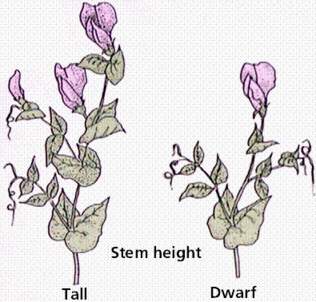
Why did Mendel choose to study pea plants in order to learn how traits are passed from parent to offspring?
a)
Pea plants grow quickly
b)
Pea plants are ultraviolet
c)
Pea plants are rare and expensive
d)
Pea plants are take years to grow
104.
If a child has red hair, they inherited a certain _______________ from their parents.
a)
ratio
b)
trait
c)
probability
d)
sex chromosome
105.
One trait that is ALWAYS present and causes the other traits to disappear is a ________________________
a)
recessive trait
b)
aggressive trait
c)
absent trait
d)
dominant trait
106.
True or False:  Recessive traits are ALWAYS present 
a)
True
b)
False
107.
A ___________________ is a relationship between two numbers
a)
genetic
b)
trait
c)
ratio
d)
cycle
108.
Offspring receives two sets of _____________ (one from each parent)
a)
blue jeans
b)
genes
c)
machines
d)
pedigree
109.
_____________________ is the appearance of an organism, or how it looks
a)
phenotype
b)
ratio
c)
recessive trait
d)
heredity
110.
A ________________________ is used to predict the possible genotype from certain parents
a)
Mendel Grid
b)
Genetic Tic Tac Toe
c)
Punnett Square
d)
Pedigree Plot
111.
______________________ is the mathematical chance that something will happen
a)
division
b)
selective breeding
c)
ratio
d)
probability
112.
_____________________ are cells that join to make offspring
a)
speed cells
b)
sex cells
c)
pea cells
d)
pedigree cells
113.
True or False:  Sex Chromosomes carry genes that determine the skin color and hair color of a child.
a)
True
b)
False
114.
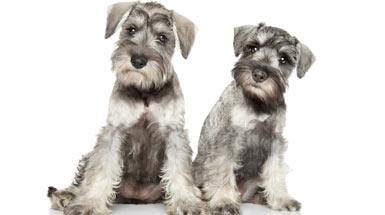
When humans breed purebred dogs to look a certain way and have traits that they like, this is an example of ___________________________
a)
Probably Breeding
b)
Sectional Breeding
c)
Selective Breeding
d)
Suspended Breeding
115.
__________________ is a tool for tracing through generations of family members.
a)
Pedigree
b)
Probability
c)
Purebred
d)
Punnett Square
116.
Emily has brown hair. Which is most likely a true statement about Emily?
a)
Emily’s favorite color is brown.
b)
Emily has a parent with brown hair.
c)
Emily’s older brother has brown hair. 
117.
Bunny A’s fur is all brown, while his brother and sisters are half brown and half white. The bunnies’ father is all brown, and the mother bunny is half brown and half white. Which best describes why Bunny A has brown fur?
a)
The bunny inherited a brown fur characteristic from each parent. 
b)
The bunny inherited a white fur characteristic from each parent. 
c)
The bunny rejected the white characteristics from its mother.
d)
The bunny rejected the brown characteristics from its father.
118.
Dominant or recessive?
tt
a)
Dominant 
b)
Recessive
119.
Dominant or recessive?
Dd
a)
Dominant
b)
recessive
c)
neither
d)
homozygous
120.
one of the alternative forms of a gene that governs a characteristic, such as hair color
a)
allele
b)
gene
c)
trait
d)
DNA
121.
Homozygous or heterozygous?
BB
a)
Homozygous
b)
Heterozygous
122.
Which of the following pairs is homozygous dominant?
a)
Hh
b)
pp
c)
HH
d)
aa
123.
Which of the following is heterozygous?
a)
Hh
b)
gg
c)
HH
d)
GG
124.
Jackie is homozygous recessive  for having dimples (D). What is her genotype?
a)
pp
b)
Dd
c)
dd
d)
DD
125.
Chromosomes are found in the ____________ of the cell
a)
Chloroplast
b)
Nucleus
c)
Cytoplasm
d)
Mitochondria
126.
What is a gene?
a)
An entire chromosome that  codes for a trait
b)
a piece of clothing
c)
a piece of a DNA on chromosome that codes for a trait
d)
Chemical messengers in your brain that code for a trait
127.
The primary function of the chromosome is to...
a)
relay messages between different cells in animals.
b)
transport waste materials rapidly out of the cell.
c)
release energy by breaking down food molecules.
d)
store the genetic instructions needed to specify traits.
128.
B = brown fur  b = white fur
In the punnett square, what is the probability for white fur? 
a)
0%
b)
25%
c)
50%
d)
75%
129.
A calico cat shows both the traits for orange fur and black fur. What kind of allele expression is this?
a)
Incomplete Dominance
b)
Co dominance
c)
Independent assortment
d)
Recessive inheritance
130.
This type of inheritance pattern is a MIXTURE of both traits.
a)
incomplete dominance
b)
co-dominance
c)
complete dominance
d)
recessive pattern
131.
Snap dragon color is a incomplete dominant trait.  A red flower (RR) is crossed with white flower (WW)? What color are flowers that are RW?
a)
Red
b)
Red and White
c)
White
d)
Pink
132.
Snap dragon color is a incomplete dominant trait.  A red flower (RR) is crossed with white flower (WW)? What color are flowers that are RW?
a)
Red
b)
Red and White
c)
White
d)
Pink
133.
If a gene is found only on the X chromosome and not the Y chromosome, it is said to be what?
a)
sex-linked trait
b)
polygenic trait
c)
codominant trait
d)
incomplete dominance trait
134.
What percentage of the offspring will have this recessive disease?
a)
0%
b)
25%
c)
50%
d)
75%
135.
How many PAIRS of chromosomes do humans have?
a)
23
b)
46
c)
1
d)
2
136.

Chromosomes 1 through 22; chromosomes that contain genes for characteristics not directly related to the sex of an organism.

a)

Homologous chromosome

b)

Autosome

c)

Sex chromosome

d)

gamete

137.

A genetic disorder in which a person has three copies of a chromosome instead of two.

a)

Sexual reproduction

b)

Monosomy

c)

genetic linkage

d)

Trisomy

138.
A homozygous dominant dog with brown fur is crossed with a heterozygous dog with brown fur. What are the percentages of the possible genotypes?
a)
100% BB
b)
75% BB and 25%Bb
c)
50 % BB and 50% Bb
d)
50% Bb and 50% bb
139.
An offspring will receive how many alleles from each parent to determine a specific trait?
a)
one
b)
two
c)
three
d)
five
140.
Which of the following is a phenotype?
a)
BB
b)
Bb
c)
bb
d)
Blue eyes
141.
Which of the following is a phenotype?
a)
BB
b)
Bb
c)
bb
d)
Blue eyes
142.
Two brown eyed parents (Bb) have a baby. What is the chance the baby is blue eyed?
a)
0 %
b)
25%
c)
50%
d)
75%
143.
An allele whose trait only shows up when no dominant allele is present.
a)
hidden allele
b)
dominant allele
c)
recessive allele
d)
present allele
144.
Heterozygous is when...
a)
the alleles are the same
b)
the alleles are different
c)
the alleles are absent
d)
the alleles are present
145.
T - tall and t = short
In the punnett square below, what belongs in the missing square
a)
tt
b)
Tt
c)
Bb
d)
TT
146.
How many alleles (letters) do each person carry for a trait?
a)
1
b)
2
c)
3
d)
4
147.
Aa, DD, bB, yy are all examples of
a)
genotypes
b)
phenotypes
148.
B = brown eyes
b = blue eyes
What is true about these two brothers that have brown eyes?
One has genotype BB the other Bb.
a)
they have same phenotype and genotype
b)
they have different genotypes and phenotypes
c)
they have same phenotype but different genotypes
d)
they have same genotype but different phenotypes
149.
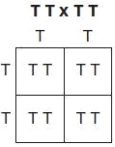
What ratio of the offspring from the cross shown will be homozygous recessive for the  trait of tallness? 
a)
0 in 4
b)
1 in 4
c)
2 in 4
d)
4 in 4
150.
In a flowering plant species, red flower color (R) is dominant over white flower color (r). What is the genotype of any red-flowering plant resulting from this species?
a)
rr
b)
R
c)
RR
d)
RR or Rr
151.
In a pedigree, what shape represents a male?
a)
circle
b)
square
c)
triangle
d)
diamond
152.
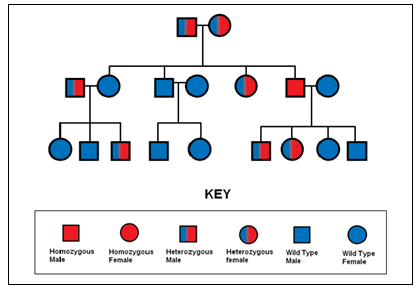
What type of heredity is shown in the pedigree?
(hint: check your notes - "modes of inheritance")
a)
Sex-Linked Dominant
b)
Sex-Linked Recessive
c)
Autosomal Dominant
d)
Autosomal Recessive 
153.
What gender has an X and a Y chromosome?
a)
male
b)
female
c)
transgender 
d)
all of the above
154.
W=white hair
w= non-white hair
If you cross a horse with WW and a horse with ww what fraction of the offspring would be expected to have white hair?
a)
none
b)
3/4
c)
1/2
d)
all
155.
Each one of the boxes on the Punnett Square represents what probability of an offsprings' genotype?
a)
25%
b)
1%
c)
10%
d)
0%
156.
What would be the results of a genetic cross between the following parents?  TT + Tt
a)
Tt, tt, tt, tt
b)
TT, TT, TT, Tt
c)
Tt, Tt, Tt, TT
d)
TT, TT, Tt, Tt
157.
How many generations are shown in this pedigree?
a)
1
b)
2
c)
3
d)
4
158.
Which individual in the first generation is a carrier?
a)
The male
b)
The female
c)
individual 1
d)
None of the above
159.
How many kids did the mother and father from the first generation have?
a)
2
b)
4
c)
5
d)
6
160.
In the second generation-how many people have the disease or display the physical trait?
a)
2
b)
4
c)
5
d)
6
161.
Colorblindness is a recessive, X chromosome sex-link disorder. Cross the parents to figure out which percentage of their offspring will be colorblind.
a)
25%
b)
0%
c)
75%
d)
50%
162.
How are individuals III-2 and II-4 related?
a)
Cousins
b)
Dad and Daughter
c)
Uncle and Niece
d)
Grandpa and Granddaughter
163.
If this pedigree shows a recessive disorder, what MUST the genotype of individual II-3 be?
a)
HH
b)
Hh
c)
hh
d)
None of the above
164.
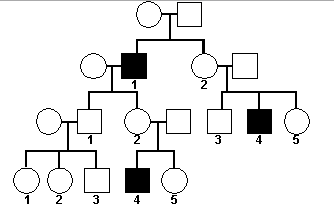
Is this trait (the shaded individuals) dominant or recessive?
a)
dominant
b)
recessive
165.

How many nucleotides make up a codon?

a)

1

b)

3

c)

5

d)

15

166.

How many codons: AAU GCG AUG

a)

9

b)

1

c)

3

d)

15

167.
What do helpful mutations do? 
a)
Increases chances of survival 
b)
Decreases changes of survival 
c)
Increases chances of developing cancer
d)
Decreases skills
168.

Mutation

a)

a DNA segment in a chromosome that is a copy of another segment

b)

the loss or excision of a section of genetic code, or its product

c)

the set of observable characteristics of an individual

d)

the changing of the structure of a gene, resulting in a variant form

169.
Which of the following best describes a DNA molecule?
a)
double helix
b)
contains ribose
c)
made of amino acids
d)
contains Uracil
170.
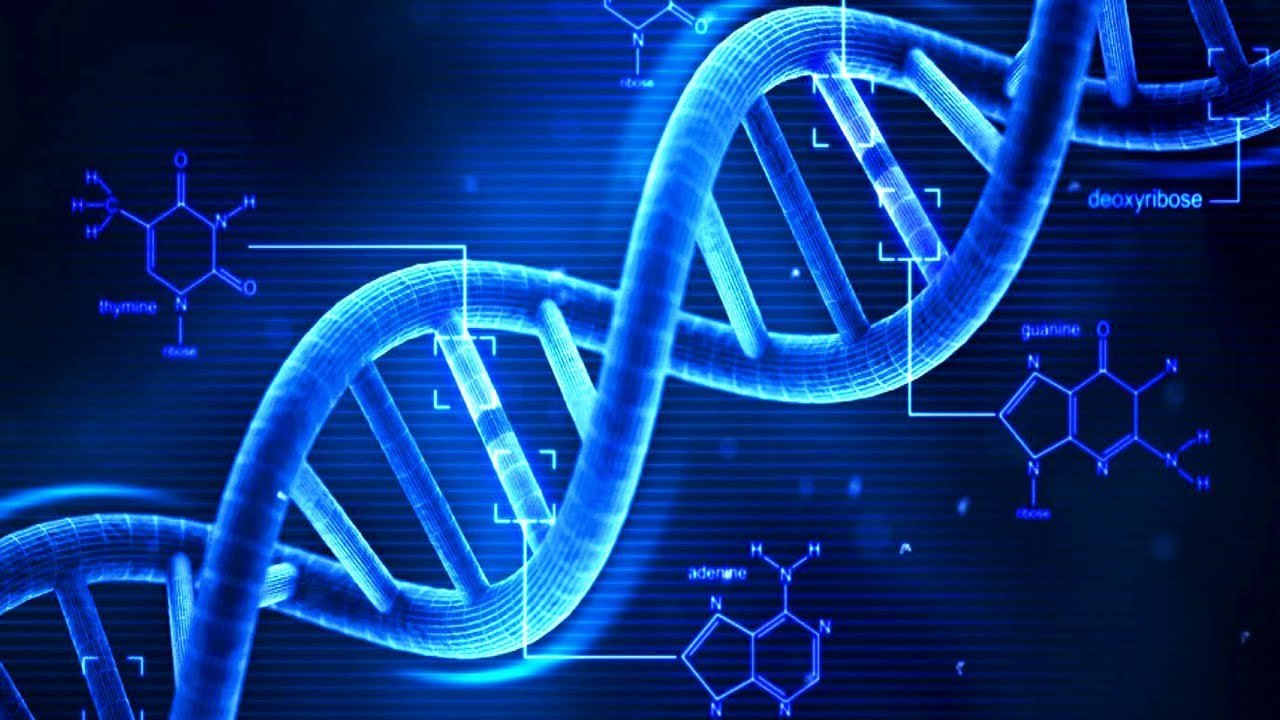
In DNA, Adenine bonds with ______________.
a)
Guanine
b)
Thymine
c)
Cytosine
d)
Adenine
171.
What does DNA stand for?
a)
Deoxyribonucleic acid
b)
Denitrogenous acid
c)
Deribonucleic acid
d)
Diribonucleic acid
172.
Which sequence of DNA bases would pair with this partial strand
ATG TGA CAG
a)
ATG TGA CAG
b)
TAC ACT GTC
c)
GTA AGT GAC
d)
CAT TCA CTG
173.

Compliment the following DNA


CCT -CTT -TAC

a)

GGA - GAA - ATG

b)

GGA - CTT - ATG

c)

CCT - GAA - ATG

174.
Sexual reproduction requires _____ parents and asexual reproduction requires ___ parents
a)
1,1
b)
2,2
c)
2,1
d)
1,2 
175.
What is an advantage of sexual reproduction?
a)
Allows genetic variation
b)
Only needs one parent
c)
Happens very quickly
d)
Offspring are exact copies of parent
176.
What is one disadvantage of sexual reproduction?
a)
Only one parent needed
b)
Off spring are exact copies of parents
c)
Happens very quickly
d)
Needs two parents
177.
When comparing the offspring of sexually and asexually reproducing organisms, we would expect the genetic material (DNA) of the sexually reproducing organism to -
a)
contain fewer mutations
b)
be lesser in quantity
c)
be simpler overall
d)
show more variation
178.
What is a disadvantage of asexual reproduction?
a)
New species of organisms cannot come into being.
b)
The offspring does not multiply rapidly.
c)
The offspring does not live for long.
d)
All of these
179.
A collection of stars, dust, and gas bound together by gravity.
a)
Nebula
b)
Galaxy 
c)
Universe
d)
Protostar
180.
 A large cloud of gas and dust in interstellar space; a region in Space where stars are born.
a)
Protostar 
b)
Nebula
c)
Galaxy 
d)
Star
181.
 The actual brightness of an object such as a star
a)
Luminosity 
b)
Apparent Magnitude 
c)
Brightness 
d)
Light Year
182.
A small, hot, dim star that is the leftover center of an old sunlike star
a)
Red Dwarf
b)
White Dwarf 
c)
Main Sequence 
d)
Giant
183.
A gigantic explosion in which a massive star collapses and throws its outer layers into space.
a)
Black Hole 
b)
Supernova
c)
Neutron Star 
d)
Nebula 
184.
All stars are measured in what 
a)
degrees
b)
Fahrenheit 
c)
Celcius 
d)
Kelvin 
185.
The most commonly accepted theory that explains the beginning of our known universe is the -
a)
Theory of Evolution
b)
Big Bang Theory
c)
Cell Theory
d)
Blackhole theory
186.
Which of the following is the largest?
a)
star
b)
universe
c)
cluster
d)
galaxy
187.
What does the Big Bang theory suggest?
a)
The universe was just there
b)
The Milky Way is the only solar system
c)
The universe is continually expanding
d)
The universe started as a point, expanded, and will return to a point
188.
What process takes place inside a star to generate energy?
a)
Nuclear fission
b)
Hydrogen Creation
c)
Nuclear fusion
d)
Helium forming
189.
In the diagram given, what happens as we move to the left?
a)
Stars get larger
b)
Stars get colder
c)
Stars get hotter
d)
Stars get smaller
190.

Which does the existance of cosmic background radiation support?

a)

the Big Bang Theory

b)

the inflationary model

c)

critical density

d)

Hubble constant

191.

which would cause the universe to collapse in on itself to make a closed universe?

a)

momentum of outward expanision

b)

force of gravity

c)

critical density

d)

Hubble constant

192.

According to latest theories, the Big Bang happened

a)

3 million years ago

b)

about 13.8 billion years ago

c)

3 billion years ago

d)

4.5 billion years ago

193.

What is the origin of the cosmic background radiation?

a)

it is a remnant of the Big Bng

b)

it is emitted by radio galaxies

c)

it is dark energy

d)

it is emitted by stars

194.

In the Big Bang model, which describes a universe that will stop expanding and begin to contract?

a)

flat

b)

open

c)

closed

d)

elliptical

195.

The light from most distant galaxies is ____.

a)

always infrared

b)

shifted toward the red end of the spectrum

c)

always ultraviolet

d)

shifted towards the blue end of the spectrum

196.

Which scientist was the first to find evidence that the universe is expanding

a)

Albert Einstein

b)

Galileo Galilei

c)

Edwin Hubble

d)

Stephen Hawking

197.

Edwin Hubble's discoveries were so important that he had something named after him.

What was it?

a)

The Hubble bridge

b)

The Hubble satellite

c)

The Hubble space orbiter

d)

The Hubble space telescope

198.
Compared to the rest of the stars, our sun is considered...
a)
Extremely Large and Cold
b)
Small with a medium temperature
c)
Medium size with medium temperature
199.
Which category is our Sun located in?
a)
White Dwarfs
b)
Supergiants
c)
Main Sequence
d)
Giants
200.
Which star is considered a Main Sequence Star?
a)
A
b)
B
c)
C
d)
D
201.
Stars are formed in a large cloud of gas and dust called a
a)
cumulonimbus cloud
b)
nebula
c)
neutron star
d)
black hole
202.
Which star has the lowest temperature?
a)
A
b)
B
c)
C
d)
D
203.
Which star has the lowest luminosity?
a)
A
b)
B
c)
C
d)
D
204.
What is the graph that shows the relations between a star's surface temperature and absolute magnitude?
a)
H-R Diagram
b)
Star Cluster Map
c)
Einstein's Diagram
d)
Newton's Chart of Stars
205.

In the diagram given, what happens as we move from to left?

a)

Stars Get Larger

b)

Stars get Colder

c)

Stars get hotter

206.

The longest stage in a star's life cycle and the stage our sun is currently in can last thousands to billions of years. Which stage is described above?

a)

white dwarf

b)

supernova

c)

main sequence

d)

neutron star

207.

The longest stage in a star's life cycle and the stage our sun is currently in can last thousands to billions of years. Which stage is described above?

a)

white dwarf

b)

supernova

c)

main sequence

d)

neutron star

208.
Betelgeuse is classified as a ____________ star.
a)
Supergiant
b)
Giant
c)
White Dwarf
d)
Main Sequence
209.
How bright a star APPEARS FROM EARTH is called what?
a)
apparent magnitude
b)
absolute magnitude
c)
size
d)
position in the sky
210.
What best describes the doppler effect?
a)
An apparent change in frequency of a wave due to the relative motion between a wave source and an observer
b)
When sound changes pitch
c)
When light changes color
d)
An apparent change in the amplitude of a wave due to the relative motion between a wave source and an observer.
211.
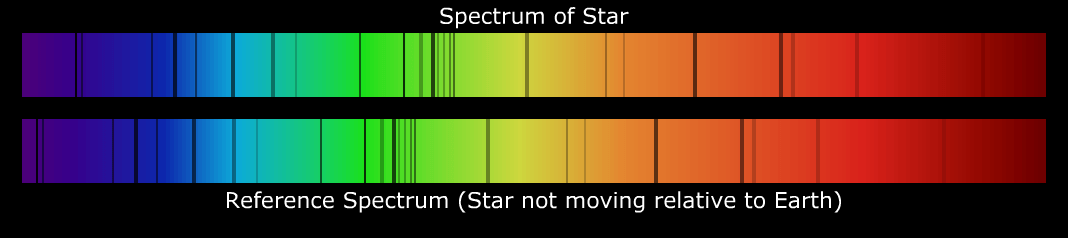
If a star is being observed from Earth and it's light has shifted towards the red side of the electromagnetic spectrum it would be...
a)
Moving towards the Earth
b)
Moving away from the Earth
c)
This is a trick question that cannot be answered
d)
It isn't a star, it is a very large blueberry.
212.
The vast majority of galaxies in our universe are moving away from us.  We know this because we observe __________ in the galaxies absorption spectra.
a)
Redshift
b)
Blueshift
c)
Turbulance
d)
Superposition
213.
Use the image to identify the motion of the object relative to Earth.  Compare the absorption spectra of the star to what the star would look like if it were not moving at all relative to Earth.
a)
It is not moving
b)
It is moving away from Earth (Redshift)
c)
It is moving towards Earth (Blueshift)
d)
It is moving towards Earth (Redshift)
214.
In red shift, the wavelengths of light become
a)
Bluer
b)
shorter
c)
longer
215.
Which has the LONGEST wavelength and, therefore, the lowest frequency/energy
a)
Gamma Rays
b)
Radio Waves
c)
Visible Light
d)
Infrared rays
216.
Which color has the least amount of energy?
a)
red
b)
orange
c)
green
d)
blue
217.
High frequency waves have _________ wavelengths.
a)
varying
b)
long
c)
the same
d)
short
218.
A refracting telescope uses: 
a)
Lens
b)
Mirrors
c)
Lens and mirrors
d)
Transmitters
219.
The best thing about radio telescopes is: 
a)
They can receive data any time of day and in any weather
b)
They can receive very high frequency signals
c)
They receive gamma rays
d)
They can intercept signals between planets 
220.

Why are many large optical telescopes located on mountains?

a)

it is cheaper to build on mountains

b)

to be above part of the atmosphere

c)

because it is easier to build telescopes on mountains

d)

to be closer to city lights

221.
The three pieces of evidence for our current theory of the universe are:
a)
blueshift, CMB, moon landing.
b)
redshift, IBM, Andromeda galaxy.
c)
redshift, CMB, distribution of elements.
d)
doppler effect, light spectra, fusion.
222.
The only elements in the universe were hydrogen and helium until:
a)
the big bang.
b)
humans came along.
c)
stars began doing fusion.
d)
the redshift was discovered.
223.
Gravity pulls gases and dust particles in space toward one another, squeezing them into a smaller and smaller space. The temperature at the center rises high enough for nuclear fusion of hydrogen to begin.
What stage in a stars life cycle is this describing? 
a)
The birth of a star
b)
The death of a star
c)
Black Hole
d)
Stellar Nebula
224.
Hotter stars appear to be what color? 
a)
Red
b)
Blue
c)
Yellow
d)
Green
225.
A star at the stage in its life cycle when it stops burning hydrogen, begins burning helium, and expands to a large, low-density star.
What stage in the life cycle does this describe? 
a)
Supernova
b)
Black Hole
c)
Main Sequence
d)
Red Giant or Red Supergiant
226.
What determines the color of a star? 
a)
It's size
b)
It's temperature
c)
It's composition
d)
They are all the same color 
227.
Larger stars (stars with more mass) have a longer life cycle. 
a)
True
b)
False
228.
A relatively small, dense star at the end of its life cycle, which generates little or no energy and has contracted to its densest state.
What stage in the life cycle does this describe? 
a)
Black Hole
b)
Nebula
c)
White Dwarf
d)
Red Giant
229.
A ________ is an object so dense with so much gravity that even light cannot escape.
a)
neutron star
b)
white dwarf
c)
blackhole
d)
black dwarf
230.

When nebula is big and hot enough is collapses on itself and ...................... is made

a)

white dwarf

b)

supernova

c)

protostar

d)

planetary nebula

231.

What does most every living thing need to survive?

a)

Steam

b)

Ice

c)

Plasma

d)

Liquid water

232.

What happens if a planet is too hot?

a)

The water will be nice and warm

b)

The water will boil away

c)

The water will be too cold

d)

The water will freeze and make ice

233.

What determines where the habitable zone is located for each star?

a)

The star's distance from Earth

b)

The size of the star

c)

How many planets the star has

d)

The size of the planet

234.
What is the habitable zone?
a)
A zone with the correct distance away from a star
b)
A zone in space where water turns into vapor
c)
A zone where life can not be sustained
d)
A zone in space where water is frozen
235.
Earth’s atmosphere contains water vapor and carbon dioxide. These greenhouse gases are important because they -
a)
are substances animals need to breathe.
b)
trap thermal energy in the atmosphere.
c)

protect against magnetic particles.
d)
create Earth’s gravitational field.
236.
Which helps protect the earth from radiation?
a)
Water
b)
Atmosphere
c)
Mantle
d)
Gravity
237.
What is the habitable zone?
a)
A zone with the correct distance away from a star
b)
A zone in space where water turns into vapor
c)
A zone where life can not be sustained
d)
A zone in space where water is frozen
238.
The Goldilocks Zone is determined by the
a)
mass and brightness of the planet
b)
mass of the planet
c)
mass and temperture of the star
d)
gravity of the star
239.

Why did the three bears take a walk?

a)

It was a nice day.

b)

They needed to go to the store.

c)

Their porridge needed to cool.

d)

They had just eaten all of the porridge.

240.
Water is thought to be what?
a)
Not needed for life.
b)
Necessary for life.
c)
Found on all planets.
d)
Found on the sun.
241.

The habitable zone is also called the Goldilocks zone because . . .

a)

There is a big bowl of porridge there

b)

The conditions for life are just right

c)

There is a bunch of gold flakes floating around in space

d)

The meteorites are golden in this zone

242.

As our sun increases in age, it also increases in size. What will happen to the habitable zone as time goes on?

a)

The habitable zone will shrink in size

b)

The habitable zone will move further away from the sun

c)

The habitable zone will grow in size

d)

The habitable zone will move closer to the sun

243.

Who wrote this obscenely long test

a)

Ms Baker

b)

Mr Benedetti

c)

Mr Taylor

d)

Mr Cole

e)

Ms Gulbenkian

244.
 If you have a bowl with six apples and you take away four, how many do you have?
a)
2 apples 
b)
1 apple 
c)
zero 
d)
The 4 you took away
245.
 What goes up and down, but always remains in the same place?
a)
Chair 
b)
Stairs
c)
Car 
d)
Water 
246.
What two colors are the cat's hat in "The Cat in the Hat"?
a)
Red and White
b)
Red and Blue
c)
Blue and White
d)
White and Black
247.
According to the old saying, "A journey of a thousand miles begins with..." what?
a)
A good night's rest
b)
A single step
c)
A map and compass
d)
An apple
248.

What is "Lepidopterophobia"?

a)

Fear of worm

b)

Fear of spider

c)

Fear of pig

d)

Fear of butterfly

249.

What is "Ataxophobia "?

a)

Fear of untidiness

b)

Fear of music

c)

Fear of saxophone

d)

Fear of cleanliness

250.

What is "Scriptophobia"?

a)

Fear of speaking in general

b)

Fear of listening in general

c)

Fear of writing in general

d)

Fear of reading in general