
 Worksheets
final SCIENCE
Total questions: 60
Worksheet time: 2hrs 13mins

What is the arrow pointing at?
solar prominence
solar flare
sunspot
core
Why does the atmosphere help sustain and protect life on the earth's surface?
All of the choices are correct
The ozone layer shields us from harmful UV radiation.
Greenhouse gases warm the air near the surface by 30 degrees C.
Oxygen is a major component of the atmosphere.
Which of the following statements accurately describes the sun?
The Sun rotates slower at its poles.
The Sun rotates at the same rate at its poles and equator.
The Sun rotates slower at its equator
The Sun does not rotate.
How do I know if an object is inside the solar system?
it orbits the sun
nothing is orbiting the sun
the sun orbits the object
it does not orbit the sun

Approximately 300 million years ago, Pangaea, shown in the illustration below, was formed. One hundred million years later, this supercontinent began to break up and move apart. Not until about 30 years ago did scientists understand why this movement occurred. The theory of plate tectonics was supported by many scientists because it answered the questions they had about the connections between plate tectonics, earthquakes and volcanoes. How does the theory of plate tectonics describe the movement of tectonic plates?
The plates are moved by heated material in the Earth.
The plates float along ocean waves
The plates are pulled toward cooler areas.
The plates are lifted by the eruption of volcanoes.
Many thousands of years ago, glaciers covered large areas of Earth’s surface. Glaciers are large blocks of ice that flow slowly over the land. Portions of the ice melted and refroze many times over the years. Which explanation best describes how glaciers contributed to the formation of coastlines along Florida and other states?
Water, from the melting ice, elevated the shoreline to forming plateaus
Water, from the melting ice, flooded the plains causing plants to die.
Water, from the melting ice, deposited sand on the ocean floor.
Water, from the melting ice, changed the shape of the coastline
Which of the following BEST describes the many rivers that flow through the state of
Florida?
Florida’s rivers are very slow due to the flatness of the terrain
Florida’s rivers are very deep as a result of the force of the water rushing down mountains.
Florida’s rivers are very swifts and cause much erosion
Florida’s rivers always begin at the coastline.

The graph above shows the relative sizes and surface temperatures of four groups of stars. The surface temperature of the stars is measured in Kelvin (K). The Sun is part of the main sequence group.
According to the graph, the Sun is best described as
average sized, with a surface temperature of approximately 6,000 K
massive sized, with a surface temperature of approximately 10,000 K
massive sized, with a surface temperature of approximately 20,000 K
average sized, with a surface temperature of approximately 8,000 K

Which statement most accurately describes the relationship between the color and temperature of stars?
yellow stars are cooler than red.
Red stars are hotter than white stars
White stars are cooler than yellow stars
Blue stars are hotter than red stars
What is absolute magnitude?
It is the relative brightness of a star.
It is how bright a star looks relative to how close it is to Earth.
It is the exact brightness.
it does not have to do with brightness
What is the composition of a star?
made of gas mostly hydrogen and helium and emits light.
Made mostly of nitrogen and oxygen and emits light.
It is made of carbon dioxide and emits light.
It is made mostly of argon and nitrogen and emits light.
In what ways does the Sun influence weather?
All answer choices are correct
The Sun evaporates water in the atmosphere to create clouds.
The Sun heats air in the atmosphere.
The Sun heats water on Earth.
The Sun heats the atmosphere of Earth unevenly. Which of the following is the most likely result of uneven heating.
Convection in the atmosphere causes a change in air density, resulting in winds
Conduction through the atmosphere causes evaporation to occur over oceans, resulting in rain
Radiation from the Sun will reflect through the atmosphere back into space resulting in cooler evenings.
Raditaion from the Sun will cause atmospheric moisture to collect over mountain ranges resulting in snow
Which is the major source of energy for most of Earth’s weather patterns?
radiation received from the Sun
earthquakes along fault zones
radioactive decay within Earth’s interior
convection currents in Earth’s mantle
Which of the following statements is TRUE about the transfer of energy from the sun to the land and to the air?
sunlight transfers energy from the sun to the land and from the sun to the air, and the land transfers energy to the air.
Sunlight transfers energy from the sun to the air, but sunlight does not transfer energy from the sun to the land and the land does not transfer energy to the air.
Sunlight transfers energy from the sun to the air and from the sun to the land, but the land does not transfer energy to the air.
Sunlight transfers energy from the sun to the land, but sunlight does not transfer energy to the air and land does not transfer energy to the air.

Throughout history, several different models of the solar system have been proposed. One such model is shown. According to a heliocentric model of the solar system, what should be located at position Q where indicated on the diagram?
The sun
Earth
Jupiter
Moon
Two of the models created to show the solar system were Ptolemy's geocentric and Copernicus's heliocentric. Which characteristic is the same for both models?
Uranus and Neptune are not included.
The Earth revolves around the Sun.
The Sun is located at the center.
The Earth orbits the moon.
Can science continuously change?
science cannot change and as a result e believe in the same ideas from 1000 years ago.
Yes, science can continues to change as new evidence is found and is durable over time.
No, science does not change over time and it stays the same.
science is based on opinions and feelings and changes all the time.
What is the difference between a scientific law and scientific theory?
a law is a statement and a theory explains that law
a law can change and theory cannot
a theory is a statement and a law is an explanation
there are no theories or laws in science
New Question New Question
A weather reporter reports that it was hot and dry yesterday. Why is this considered the weather and not the climate?
Climate describes atmospheric conditions over a long period of time
Precipitation conditions are not a part of weather
Temperature conditions are not a part of weather
Climate describes atmospheric conditions for each day
Many factors are used to determine the climate of an area. Which of the following is the two main factors that determine climate?
Precipitation and temperature
wind and location
humidity and wind
air pressure and dew point temperature
warm air rising into the atmosphere and creating clouds and cold air sinking is what process?
convection
conduction
radiation
friction
A jar of water is placed over a flame and the flame warms the water at the bottom of the jar.
What happens to the water at the bottom of the jar before it boils?
As the water at the bottom of the jar becomes a little warmer than the water around it, the warmer water will start to rise.
The water at the bottom of the jar will get warmer, but it will not rise.
The water at the bottom of the jar will get warmer, but it will not rise.
All of the water in the jar will get warmer at the same time, so there is no movement of the water in the jar.
Jamal is making a model of the universe using common objects to represent the universe, the Milky Way, the solar system and the Sun. He chooses a grape, his classroom, a tennis ball and an extra-large pizza to represent objects in his model. He decides to use the pizza to represent the Sun. Why is Jamal’s decision not the best choice?
The grape is the better choice since it is the smallest of the selected objects.
The classroom should be used since it is large like the Sun.
The tennis ball is the better choice due to its yellow color
The pizza is the better choice because of its shape.

Which statement most accurately describes the planets?
The outer planets are relatively the same distances from each other
The inner planets are closer to each other than the outer planets.
The inner planets have faster orbits since they are farther from the Sun.
The outer planets have less gravitational pull since they are closer together.

Students were asked to sort astronomical objects by similarities. One group sorted the objects as shown in the table below.How did the students most likely justify sorting the objects as they did?
The objects in SET 1 have rocky surfaces, while the objects in SET 2 contain gases.
The objects in SET 1 are all planets while SET 2 objects all orbit the Sun.
The objects in SET 1 are all part of the Milky Way galaxy, while SET 2 objects are equal distances apart.
The objects in SET 1 are located the same distance from the Sun, whereas, the objects in SET 2 are all of similar sizes.
grouping of astronomical bodies was posted on the classroom whiteboard. The teacher asked the students to determine if the objects were related or unrelated and to justify their answer. Which response would the teacher most likely expect to see?
Galaxy Star Nebula
Related: All three have a connection to stars
Unrelated: Nebulas are part of a galaxy while stars are not.
Related: All three are found in our solar system
Unrelated: Nebulas are not found in the universe.
Humans cut down trees in a location. This caused an increase in temperature and decrease in rainfall in that location. Which of these Earth systems interacted to produce this difference in climate?
biosphere, cryosphere, and geosphere
atmosphere, hydrosphere, and geosphere
cryosphere, atmosphere, and hydrosphere
biosphere, atmosphere, and hydrosphere
An unusually cold winter is a problem for Florida’s manatees. Colder air temperatures cause water temperatures to drop which leads to manatee illness and death. Manatees will take shelter in the warmer waters found near natural springs and power plants. Which of the following accurately describes this chain of events leading to manatee illness?
Changes in the atmosphere affect the cryosphere, which affects the hydrosphere.
Changes in the hydrosphere cause changes to the biosphere, which affect the atmosphere.
Changes in the atmosphere cause changes to the hydrosphere, which affects the biosphere.
Changes in the geosphere cause changes to the hydrosphere, which affects the atmosphere
How are clouds related to water vapor and water droplets?
Water vapor in the air condenses to form tiny water droplets, but the water vapor and water droplets do not make up clouds.
Water vapor in the air condenses to form tiny water droplets, and these water droplets make up clouds.
Water vapor in the air makes up clouds, but water vapor does not condense to form tiny water droplets that make up clouds.
Water vapor in the air stays in the air as water vapor. The water vapor does not make up clouds, and it does not condense to form tiny water droplets.
What two things are needed to make a real cloud?
small particles of dust and cold air
water and ice
ice and hairspray
dust and ice

The illustration below shows a meandering river moving toward the ocean. What most likely happens to the river in the area indicated by the arrow?
The river is narrowed by mechanical weathering caused by increased rain water.
The river slows down as it nears the ocean and deposits silt and sediment.
The river will eventually completely fill in with soil.
The river is widened by deposition.

The photograph below shows a pile of rubble in front of the path of a Chilean glacier. Which statement best describes the processes that formed these piles of small rocks?
The rocks were broken up by erosion, then weathered down the mountain by the glacier.
By erosion, the glacier moved rocks down the mountain and then deposited them at the bottom.
The rocks were eroded in slabs, then weathered by the wind at the foot of the mountain.
The rocks were weathered by the force of a glacier.

The chart below includes various examples of how the earth is built up or torn down. Which of the descriptions represents the process of physical weathering?
1 only
2 and 3
2, 4 and 5
2 and 4

Malik and Jeanine were asked to demonstrate the answer to the question, “How does the slope of a mountain effect the amount of erosion that occurs?” They set up their demonstration, as shown in the illustration below, then measured and recorded the amount of soil eroded down the slopes by the water. The data table shows the average of their results. Which statement best explains how the slope of a mountain affects the amount of erosion?
The height of a slope has no impact on the amount of erosion which occurs
A higher slope results in more erosion.
A lower slope results in more erosion
A higher slope results in less erosion

What happens when the crustal plates move as shown in the figure?
An ocean forms.
Volcanic mountain ranges form.
Sea-floor spreading occurs as the oceanic plate moves.
A transform boundary forms where the subduction occurs.

How do I change sedimentary to metamorphic?
heat and pressure
melting
cooling
weathering
Which statement about the formation of rocks is true?
Weathering and erosion can change sedimentary rock into sediment
Heat and pressure can change igneous rock to sedimentary rock
Heat and pressure cause metamorphic rock to weather and erode
Weathering and erosion prevent magma from changing into igneous rock
Granite is a light colored igneous rock found in the mountains. When granite weathers, it breaks down into larger grains of sand and much smaller particles of silt and clay. These pieces roll down the sides of the mountain and form piles. After many years, what type of rock would most likely be formed at the foot of a mountain?
Sedimentary rock will form as the layers sand, silt and clay are pressed together.
Metamorphic rock will form due to the pressure caused by the movement of the mountain.
Magma rock is formed from the intense heat released from the volcanic mountain.
Igneous rock will form since all mountains are formed from volcanoes.
Imagine a metamorphic rock that has been subjected to intense heat and pressure. Over time, it gets pulled underground as part of a tectonic plate that is sinking beneath another plate along a convergent boundary. The rock melts as it goes deeper; then the molten rock rises up and seeps out of a crack in the ocean floor and hardens. What type of rock is it now?
igneous
metamorphic
igneous
lava
Which of the following statements best describes how the Gulf Stream affects the weather along the east coast?
It makes the air less humid and brings less rain to the area
It makes the air temperature warmer and the air more humid
It makes the air temperature cooler and the winds stronger
It makes the wind stronger and brings less rain to the area
Why are ocean currents important to coastal regions?
They can warm or coool the air temperatures along coastal regions.
They produce high and low tides along coastal regions
They produce warm air temperatures along coastal regions
They increase the rate of precipitation as cold water moves along coastal regions
Why does weather tend to move eastward across the central United States?
Global winds blow generally from west to east in the middle latitudes. Mountain breezes blow from the western mountains across the country.
Warmer air from the West Coast tends to spread out toward cooler air over the East Coast.
Air moves from higher air pressure over the Pacific Ocean to lower air pressure over the Atlantic Ocean.

Desertification is often an unintended result of human activities. Which human activity helps reverse desertification?
adopting practices to stop cattle from overgrazing grass
removal of topsoil and native vegetation
slash-and-burn agriculture with fire
deforestation
After an area has been the process of deforestation, increased erosion happen to the soil. Over time which process would happen next?
urbanization
desertification
rural
deforestation
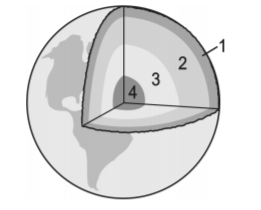
The diagram below shows four layers of Earth. Each layer is identified by a number.
Which layer of Earth is composed primarily of solid iron?
4
3
2
1
Which of the following best describes the lithosphere?
The outer rigid portion of the upper mantle and the rigid crust
The rigid crust
The lower part of the mantle and the outer core
the lower fluid mantle and upper rigid mantle
Comets are astronomical bodies, made up of ice and dust, which orbit the Sun. During its elliptical orbit, a comet’s distance from the Sun varies. As a comet nears the Sun, what happens to the speed of its orbit?
The speed decreases due to the gravitational pull of the Sun.
The speed decreases due to an increase in orbit size.
The speed increases due to the gravitational pull of the Sun.
The speed increases due to a decrease in orbit size.
The Orion Nebula is a gaseous cloud in space containing numerous new stars. When viewing it through a high-powered telescope, an observer sees what the nebula looked like 1,500 years ago. How is this possible?
Light from the telescope takes 1,500 years to reach the nebula.
The nebula is 1,500 years old.
It takes 1,500 years for light from the nebula to reach Earth
A high-powered telescope needs to be adjusted for its location
When measuring from Earth to any place inside the solar system, which unit of measurement is used?
mile
astronomical unit
light year
feet
Venus is further in distance from the sun than Mercury but it has a higher average surface temperature. What most likely accounts for this?
Venus has no atmosphere, so energy from the sun is not reflected back into space
Venus has no atmosphere so more energy is able to be absorbed by the surface
Venus has a thick atmosphere that traps the heat from the sun
Venus has a thick atmosphere that reflects energy back into space

