
 Worksheets
Semester 2 Final Review
Total questions: 49
Worksheet time: 1hrs 7mins
Which analogy is best for DNA?
Like a classroom
Like a table group in the class
Like a student in the class
What is the nucleus's job in the cell?
To build proteins
To make energy
To instruct the rest of the cell in what to do
The control traffic in and out of the cell
What is the mitochondria's job in the cell?
To build proteins
To make energy
The instruct the rest of the cell in what to do
The control traffic in and out of the cell
How many chromosomes does a gamete (sex cell) have?
46
3
23
12
You get half your genetic information from each parent.
True
False

What is the definition of mutation?
Natural Breeding
A random change in the genes of an organism
Natural Selection
Breeding two animals to create a new one
True or False: Mutations are random.
True
False
True or false, mutations create genetic diversity?
True
False
Mutations can benefit organisms because they can:
Cause illness
Make an organism more suited to live in its environment.
Make organisms live shorter lives
Cause organisms to grow extra limbs.
Which of the following genotypes is homozygous dominant?
A
Aa
AA
aa
In a flowering plant species, red flower color (R) is dominant over white flower color (r). What is the genotype of any red-flowering plant resulting from this species?
rr
R
RR or Rr
RR


This animal is a product of...
Natural Selection
Environmental Pressures
Nature
Artificial Selection
Artificial selection is...
the process by which humans select who reproduces based on human desired traits
the process by which natures selects who lives and dies based on overall fittness
the process by which animals adapt to their surroundings.
the process by which people take over ecosystems.
Why are beneficial traits more likely to be passed onto offspring?
Because the animal wants those traits the most
Because they are the only traits that can be passed on
Because they make the organism more likely to survive and reproduce.
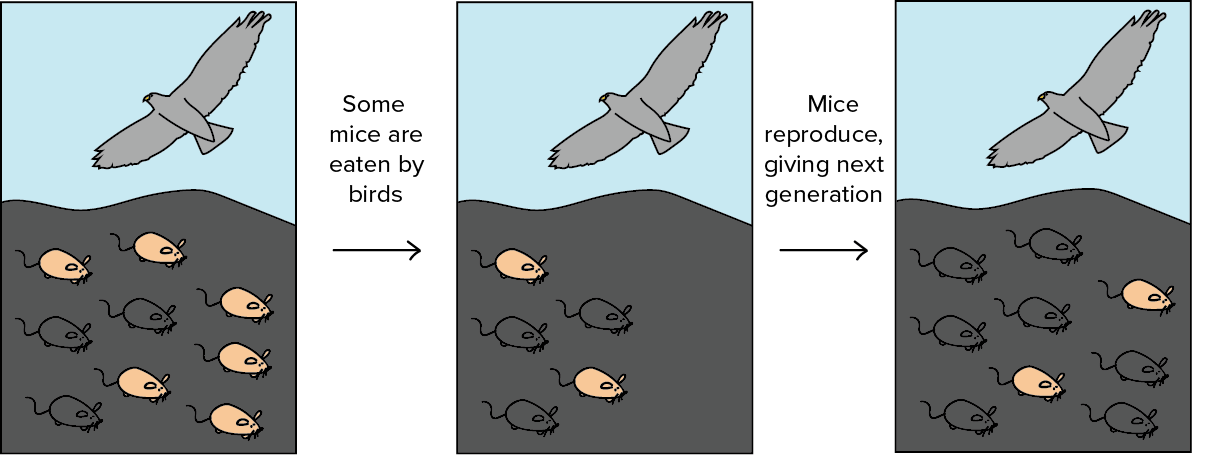
1. A mutation causes a new fur color variation to appear in a mouse population. In which of the situations described below would the new fur color become more common than the old color in the mouse population?
A. If plenty of food is available in the mouse habitat.
A. If the new fur color gene is a recessive allele.
If the amount of reproduction in the mouse population stays the same.
A. If the new fur color gene is helpful in the survival of mice and their offspring.
What is an advantage of sexual reproduction?
Allows genetic variation
Only needs one parent
Happens very quickly
Offspring are exact copies of parent
What is a disadvantage of asexual reproduction?
Organisms cannot adapt to challenges very quickly
Organisms only have one parent
There is more genetic variation
They are all female
Whyich type of reproduction creates more genetic diversity?
Asexual
Sexual
Neither
What is one disadvantage of sexual reproduction?
Only one parent needed
Off spring are exact copies of parents
Happens very quickly
The need to find a mate

What is an adaptation?
A mutation
A trait that improves fitness (the ability tho survive and reproduce)
A selective pressure that causes change
Any change in a population

The green beetles are an example of what selection pressures?
Sexual selection
Predators and environment
Environment and finding food
Diet

The giraffe's neck is an example of ___________________________ resulting from _______________________________ (selection pressure)
Artificial selection, environmental
Natural selection, the need to find food
Artificial selection, human
Natural selection, predator

This gecko has an extreme look, which answer best explains how the gecko got this way?
The gecko is being fancy to attract a mate, the more they look like leaves the more attractive they are the more often they mate.
There was genetic variation in the gecko population, geckos that looked more like leaves had camouflage and survived predators more often and reproduced more often.
This gecko is a mutant and will likely not survive to pass on its genes because it looks so strange and predators will notice it more now.
There is no gecko... it's all in your mind...
An ecological niche is ...?
a small physical space
the role of an organism it its ecosystem
the benefits an organism provides the environment
the same thing as a habitat
Which animal is best suited for this niche?
It lives in woodlands and meadows eating plants and being prey for larger birds and mammals
Bob cat
Gopher snake
Cotton tail rabbit
Stellar Jay
What happens during the process of natural selection
individuals with the most beneficial traits survive and reproduce more offten
Individuals with the weirdest mutations survive and reproduce to create exaggerated traits
Harmful traits are passed onto the next generation

The chameleons tongue is an example of a _________________.
selective pressure
mutation
adaptation
fancy trait

What type of evidence is represented in the picture above:
Fossils
Vestigial Structures
DNA
Homologous Structures

What type of evidence is shown in this picture?
Fossils
Homologous Structures
Vestigial Structures
DNA



What is a fossil?
The rotting remains of ancient animals
The remains of ancient animals preserved in rock
A purse brand for cool moms
According the law of superposition the deeper we dig, _______.
the younger the rocks get
the smellier the rocks get
the harder the rocks get
the older the rocks get
Which analogy is best for a chromosome?
A classroom
A student
A group of students

Check all the selection pressures that you think played a roll in leopards evolving spots?
Female choice- spots are purdy
Finding food- catching prey
Avoiding predators- camouflage
Environment- camouflage in tall grass and dappled shade
Dolphins fins have the same structure (bones) as a wolfs legs, what type of evidence for evolution does this represent?
DNA
vestigial structures
homologous structures
embryology

Which of these wing structures is analogous to the other three?
Bird
Pterodactyl
Butterfly
Bat
Name that Mutation!
When part of a gene is removed
Substitution
Insertion
Deletion
Inversion

How do you know a furby is NOT alive? (select all that apply)
They cannot grow
The can move
They cannot evolve
They can make noise
This sentence is an example of what type of mutation?
The big rat saw got fat cat and ran.
Substitution
Deletion
Insertion
Name that Mutation!
When extra information (bases) are added to a gene
Deletion
Insertion
Substitution

