
 Worksheets
Yr 7 - Forces
Total questions: 65
Worksheet time: 2hrs 39mins


What is defined as a push or pull?
force
motion
vector
speed
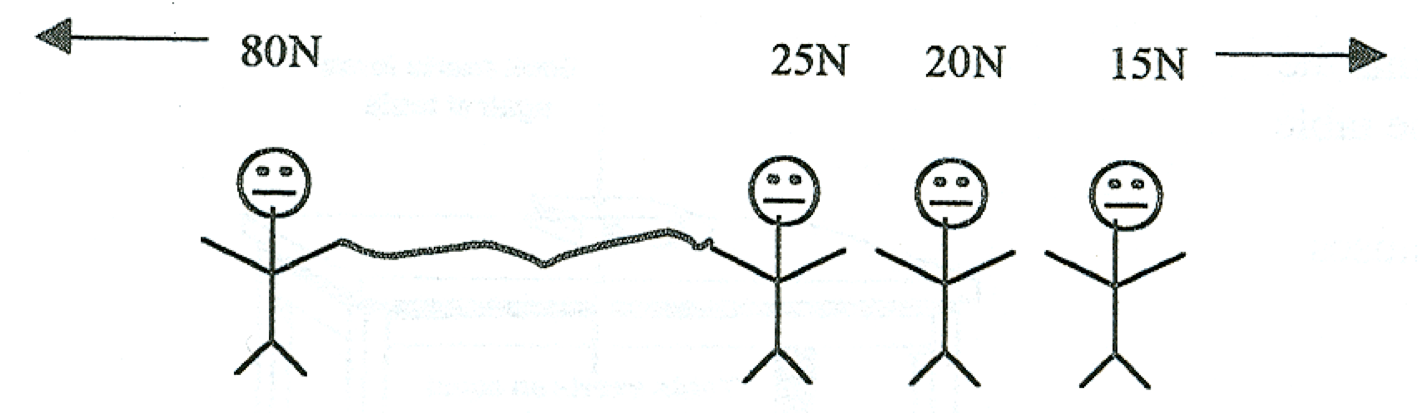
If the net force is equal to zero, the forces acting on the object are
balanced
unbalanced




The magnetic field of a magnet is ____________ further away from the magnet.
stronger
weaker
In a magnet the opposite poles will ___________.
attract
repel

Which of the following forces can push (repel) and pull (attract)?
Magnetic Force
Electric Force
Gravitational Force
Both Magnetic and Electric Force.
All Three, Magnetic, Electric and Gravitational Force.

Iron filings and bar magnets are placed on a piece of paper. Explain the pattern on the diagram below. Where is the magnetic field the strongest?
The magnetic field is only strong at the north pole
The magnetic field is only strong at the south pole
The magnetic field is strongest at the magnet’s poles.
Moving a magnet near a compass can cause the compass needle to move, even though the magnet does not touch the compass. This observation is evidence for which characteristics of magnetic fields?
There is a north and south pole on a magnet.
They can exert a force accross a distance.
Magnetic fields do not exist.
Which of the following data would support the claim that the gravitational force between objects depends on mass?
The gravitational force gets weaker as objects get farther apart.
The graviational force only pulls on objects.
The gravitational force is greater on more massive planets.
The graviational force is only attractive.


How is weight different from mass?
Weight is the measure of the pull of gravity on an object, and mass is the amount of matter in an object.
Weight is the amount of matter in an object, and mass is the measure of the pull of gravity on an object.
Weight is the measure of the pull of gravity on an object, and mass is the amount of space that an object fills.
Weight and mass are no different from each other.
7.Luis rubbed a balloon on his hair and held the balloon next to a faucet trickling water. He observed that as the balloon was placed close to the water, the stream of water appeared to “bend” to move out of the way. Which of the following forces is responsible for the stream of water moving away from the balloon?
Gravity
Magnetism
Friction
Electric
9. Imagine two planets,
Planet A and Planet B, in a distant galaxy. Both planets have the same size, but Planet A has more mass than Planet B. Suppose two identical alien space vehicles land on each planet. Which of the following statements is true?
The weight of the space vehicle is greater on Planet A, but the vehicle’s masses are the same on both planets.
The mass of the space vehicle is greater on Planet A, but the vehicle’s weights are the same on both planets.
Both the mass and weight of the space vehicle are greater on Planet A.
Both the mass and weight of the space vehicle are the same on both planets.
10. A ball rolls down from the top of
a grassy hill, reaches the bottom of the hill, continues to roll, and then
starts to slow down and comes to a stop. What forces caused this ball's motion?
Frictional force caused the ball to roll down the hill, but air resistance caused the ball to slow down and stop.
Magnetic force caused the ball to roll down the hill, but gravity caused the ball to slow down and stop.
The force of the hill caused the ball to roll down it, but gravity caused the ball to slow down and stop.
Gravity caused the ball to roll down the hill, but frictional force caused the ball to slow down and stop.
11. Gordon is making a list of forces for his science class. Which of the following should Gordon NOT list as a force?
gravity
friction
a push or pull
mass
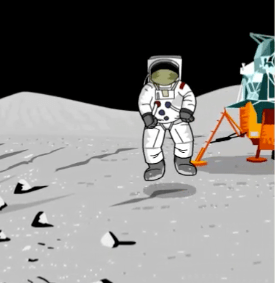
12. On the moon, a bag of sugar has a weight of 3.7 Newtons (N) and a mass of 2.26 kilograms (kg). Which of the following describes the mass of the sugar on Earth?
more than its mass on the Moon
same as its mass on the Moon
less than its mass on the Moon
same as is weight on the Moon
13. Some forces require direct contact, while others, like gravity, act at a distance. Which of the following is NOT influenced by gravity?
Earth's tides
your weight
Earth's Orbit
magnetism
14. Ignoring mass and weight contributed by fuel, what happens when the space shuttle takes off and moves away from Earth?
Its mass decrease and weight increases
Its mass increases and weight decreases
Its mass remains constant and weight decreases
Its mass remains constant and weight increase
15. Gravity is a force that every mass exerts on every other mass. When you jump up in the air, not only does the Earth exert a gravitational force on you, but you also exert a gravitational force on the Earth. You, of course, fall back down to the Earth. Which of the following explains why the Earth is not moving toward you when you jump up in the air?
Earth exerts a gravitational force on itself.
You don’t weigh enough to affects Earth’s surface.
Your mass is very small compared to Earth’s mass.
Earth’s fixed orbit around the Sun keeps it from moving
16. If Earth's mass was cut in half, what would happen to your mass?
increase because gravitational force increases
decrease because gravitational force increases
decrease because gravitational force decreases
nothing, mass is not affected by gravitational force
17. A type of friction that occurs when air pushes against a moving object causing it to negatively accelerate.
surface area
air resistance
descent velocity
gravity
________ acts to slow the rate at which objects fall.
Thrust
Barometer
Air Resistance
Gravity
What is a parachute designed to maximize?
Gravity
Air Pressure
Air Resistance
Thrust
The weight of air pushing on everything around it is called?
Air Resistance
Force
Gravity
Air Pressure
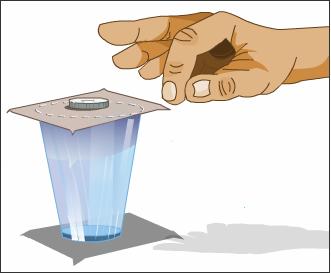
While you’re ice-skating with your friends, you push off from one end of the rink and slide forward. Based on Newton’s first law of motion, what is true?
You will lose your balance and fall over before you reach the middle of the rink.
You will continue to glide until a force causes you to stop or change direction,
The force of gravity will keep your velocity until your friends make you stop.
The size of your skates will determine how quickly or slowly you move over ice.
What is the relationship between heavy objects and inertia?
Only heavy objects have inertia.
Heavy objects have more inertia.
Heavy objects have less inertia.
Heavy objects have no inertia.
You are riding in the car with your grandfather, and he turns left. Why do you shift to the right?
It takes a moment to catch up with the new velocity of the car.
You have more inertia than the car, so it takes longer for you to shift to the left.
You had been sitting at rest until the force of the turn set you in motion.
The car continued in the same velocity, but you had a different inertia.
What does the second part of Newton’s first law say about objects at rest?
They cannot move unless they have a bit of friction.
If they are heavy, they will stay at rest, but if they are light, they will move.
They will stay at rest unless an outside force makes them move.
They have more inertia than objects in motion.

