wayground logo

Free Printable Worksheets

NEW

Font size

S
M
L
XL
Worksheets

SNC1W EXAM REVIEW - CHEMISTRY

Total questions: 80

Worksheet time: 20hrs 0mins

Name
Class
Date
1.
An electron is:
a)
Neutral 
b)
Positively Charged 
c)
Electrostatic 
d)
Negatively Charged 
2.
When the number of electrons and protons is the same, the atom will: 
a)
Have no charge
b)
A positive charge
c)
Explode
d)
A negative charge
3.
Breaking a toothpick is an example of which type of change?
a)
Chemical Change 
b)
Mechanical Change 
c)
No Change 
d)
Physical Change 
4.
An explosion is an example of a: 
a)
Chemical Change 
b)
Physical Change
5.
Solids take the shape of their container.
a)
True
b)
False
6.

The desk is blue and 500 cm

a)

Qualitative

b)

Quantitative

c)

Both

d)

Peanut

7.

There are 3 sub atomic particles that we know of are...

a)

Proton, Neutron, electron

b)

Proton, electron, venton

c)

electron, Noltron, Kontron

d)

Noltron, kontromn, venton

8.
Each column in the periodic table is called a 
a)
period
b)
group
c)
cluster
d)
unit
9.
The atomic number tells you what?
a)
number of electrons
b)
number of protons
c)
number of neutrons
d)
both electrons and protons in an atom.
10.
Which group of the periodic table is composed of inert (not reactive)  gases?
a)
alkali metals
b)
alkaline earth metals
c)
halogens
d)
noble gases
11.
Elements which are shiny, conduct electricity and heat are called
a)
metal
b)
nonmetal
c)
metalloid
d)
nonexistent
12.
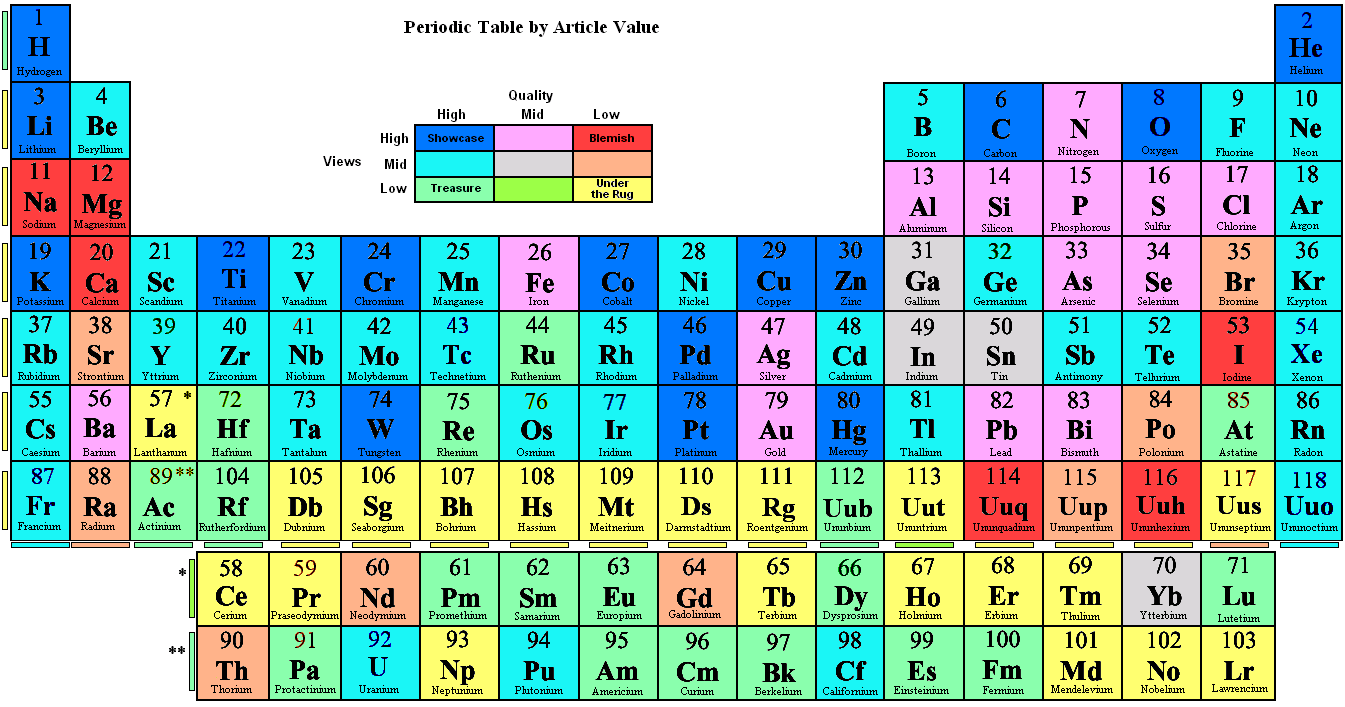
The atoms along the staircase are called 
a)
metals
b)
nonmetals
c)
metalloids
d)
noble gases
13.
Which is a halogen?
a)
Helium
b)
Chlorine
c)
Oxygen
d)
Neptune
14.
Which is an alkali metal?
a)
Magnesium
b)
Iron
c)
Sodium
d)
Europium
15.
A horizontal row of elements in the periodic table.
a)
column
b)
group
c)
period
16.
A vertical column in the periodic table.  Elements share similar properties.
a)
row
b)
group
c)
period
17.
A proton is....
a)
A negatively charged subatomic particle
b)
A positively charged subatomic particle
c)
A neutrally charged subatomic particle
d)
The only subatomic particle located in the nucleus
18.
A neutron has a charge of
a)
+2
b)
No charge
c)
-1
d)
+1
19.
The yellow atoms are called 
a)
metals
b)
nonmetals
c)
metalloids
d)
noble gases
20.

How many Valance electrons does fluorine have?

a)

6

b)

16

c)

7

d)

17

21.
How many electrons does Oxygen need to fill its outer shell?
a)
3
b)
4
c)
1
d)
2
22.
The period for Bromine is ___________.
a)
3
b)
2
c)
4
23.
An element's identity is determined by the number of
a)
electrons.
b)
protons.
c)
neutrons.
d)
valence.
24.
Group 18 elements are known as the _____ _____ and have full valence shells.
a)
royal gases.
b)
supreme solids.
c)
noble gases.
d)
legit liquids.
25.
What period and group is Silver (Ag)? 
a)
Period 2, Group 1
b)
Period 3, Group 16
c)
Period 5, Group 11
d)
Period 2, 14
26.
The elements in this group have 5 valence electrons and include elements N, P, and As.
a)
Group 5
b)
Group 1
c)
Group 18
d)
Group 15
27.
Which of the following is not a property of metals?
a)
brittle
b)
malleable
c)
lustrous
d)
conductive
28.
What happens in ALL chemical changes?
a)
Change in state of matter
b)
A new substance is formed
c)
Bubbles are produced
d)
An explosion
29.
Which of the following is a sign that a chemical reaction has occurred?
a)
change in shape
b)
melting
c)
formation of a gas
d)
dissolving
30.
What subatomic particles would you find in the nucleus of an atom?
a)
Protons only
b)
Protons and Neutrons
c)
Neutrons and Electrons
d)
Protons and Electrons 
31.
Which subatomic particles contribute the most to the mass of an atom?
a)
Protons, Neutrons, Electrons
b)
Protons only
c)
Protons and Electrons
d)
Protons and Neutrons
32.
What is the number of protons that the element in this image contain?
a)
14
b)
7
c)
15
d)
18
33.
An atom has 10 protons, 15 neutrons and 10 electrons what is its mass number.
a)
20
b)
10
c)
5
d)
25
34.
An element with a mass number of 11 and an atomic number of 5 has how many neutrons?
a)
11
b)
5
c)
6
d)
16
35.
What is the atomic number of the atom pictured? 
a)
9
b)
10
c)
18
d)
19
36.
What is the atomic mass of the atom pictured? 
a)
9
b)
10
c)
18
d)
19
37.
How many electron shells/levels does this atom have?
a)
1
b)
2
c)
3
d)
4
38.
Neon has an atomic number of 10 and an atomic mass of 20.180.  How many protons, electrons, and neutrons will it have?
a)
P=10 E=10 N=11
b)
P=5  E=5  N=10
c)
P=10  E=10  N=10
d)
P=10  E=5  N=5
39.
How many valence electrons does Neon have?
a)
7
b)
8
c)
9
d)
10
40.
Which one of these is a chemical property?
a)
melting point
b)
boiling point
c)
color
d)
flammability
41.
Which of the following is a chemical property?
a)
ability to rust
b)
ability to conduct heat
c)
volume
d)
magnetic
42.
What kind of properties can only be observed when a substance changes into a different substance?
a)
physical properties
b)
chemical properties
c)
liquid properties
d)
real properties
43.
Which of the following is an example of MATTER?
a)
light
b)
air
c)
gravity
d)
sound
44.
What is the change of state from a solid straight to a gas called?
a)
melting
b)
evaporating
c)
freezing
d)
sublimation
45.
What is the name of this element?
a)
Helium
b)
Hydrogen
c)
Argon
d)
Silver
46.

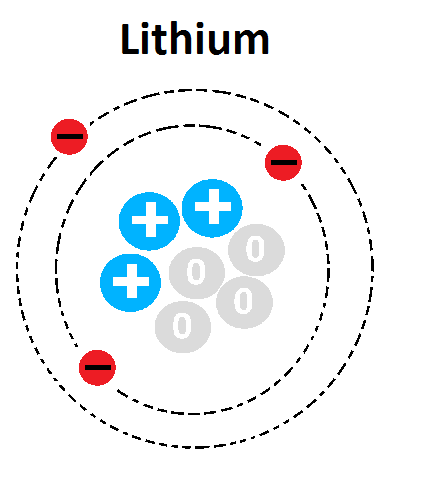
What element is represented in this Bohr Model?

a)

Carbon

b)

Hydrogen

c)

Aluminum

d)

Lithium

47.
What is the mass number of this atom?
a)
1
b)
3
c)
4
d)
7
48.
What is the name of this element?
a)
Lithium
b)
Boron
c)
Carbon
d)
Neon
49.
What's a valence electron?
a)
electrons in the second energy level
b)
electrons in the outermost energy level
c)
the atomic number
d)
electrons in the first level
50.
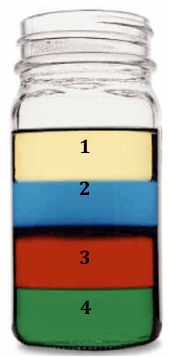
Put the liquids in order from most dense to least dense?
a)
4, 3, 2, 1
b)
1, 2, 3, 4
c)
3, 4, 2, 1, 
d)
4, 3, 1, 2
51.
Why does ice float?
a)
Liquid water is less dense than solid water.
b)
Solid water is less dense than liquid water.
c)
Gaseous water is less dense than solid water.
d)
Liquid water is less dense than gaseous water.
52.
What is the formula for density?
a)
density = mass x volume
b)
density = mass / volume
c)
density = mass + volume
d)
density = mass - volume
53.
Jack has a rock. The rock has a mass of 14 g and a volume of 2 cm3. What is the density of the rock?
a)
7 mL
b)
7 g/cm3
c)
28 g/cm3
d)
1/7 g/cm3
54.
What is the volume of 150 grams of lead if it has a density of 11.3 g/cm3?
a)
13.3 g
b)
13.3 cm3
c)
.075 g
d)
1695 cm3
55.
The density of this material is 2 g/cm3.
There are 24 cm3  Find the total mass.
a)
12 grams
b)
48 grams
c)
12 g/cm3
d)
48 g/cm3
56.

The candy was sour.

a)

Qualitative Data

b)

Quantitative Data

57.

The bug was 5cm long.

a)

Qualitative Data

b)

Quantitative Data

58.

The flower is red.

a)

Qualitative Data

b)

Quantitative Data

59.

It is cloudy outside today.

a)

Qualitative Data

b)

Quantitative Data

60.

There are 13 boys and 14 girls in fifth period.

a)

Qualitative Data

b)

Quantitative Data

61.

The mass of the beaker was 122 g.

a)

Qualitative Data

b)

Quantitative Data

62.
What is an ion?
a)
A Charged Atom
b)
A Large Atom
c)
A Small Atom
d)
A Cute Atom
63.
Why are ions formed?
a)
To make our lives difficult
b)
Because atoms want 8 valence electrons
c)
Because atoms have the same number of protons and electrons
d)
Because atoms gained neutrons
64.
An atom becomes _________ when it gains electrons.
a)
Positive
b)
Negative
c)
Neutral
d)
Invinsible
65.
An atom becomes _______ when it loses electrons.
a)
Positive
b)
Negative
c)
Neutral
d)
Invinsible
66.
A Radium atom wants...
a)
One more electron
b)
One less electron
c)
Two more electrons
d)
Two less electrons
67.
What is a Rubidium ion's symbol?
a)
Rb-
b)
Rb+
c)
Rb-2
d)
Rb+2
68.

What is the symbol for a phosphorus ion?

a)

P-3

b)

P+3

c)

P-2

d)

P+2

69.

What is the symbol for a gallium ion?

a)

Ga+3

b)

Ga-3

c)

Ga+2

d)

Ga-2

70.

When oxygen becomes an ion it will:

a)

gain 2 electrons

b)

lose 2 electrons

c)

gain 8 electrons

d)

lose 8 electrons

71.

What is the electron configuration of sodium?

a)

2, 8

b)

2, 8, 2

c)

2, 8, 1

d)

11

72.

What is the electron configuration of calcium?

a)

2, 8, 8, 2

b)

2, 8, 10

c)

20

d)

2, 18, 2

73.

Which element has an electron configuration of 2, 5?

a)

Oxygen

b)

Nitrogen

c)

Phosphorus

d)

Carbon

74.

Which element has an electron configuration of 2, 8, 8?

a)

Lead

b)

Flourine

c)

Neon

d)

Argon

75.
How many valence electrons are in an atom of Ba?
a)
2
b)
8
c)
4
d)
1
76.
How many valence electrons are in an atom of Ar?
a)
2
b)
8
c)
4
d)
1
77.
How many valence electrons are in an atom of K?
a)
3
b)
8
c)
4
d)
1
78.
How many valence electrons are found in atoms of group 1?
a)
7
b)
6
c)
4
d)
1
79.
If my charge becomes 2+ what does that say about me?
a)
I am stealing 2 electrons
b)
I am losing 2 electrons
c)
I am in period 2
d)
I have an atomic # of 2
80.
If I gain electrons I become
a)
Positive because I've added to my atom
b)
negative because I've added electrons
c)
same because i'm balanced
d)
equal because now I have electrons