wayground logo

Free Printable Worksheets

Font size

S
M
L
XL
Worksheets

SS Final Exam Review

Total questions: 85

Worksheet time: 3hrs 50mins

Name
Class
Date
1.

Is North America located in the Northern Hemisphere or Southern Hemisphere?

a)

Northern Hemisphere

b)

Southern Hemisphere

2.

Is the Indian Ocean located in the Western Hemisphere or Eastern Hemisphere?

a)

Western Hemisphere

b)

Eastern Hemisphere

3.
New York is ______ of Texas.
a)
Northeast
b)
North
c)
Southwest
d)
South
4.
To go from New Jersey (NJ) to Florida (FL) you go _________. 
a)
North
b)
South
c)
East
d)
West
5.
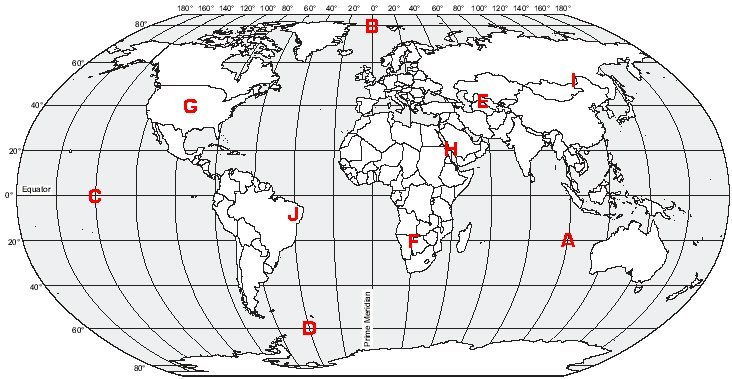
What is the approximate location of letter B?
a)
80oN, 0o
b)
0o, 80oW
c)
80oS, 0o
d)
0o, 80oE
6.
Skilled workers
a)
Artisans
b)
Merchants
c)
Tomb
d)
Nobles
7.

Monotheism means...

a)

Belief in one god

b)

Belief in many gods

c)

Belief in no gods

8.

Which is NOT a feature of culture?

a)

language

b)

architecture

c)

music

d)

geography

9.
What did the first civilizations develop near?
a)

Mountains

b)

Forests

c)

Plains

d)

Rivers

10.

What was the most important development that occurred during the New Stone Age?

a)

domestication of animals

b)

agrictulture

c)

permanent homes

d)

hunting

11.

What is a Hunter-gatherer?

a)

The first known group of people that domesticated animals.

b)

A person that digs up the past using fossils.

c)

A person that mostly eats seeds, berries, nuts, and wild meats.

d)

A person who makes houses out of rocks in the area..

12.
Which of the following advancements made it possible for people to build permanent settlements?
a)
Fire
b)
Stone Tools
c)
Specialization
d)
Agriculture
13.

True or false: Otzi is considered to be a well-preserved mummy.

a)

True

b)

False

14.

Civilization in Mesopotamia developed between which two rivers?

a)

the Persian Gulf and the Mediterranean

b)

the Tigris and the Persian Gulf

c)

the Persian Gulf and the Euphrates

d)

the Euphrates and the Tigris

15.

The Sumerian writing system was called

a)

Cuneiform

b)

Hieroglyphs

c)

English

d)

Sargon

16.
What is Hammurabi's Code?
a)
story of Babylonian empire's creation by the gods
b)
written language of Babylonian Empire
c)
 collection of written laws from the Babylonian Empire
d)
book describing warfare from the Babylonian Empire
17.
A Sumerian temple to honor their chief god was called a
a)
scribe.
b)
cradle.
c)
Gilgamesh.
d)
ziggurat.
18.
Traditional stories used to explain natural events
a)
Poems
b)
Myths
c)
Novels
d)
Tales
19.
How did ancient Egyptians show their belief in an after life?
a)
They believed in only one god
b)
They preserved (Mummified) the bodies of the dead
c)
They became famous warriors
d)
They prayed in temples everyday
20.

Where was the "RED LAND" in Egypt?

a)

In the deserts

b)

On the banks of the river

21.
Pharaohs all had this
a)
absolute power
b)
multiple wives
c)
pyramid tombs
d)
treaties with other peoples
22.

a reed that grew wild along the Nile that was used to make paper

a)

papyrus

b)

cat tails

c)

bermuda

d)

cotton

23.

Pyramids were built to

a)

for worshipping the Gods

b)

to look strong and cool to other nations

c)

be tombs for the Pharaohs

d)

to give farmers jobs when not farming

24.

The Rosetta Stone is a slab of _________________ rock carved in three languages. It led to the deciphering of hieroglyphics.

a)

red

b)

black

c)

blue

d)

purple

25.

Which of these is true?

a)

The top of the social pyramid has the most power.

b)

The bottom of the social pyramid has the most power.

26.

The rebirth of a soul in a new body, based on karma.

a)

dharma

b)

reincarnation

c)

ahisma

d)

shrine

27.
Ancient China was surrounded by desert, mountains and ocean. What impact did these natural borders have on the culture? 
a)
They helped to integrate the cultures of other world civilizations.
b)
They caused China to constantly be at war with other world civilizations.
c)
They helped China to establish trade with other civilizations.
d)
They isolated the Chinese civilization allowing it to develop independently. 
28.
The Silk Road was what?
a)

One road that was the color of silk

b)

A network of roads used for spreading goods and ideas

c)

A road that only silk was traded on

d)

The name of the first road in Asia

29.

The civil service examination system in ancient China brought more able young men into government services although they had to know how to ___________.

a)

read and write

b)

sew

c)

behave

d)

rule

30.

Which geographic features isolated the ancient Greeks from each other and led to the creation of city-states?

a)

flat with rich soil

b)

dry and deserts

c)

rocky and mountainous

d)

none of the above

31.

What sea was to the south of Greece?

a)

Ionian Sea

b)

The Atlantic Ocean

c)

Mediterranean Sea

d)

The Black Sea

32.
Which statement is true?
a)
Pericles focused his attentions entirely on building up the Athenian army.
b)
Pericles was obsessed with riches, and he promoted trade to make himself wealthy.
c)
Pericles encouraged growth in the arts, including music and drama.
d)
Pericles was a timid leader who made very little difference to the development of Athens.
33.
Which city-state was famous for its art, architecture and culture?
a)
Athens
b)
Sparta
c)
Both
34.
Spartan society was notable for
a)
a higher standard of living than most Greek city-states
b)
an emphasis on military and athletic ability
c)
great intellectual and artistic accomplishment
d)
being the birthplace of democracy
35.
Democracy originated in which society?
a)
Greek
b)
Roman
36.
Who was NOT a Greek philosopher?
a)
Pythagoras
b)
Aristotle
c)
Socrates
d)
Plato
37.

Who did the Olympic Games originally honor?

a)

Athena

b)

Zeus

c)

Poseidon

d)

Odysseus

38.
Where is Rome located?
a)
Seven Hills
b)
Italian Peninsula
c)
Along the Tiber River
d)
All of the above
39.

Parts of the Justinian Code were used by many different countries in the Western world as they developed their own laws. 

a)

True

b)

False

40.
In early Roman Republic, which group controlled the government and had the most power?
a)

patricians

b)

plebeians

41.
Justinian's Code was an important contribution in the area of...
a)
The military
b)
Architecture
c)
Religion
d)
The law
42.

Which is NOT a main reason for the Fall of Rome?

a)

Barbarian Invasion

b)

Weak Emperors

c)

Corrupt government

d)

Disease

43.
Land was to the feudal system as ________ is to modern society.
a)
Money
b)
Real estate
c)
Education
d)
Politics
44.
What is a fief?
a)

land given to Knights in exchange for loyalty in the feudal system

b)

Something Kings ate

c)

A disease that killed many peasants

d)

Not a real thing

45.

The Eastern Roman Empire became known as the

a)

Holy Roman Empire

b)

Byzantine Empire

c)

Ottoman Empire

d)

Mongol Empire

46.
The Byzantine capital city was ___.
a)
Constantinople
b)
Rome
c)
Venice
d)
Cordoba
47.
The ___ conquered the Byzantine Empire in 1453 AD.
a)

Muslim Turks

b)

Crusaders

c)

Mongols

d)

Mughals

48.

All of the following were controversies between the Church of Rome and the Byzantine Church EXCEPT —

a)

the language of the Church

b)

the role of women in the Church

c)

the role of the Pope

d)

the religious icons

49.

True or False: Judaism, Christianity, and Islam are all Polytheistic.

a)

True

b)

False

50.

Which of the following do Judaism, Christianity, and Islam all have in common?

a)

All believe in the same god.

b)

All three have prophets.

c)

Jerusalem is the holiest city in the world for all three.

d)

They share the same holy book.

51.

Who fought each other in the Crusades?

a)

The Romans and the Greeks

b)

The Christians and the Muslims

c)

The Eastern and Western Roman Empires

52.

The city of Jerusalem is important to what three major religions?

a)

Buddhism, Hinduism, and Islam

b)

Islam, Christianity, and Hinduism

c)

Islam, Christianity, and Judaism

53.

What religious leader from the Catholic Church helped to organize the First Crusade?

a)

Basil II

b)

Pope Urban II

c)

Justinian

54.
The first Crusade got started when the Seljuk Turks did what?
a)

Prevented Christians from entering Jerusalem

b)

Attacked the Catholic city of Rome

c)

burnt down the city of Jerusalem

d)

Captured the city of Constantinople

55.

How did the Crusades fail?

a)

Crusaders failed to keep control of Jerusalem.

b)

Crusaders failed to conquer Egypt.

c)

Crusaders never won a battle in the Holy Land.

d)

Crusaders destroyed trade relations between East/West.

56.

The Crusades led to an interest in exploration to find better/faster trade routes.

a)

True

b)

False

57.

How did the Black Death spread?

a)

overcrowded, dirty cities

b)

social distancing

c)

trading in the Americas

d)

dogs and cats

58.
A document or other record of past events created by someone who was present during the events or the time period in which they occurred.
a)
Secondary Source
b)
Primary Source
59.

Which of these is NOT an example of a primary source?

a)

Original uniforms worn by soldiers

b)

Diaries written at the time of an event

c)

video of a historical event

d)

A poem about a famous person from your classmate

60.

Something made about an event or time period by someone who was not there

a)

Primary

b)

Secondary

61.
What is movement?
a)
Tells us how people, goods, recourses, and ideas move from one place to another
b)
Tells us what makes an area special and what makes it different from every other area
c)
Tells us ways in which the places in an area are alike.
62.
What is location?
a)
Tells us where people and places are
b)
Tells us what makes an area special and what makes it different from every other area.
c)
Tells how people, goods, resources, and ideas move from one place to another.
63.
The imaginary line that runs through the middle of the earth east and west is called?
a)
Prime Meridian
b)
Equator
c)
Date Line
64.
Cutting down trees to build houses is an example of which?
a)
Location
b)
Place
c)
Human-Environment Interaction
d)
Movement
65.
The fact that Africa is south of Europe is an example of which?
a)
Movement
b)
Absolute Location
c)
Relative Location
d)
Place
66.
Where is it exactly on the Earth?
a)
Place
b)
Perfect Location
c)
Absolute Location
d)
Relative Location
67.
Which of the following is a cardinal direction?
a)
northwest
b)
east
c)
southeast
d)
lake
68.
the term for one-half of a globe or one-half of the planet Earth
a)
Sphere
b)
Legend
c)
Prime Meridian
d)
Hemisphere
69.
Latitude and Longitude are measured in ________.
a)
inches
b)
Feet
c)
Degrees
d)
Grams
70.
What is an imaginary line drawn from the North Pole through Greenwich, England to the South Pole?
a)
longitude
b)
latitude
c)
equator
d)
prime meridian
71.
The artifact below is evidence that Sumerians had
a)
written language
b)
art
c)
chariots
d)
all of the above
72.
Which of these was invented by the Sumerians?
a)
Chariot
b)
Wheel
c)
Cuneiform
d)
all of the above
73.
Bartering between city-states is an example of
a)
HEI
b)
Region
c)
Place
d)
Movement
74.
________ conquered the city states and built the first empire.
a)
Hammurabi
b)
Sargon
c)
Gilgamesh
d)
Bebuchadnezzer
75.
A family of rulers is called a __
a)
Mummy
b)
Dynasty
c)
Kingdom
d)
Summerians
76.
What were people called who were trained to write?
a)
Scribes
b)
Writers
c)
Ms. Flannigan
d)
Pictionary
77.
What was the purpose of the Great Wall of China?
a)
To keep out invaders
b)
It was pretty
c)
The slaves needed jobs
d)
So they didn't mow the neighbors yard
78.

What type of geographic feature would make civilizatins easy to invade?

a)

mountains

b)

plains (open land)

c)

deserts

79.

Confucius believed in a government system based on ________, not on family connections.

a)

ancestry

b)

merit

c)

money

80.

Who makes the decisions in a democracy?

a)

a monarch

b)

the aristocrats

c)

all citizens

d)

slaves

81.

The Romans were greatly influenced by the Greeks.

a)

true

b)

false

82.

How many years have passed between AD 475 and AD 508?

a)

33 years

b)

983 years

c)

982 years

83.

Athens, Rome, and the Islamic Empire all experienced a golden age. This is a time of __________.

a)

brilliance

b)

poverty

c)

religious war

84.

Mohenjo Daro had no water system, and people had to fetch water from the nearby river

a)

True

b)

False

85.

If you were to plan a city layout inspired by Mohenjo Daro, what key features would you include?

a)

Random street layout, limited public spaces, and a focus on religious buildings.

b)

Narrow streets, massive walls, and a hierarchical structure.

c)

Grid system, separate districts, and sophisticated water and sewage systems.

d)

Centralized palace, large temples, and a single water source.