
 Worksheets
Freshman Science Final review 2019
Total questions: 49
Worksheet time: 4hrs 5mins
Name
Class
Date
1.
What is the correct equation for cellular respiration?
a)
6O2 + C6H12O6 -> 6CO2 + 6H2O + Energy
b)
6O2 + C6H12O6 + Energy -> 6CO2 + 6H2O
c)
6CO2 + 6H2O -> 6O2 + C6H12O6 + Energy
d)
6CO2 + 6H2O + Energy -> 6O2 + C6H12O6
2.
What is cellular respiration?
a)
the breakdown of glucose to release ATP
b)
the breakdown of glucose to release NADH
c)
the breakdown of glucose to release FADH
d)
the breakdown of glucose to release carbon
3.
Has membrane bound organelles
a)
Prokaryote
b)
Eukaryote
c)
both
4.
Which of the following provide evidence for the hypothesis that prokaryotes evolved before eukaryotes.
a)
prokaryotes are more complex
b)
prokaryotes have no nucleus and fewer genes
c)
eukaryotes are multicellular which makes them simpler
d)
prokaryotes grow into eukaryotes
5.
Which is true of prokaryotic and eukaryotic cells?
a)
Prokaryotic cells are larger than eukaryotic cells.
b)
Eukaryotic cells do not have nuclei, and prokaryotic cells do have nuclei.
c)
Prokaryotic cells lack membrane-bound organelles, and eukaryotic cells contain membrane-bound organelles.
d)
Eukaryotic cells are simpler than prokaryotic cells.
6.
What is special about organisms that are autotrophs?
a)
They have 10 legs.
b)
They make their own food.
c)
They only eat at night.
d)
They are brightly colored.
7.
Which type of organism cannot make their own food and must get it by eating other organisms?
a)
autotroph
b)
plant
c)
fungi
d)
heterotroph
8.
Which equation below represents photosynthesis?
a)
b)
c)
d)
9.
Proteins are made of monomers called ___________
a)
Nucleotides
b)
Monosaccharides
c)
Amino Acids
d)
Glycerol and fatty acids
10.
DNA and RNA are examples of
a)
Carbohydrates
b)
Lipids
c)
Proteins
d)
Nucleic Acids
11.

Which macromolecule is shown?
View Figure 1 (if not visible)
View Figure 1 (if not visible)
a)
lipid
b)
protein
c)
nucleic acid
d)
carbohydrate
12.
What is the function of nucleic acids?
a)
store genetic information
b)
store energy (long-term)
c)
store energy (short-term)
d)
build skin, hair, nails, muscles
13.
Genetic information is stored in which class of organic compounds?
a)
proteins
b)
lipids
c)
nucleic acids
d)
carbohydrates
14.
All organic compounds contain the element
a)
carbon
b)
nitrogen
c)
phosphorus
d)
sulfur
15.
Enzymes are..
a)
nucleic acids
b)
carbohydrates
c)
lipids
d)
proteins
16.
What is the function of cellulose?
a)
store long-term energy
b)
repair tissues
c)
create plant cell walls
d)
supply short-term energy
17.

This multicellular monster is comprised of cells with no cell walls, and it actually ate the scientist who discovered that!
a)
Protista
b)
Fungi
c)
Plantae
d)
Animalia
18.

Although menacing in appearance, this multicellular monstrosity was found to be entirely autotrophic. (The scientist stuck in its back happened purely by accident!) Under closer examination, its cells appeared to be surrounded by cell walls made of cellulose.
a)
Protista
b)
Fungi
c)
Plantae
d)
Animalia
19.

Cattle egrets forage (feed) in fields among cattle. The egret gets easy access to flying insects stirred up by the cattle, and the cattle don't care if they are there or not.
a)
mutualism
b)
commensalism
c)
competition
d)
parasitism
20.
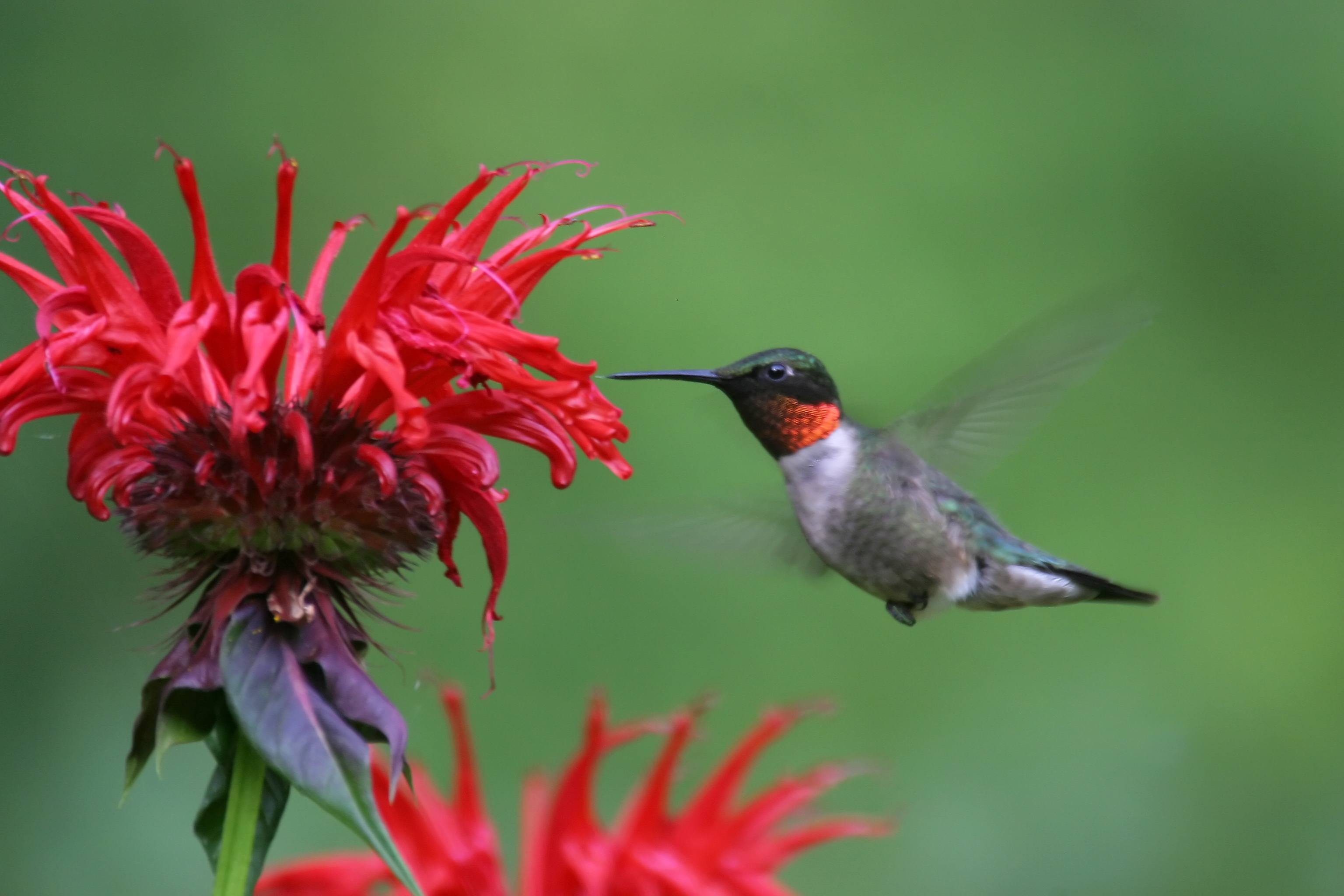
What type of symbiosis? Hummingbirds feed on nectar from flowers. The flowers are pollinated by hummingbirds as they move from flower to flower.
a)
commensalism
b)
mutualism
c)
parasitism
d)
predation
21.
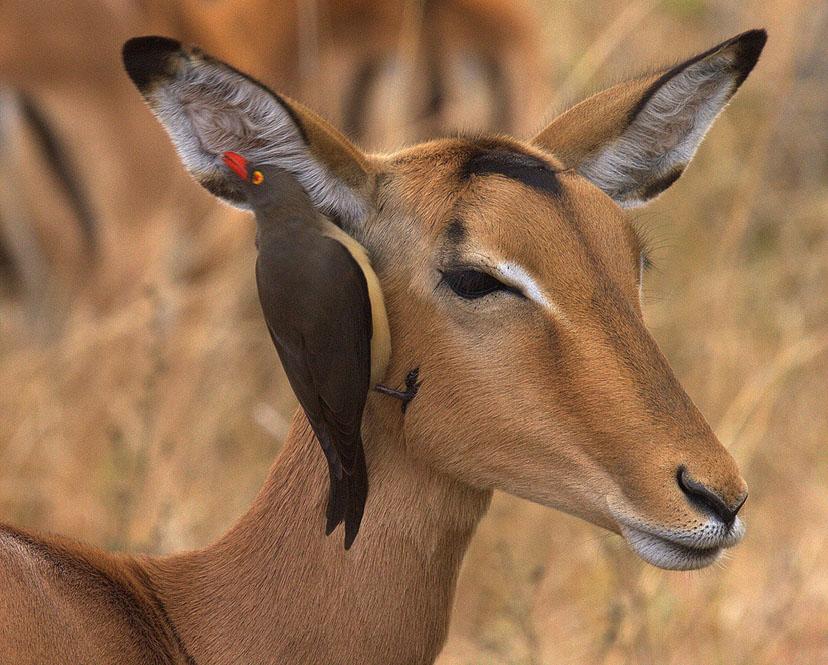
Red-billed oxpeckers are birds that often feed on parasites that infest impala. This is an example of _______.
a)
commensalism
b)
mutualism
c)
neutralism
d)
competition
22.

The graph represents a _______________ relationship between moose and wolves.
a)
competitive
b)
mutualistic
c)
parasitic
d)
predator-prey
23.
What kind of transport does not require energy?
a)
Active
b)
Vacuole
c)
Passive
d)
Na/K Pump
24.
Which of the following is the best example of osmosis?
a)
NA/K Pump
b)
Water moving though the cell membrane
c)
Kidneys
d)
Photosynthesis
25.
a cell organelle which contains chemicals that break down large food particles into smaller ones and that can be used by the rest of the cell
a)
chloroplasts
b)
ribosomes
c)
lysosomes
d)
cell membrane
26.

a small grain shaped organelle found in the cytoplasm of a cell or on the R-ER that produced proteins
a)
cytoplasm
b)
ribosome
c)
cell membrane
d)
mitochondria
27.
In which stage of the cell cycle does the cell duplicate its DNA?
a)
G1
b)
S
c)
G2
d)
Mitosis
28.
A human cell has 46 chromosomes before mitotic division. How many chromosomes will the daughter cells after mitosis.
a)
12
b)
23
c)
46
d)
92
29.

The stages of mitosis in order
a)
Metaphase, Anaphase, Prophase, Telophase
b)
Prophase, Anaphase, Metaphase, Telophase
c)
Prophase, Metaphase, Anaphase, Telophase
d)
Anaphase, Prophase, Telophase, Metaphase
30.

The structures labeled B are
a)
centrioles
b)
chromatids
c)
centromeres
d)
chromopheres
31.
Enzymes are considered to be
a)
Lipids
b)
Carbohydrate
c)
Protein
d)
Nucleic Acid
32.
Enzymes are capable of increasing the rate of a chemical reaction within a living cell. Enzymes accomplish this through which of the following means?
a)
reducing the number of products
b)
reducing the activation energy
c)
increasing the temperature of the cell
d)
increasing the concentration of reactants
33.
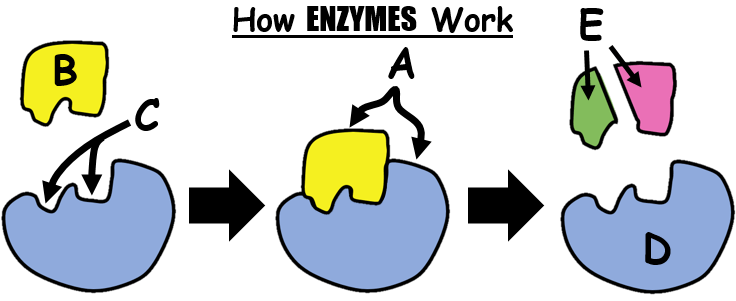
Letter C...
a)
active site
b)
enzymes
c)
substrate
d)
products
34.

An organism that lives by breaking apart dead organic matter into simpler parts is...
a)
scavenger
b)
consumer
c)
decomposer
d)
carnivore
35.

Which of the following is a herbivore?
a)
cricket
b)
frog
c)
hawk
d)
shrew
36.
A community of living and nonliving things in their natural environment makes up a
a)
food web
b)
ecosystem
c)
food chain
37.

If the grasshopper were to be removed completely from the food web, what organism would be most effected?
a)
The squirrel
b)
The shrew
c)
The deer
d)
The rabbit
38.
Which of the following organisms are LEAST closely related?
a)
organisms that share a domain
b)
organisms that share a family
c)
organisms that share a genus
d)
organisms that share a species
39.
The scientific name for an organism is made from the:
a)
class and family name
b)
genus and species name
c)
domain and kingdom name
d)
kingdom and phylum name
40.
The 8 levels of classification, most broad to most specific.
a)
Domain, Genus, Family, Order, Class, Phylum, Kingdom, Species
b)
Domain, Species, Kingdom, Genus, Phylum, Family, Class, Order
c)
Domain, Kingdom, Phylum, Class, Order, Family, Genus, Species
d)
Order, Kingdom, Species, Domain, Phylum, Family, Class, Genus
41.
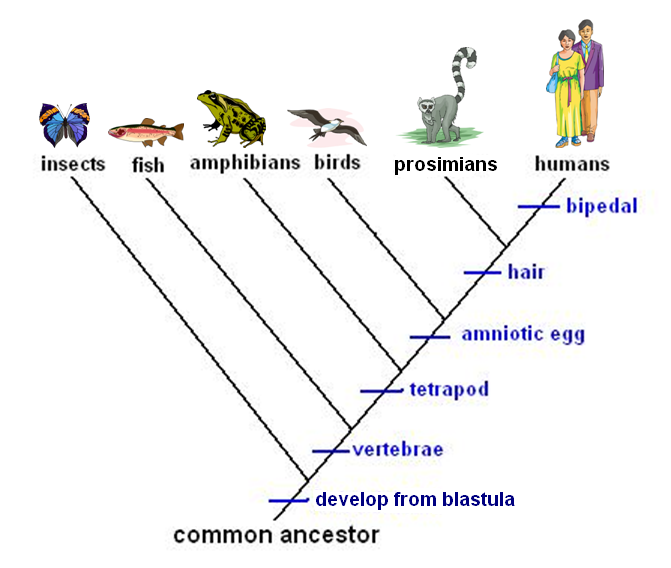
Which organisms pictured on the cladogram have hair?
a)
prosimians only
b)
prosimians and humans
c)
humans only
d)
prosimians and birds
42.
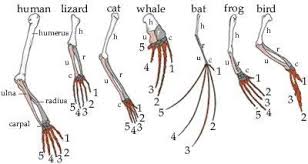
What is this an example of?
a)
vestigial structures
b)
embryology
c)
homologous structures
d)
fossil record
43.
A flash flood carried a raft of Amazon ants away from their original population. There is enough distance between the two groups, that they will never meet in nature again. What type of reproductive barrier is this?
a)
behavioral isolation
b)
temporal isolation
c)
gametic isolation
d)
geographic isolation
44.
The flowers of pink tulips open in the morning, while the flowers of lavender tulips open in the early afternoon. The bees that pollinate these tulips cannot carry pollen back & forth between the two types of tulips because of their flowers being closed at different times of day. What type of reproductive barrier is this?
a)
behavioral isolation
b)
hybrid sterility
c)
temporal isolation
d)
mechanical isolation
45.
The term for the formation of new and distinct species over the course of evolution is...
a)
speciation
b)
biological species concept
c)
reproductive barrier
d)
natural selection
46.
What is a species?
a)
A group of organisms that can mate with each other and produce fertile offspring.
b)
A group of organisms that can mate and produce offspring even if those offspring are infertile.
c)
A group of organisms that genetically are very different from each other.
d)
Indivual organisms that live in the same environment.
47.

What type of selection is depicted in the picture?
a)
stabilizing
b)
directional
c)
disruptive
d)
the answer is not here
48.

What type of selection?
a)
Directional
b)
Stabilizing
c)
Disruptive
49.

Which of the three graphs shows stabilizing selection?
a)
A
b)
B
c)
C
100 %

