wayground logo

Free Printable Worksheets

Font size

S
M
L
XL
Worksheets

Taher- physics-Reflection and Mirrors

Total questions: 47

Worksheet time: 52mins

Name
Class
Date
1.

You place in front a concave mirror an object as showen in figure What are the image properies

a)

real, inverted , and smaller

b)

real ,upright , and larger

c)

real , inverted, and larger

d)

virtual , inverted , and larger

e)

virtual , inverted , and smaller

2.

This image is

a)

real.

b)

virtual.

3.

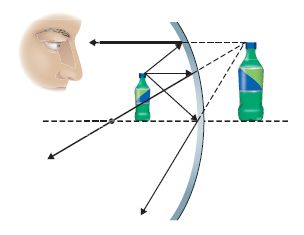
The image formed by this diverging mirror is

a)

upright, smaller, real

b)

inverted, larger, virtual

c)

upright, smaller, virtual

d)

inverted, smaller, real

4.

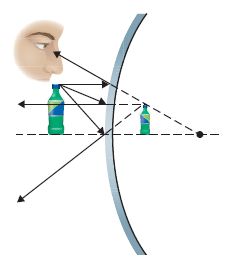
The image formed by this converging mirror is

a)

upright, same size, virtual

b)

inverted, same size, real

c)

inverted, larger, virtual

d)

upright, smaller, real

5.
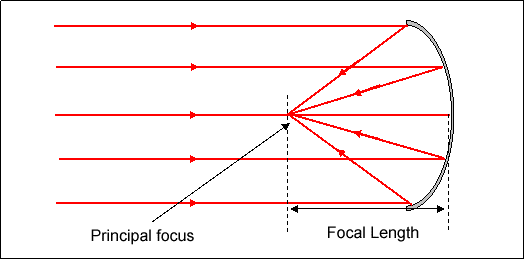
This is an example of a __________ mirror.
a)
Concave
b)
Convex
c)
Plane
d)
Magnifying
6.
Which of the mirrors is used as rear view mirror in vehicles?
a)
Concave
b)
Convex
c)
Plane
7.
This diagram best represents 
a)
reflection
b)
refraction
c)
absorption
d)
diffusion
8.
How does light travel
a)
It curves around corners
b)
Really slow
c)
In a straight line
d)
In circles
9.
What is B?
a)
Angle of incidence
b)
Angle of reflection
c)
Incident ray
d)
Reflected ray
10.
What is C?
a)
Angle of incidence
b)
Angle of reflection
c)
Incident ray
d)
Reflected ray
11.
What is E?
a)
Angle of incidence
b)
Angle of reflection
c)
Normal
d)
Reflect ray
12.
Convex mirrors can create real images.
a)
True
b)
False
13.
Concave mirrors can create virtual and real images.
a)
True
b)
False
14.
Which type of mirror magnifies a close up image, like a make-up mirror.
a)
Concave
b)
Convex
c)
Specular
d)
Plane
15.
Why can you see most objects?
a)
A. they emit light
b)
B. light refracts through them
c)
C. light reflects off them
d)
D. they absorb light
16.
What is the value of the unknown angle (theta) in the following diagram?
a)
A. 30 degrees
b)
B. 45 degrees
c)
C. 90 degrees
d)
D. 60 degrees
17.
An object is placed 10 cm from a convex mirror. Its image is formed 5 cm behind the mirror.The focal length of the given convex mirror is
a)
-5 cm
b)
5 cm
c)
10 cm
d)
-10cm
18.
A real image having a size of 10 cm is formed by a concave mirror. The size of the object is 5 cm.The magnification of the object is
a)
-5
b)
5
c)
2
d)
-2
19.
an image that forms when light rays actually meet
a)
virtual image
b)
real image
c)
diffuse reflection
d)
regular reflection
20.
Which terms describe the reflection seen in this image?
a)
virtual, upright
b)
virtual, inverted
c)
real, upright
d)
real, inverted
21.
What type of image is produced by a flat mirror?
a)
Real and upright
b)
Real and inverted
c)
Virtual and upright
d)
Virtual and inverted
22.
Convex mirrors can create real images.
a)
True
b)
False
23.
Concave mirrors can create virtual and real images.
a)
True
b)
False
24.
Plane mirrors create real images.
a)
True
b)
False
25.
In a concave mirror, if an incident ray passes through F and hits the mirror then it will reflect
a)
Towards C
b)
Towards F
c)
Parallel
d)
Away from the mirror
26.
Convex Mirrors produce...
a)
only virtual images
b)
virtual or real images
c)
only real images
d)
inverted images
27.
What kind of mirror is shown here?
a)
plane
b)
concave
c)
convex
d)
diffuse
28.
What is B?
a)
Angle of incidence
b)
Angle of reflection
c)
Incident ray
d)
Reflected ray
29.

Which of the following statements is/are true of a virtual image?

a)

Virtual images are always located behind the mirror.

b)

Virtual images can be magnified in size, reduced in size or the same size as the object.

c)

Virtual images can be formed by concave, convex and plane mirrors.

d)

All of these

30.
An image that you can see , but does not really exist is called which of the following?
a)
Real Image
b)
Fake Image
c)
Virtual Image
d)
Digital Image
31.
An object is placed 10 cm from a convex mirror. Its image is formed 5 cm behind the mirror.The focal length of the given convex mirror is
a)
-5 cm
b)
5 cm
c)
10 cm
d)
-10cm
32.
a flat sheet of glass that has a smooth, silver-colored coating on one side
a)
plane mirror
b)
concave mirror
c)
convex mirror
d)
solid mirror
33.

You place infront a convex mirror an object as showen in figure What are the image properties ( choose 3 )

a)

real

b)

virtual

c)

upright

d)

inverted

e)

larger

34.

true or false

a)

true

b)

false

35.

True or False

a)

True

b)

False

36.

TRUE or FALSE

a)

True

b)

False

37.

Light from a laser strikes a plane mirror at an angle of 38° to the normal. If the angle of incidence increases by 13°,what is the new angle of reflection?

a)

38

b)

51

c)

25

d)

76

38.

Suppose the angle of incidence of a light ray is 42°.What is the angle of reflection?

a)

42

b)

90-42=84

c)

90+42=132

39.

Suppose the angle of incidence of a light ray is 42°. What is the angle between the incident ray and the reflected ray?

a)

42

b)

90-42=48

c)

90+42=132

d)

42+42=84

40.

On a smooth surface ,parallel light rays reflect in parallel.

a)

specular reflection

b)

diffuse Reflection

41.

On a rough surface ,parallel light rays reflect in different directions, not in parallel

a)

specular reflection

b)

diffuse reflection.

42.

which is plane mirror?

a)
b)
c)
43.

which is convex mirror?

a)
b)
c)
44.

which is concave mirror?

a)
b)
c)
45.

You place an object Xo=36.0 cm in front of a concave mirror with a F=16.0-cm focal length.Determine the image position. Xi=?

a)

28.8

b)

13.8

c)

11

d)

-11

46.

You place an object Xo=36.0 cm in front of a convex mirror with a F=16.0-cm focal length.Determine the image position. Xi=?

a)

28.8

b)

13.8

c)

11.07

d)

-11.7

47.

You place a 3.0 cm-tall object 20.0 cm from a concave mirror with a 16.0 cm focal length . Determine the image position Xi=?

a)

13.8

b)

28.8

c)

11.07

d)

-11.07

e)

80