wayground logo

Free Printable Worksheets

NEW

Font size

S
M
L
XL
Worksheets

ELECTRO KIMIA

Total questions: 63

Worksheet time: 1hrs 2mins

Name
Class
Date
1.

The area of chemistry that deals with the interconversion of electrical energy and chemical energy is ...

a)

electrophysics

b)

electrochemistry

c)

electrolysis

d)

electrocatalysts

2.

Berikut ini adalah fungsi baterai dalam elektrolisis, kecuali

a)

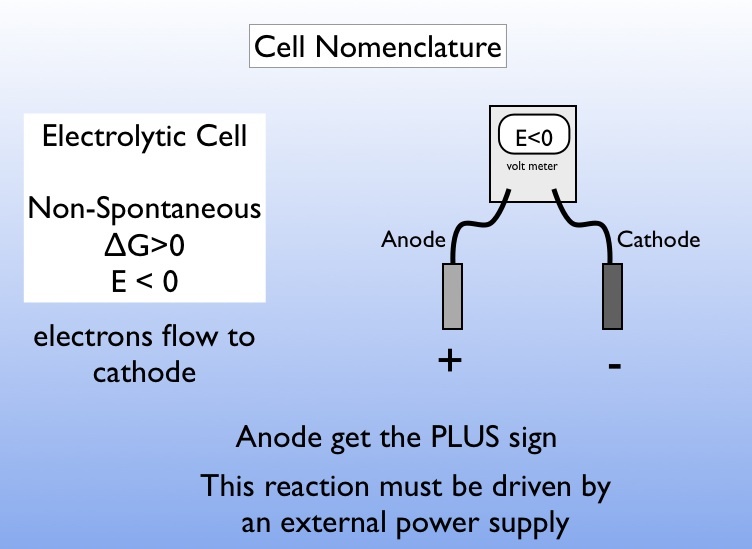
electron pump

b)

mengarahkan elektron ke katoda

c)

menarik elektron dari anoda

d)

menarik elektron dari katoda

3.

What is an anode?

a)

It is the electrode where oxidation takes place.

b)

It is the electrode where reduction takes place.

c)

It is an aqueous solution containing an electrode.

d)

It is the salt bridge that connects half-cells.

4.

What is a cathode?

a)

It is the electrode where oxidation takes place.

b)

It is the electrode where reduction takes place.

c)

It is an aqueous solution containing an electrode.

d)

It is the salt bridge that connects half-cells.

5.

Electrons always flow from

a)

cathode to anode

b)

anode to cathode

6.

Electrons are gained at the

a)

anode

b)

cathode

7.

What occurs to the mass of copper electrode in the following reaction?

Zn/Zn2+ // Cu2+/Cu

a)

increases

b)

decreases

c)

remains the same

8.

Which metal is the negative electrode?

Zn/Zn2+ // Cu2+/Cu

a)

zinc

b)

copper

9.
What is electrolysis?
a)
breaking down of a compound using a current
b)
making a compound using a current
10.
What kind of Electrical Current does Electroysis require?
a)
Direct
b)
Indirect
c)
Anternative
d)
A alternating
11.
Which statement correctly describes the 2 electrodes?
a)
The anode is negative and the cathode is positive
b)
The anode and cathode are both positive
c)
The anode is positive and the cathode is negative
d)
The anode and cathode are both negative.
12.
What is the name given to the solution that is being electrolysed?
a)
Salt solution
b)
Electric solution
c)
Mineral solution
d)
Electrolyte
13.
Explain why the electrolyte has to be a liquid.
a)
So the ions can move
b)
So the electrons can move
c)
So that it doesn't get too hot
d)
So the fish are ok
14.
It is essetial that the electrolyte is a liquid so that...
a)
Charged ions can migrate towards the electrodes. 
b)
Charged ions can migrate towards the electrodes.
c)
The solution can move around.
d)
The current can flow through it.
15.
What happens at the positive electrode?
a)
Positive non-metal ions are attracted
b)
Positive metal ions are attracted
c)
Negative non-metal ions are attracted
d)
Negative metal ions are attracted
16.
Positive ions (cations) will move towards the cathode (-) where they will discharge by....
a)
Breaking apart
b)
Losing electrons
c)
Clumping together.
d)
Gaining electrons
17.
When NaCl solution is electrolysed what has forms at the anode?
a)
Hydrogen
b)
Oxygen
c)
Chlorine
d)
Sodium
18.
What does the Cathode (-) do to ions?
a)
Give electrons to the Positive ions to turn them back into atoms
b)
Take electrons from the positive ions?
c)
Turn ions back into atoms by removing electrons
d)
Turn atoms into ions by adding electrons
19.
What is the product formed at the cathode during the electrolysis of molten magnesium fluoride?
a)
magnesium
b)
hydrogen
c)
fluorine
d)
oxygen
20.
What is the gas produced at the anode during the electrolysis of dilute hydrochloric acid?
a)
water
b)
oxygen
c)
hydrogen
d)
chlorine
21.
What is the product formed at the anode during the electrolysis of concentrated copper(II) chloride?
a)
copper
b)
chlorine
c)
hydrogen
d)
oxygen
22.
What does the Cathode (-) do to ions?
a)
Give electrons to the Positive ions to turn them back into atoms
b)
Take electrons from the positive ions?
c)
Turn ions back into atoms by removing electrons
d)
Turn atoms into ions by adding electrons
23.
Why can ionic compounds not conduct electricity when they are solid?
a)
their electrons are not free to move
b)
their ions are free to move
c)
their ions are not free to move
d)
their electrons are free to move
24.
What type of charge does a metal ion have?
a)
+
b)
-
25.
The electrode connected to the positive terminal of a battery is __________.
a)
cathode
b)
anode
26.
An experiment is set up as shown in the diagram below.  Both electrodes P and Q are made of graphite.  Which of the following gives the correct results as electrolysis proceeds? 
a)
Electrolytes: Aqueous sodium chloride; Mass of P: Remains unchanged;                Mass of Q: Increase
b)
Electrolytes: Aqueous sodium chloride; Mass of P: Increase; Mass of Q: Remains unchanged
c)
Electrolytes: Aqueous copper(II) sulfate; Mass of P: Remains unchanged;             Mass of Q: Increase
d)
Electrolytes: Aqueous copper(II) sulfate;              Mass of P: Increase; Mass of Q: Remains unchanged
27.
What is an electrolytic cell? 
a)
a cell that converts chemical energy into electrical energy 
b)
a cell that converts electrical energy into electrical energy 
c)
a cell that converts electrical energy into chemical energy 
d)
A cell that converts kinetic energy into potential energy. 
28.
What is the name of the negative electrode?
a)
cathode
b)
anode
29.
What is the name of the positive electrode?
a)
cathode
b)
anode
30.
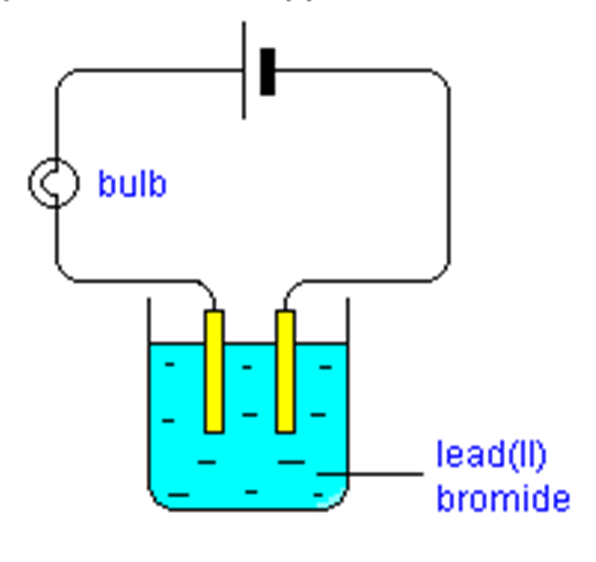
The diagram shows the electrolysis of lead(II) bromide using inert electrodes. Why does the bulb only light up  when the lead(II) bromide is melted?
a)
Bromine atoms in lead(II) bromide are converted to ions when it is melted
b)
Electrons flow through the lead(II) bromide when it is melted
c)
The ions in lead(II) bromide are acting as the mobile charge carriers when it is melted
d)
There are no ions in solid lead(II) bromide
31.
In electrolytic cell which its electrolyte is aqueous copper (II) sulfate, copper are used as electrodes. What is the product at the anode?
a)
Oxygen gas and water
b)
Copper metal
c)
Copper (II) ions
d)
Hydrogen gas
32.
Anion loses electrons at the
a)
cathode
b)
anode
33.
What is the name of a positively charged ion?
a)
positron
b)
proton
c)
cation
d)
anion
34.
What is the name of a negatively charged ion?
a)
negatron
b)
electron
c)
cation
d)
anion
35.
What is the name of a negatively charged electrode?
a)
cathode
b)
anode
c)
cation
d)
anion
36.
What is the name of a positively charged electrode?
a)
cathode
b)
anode
c)
cation
d)
anion
37.
What state must the ionic compound be in to be electrolysed?
a)
aqueous only
b)
solid only
c)
solid or aqueous only
d)
molten or aqueous only
38.
What particle carries the charge in the wire?
a)
electron
b)
proton
c)
ion
d)
atom
39.
What particle carries the charge in the electrolyte?
a)
electron
b)
proton
c)
ion
d)
atom
40.
Which non-metal is often used for electrodes?
a)
carbon
b)
copper
c)
zinc
d)
silicon dioxide
41.
In an aqueous solution of copper chloride, which ions are attracted to the negative electrode?
a)
Cu2+ and Cland Hand OH-
b)
Cu2+ and H
c)
 Cland OH-
d)
Cu2+ 
42.
In an aqueous solution of copper chloride, which substance is produced at the positive electrode
a)
copper
b)
chlorine
c)
oxygen
d)
chloride 
43.

How many atoms are in a molecule of water?

a)

3 atoms

b)

2 atoms

c)

1 atom

d)

4 atoms

44.
What is the name of the positive electrode?
a)
cathode
b)
anode
45.
What is the name of the negative electrode?
a)
cathode
b)
anode
46.

Choose the half-equation that shows the discharge of aluminium ion.

a)

Al3+ - 3e- --> Al

b)

Al2+ + 3e- --> Al

c)

Al3+ + 3e- --> Al

d)

Al3+ --> Al + 3e-

47.

What is the half-equation for the discharge of hydroxide ions?

a)

2O2- --> O2 + 4e-

b)

OH- --> OH + e

c)

4OH- --> 2H2O + O2 + 4e-

d)

2H2O + O2 + 4e- --> 4OH-

48.

Describe the test for oxygen

a)

Squeaky pop

b)

Relight glowing splint

c)

Lime water goes cloudy

49.

Describe the test for chlorine gas

a)

Blue litmus paper turns white

b)

Squeaky pop test

c)

Lime water turns cloudy

50.

Describe the test for hydrogen

a)

Squeaky pop

b)

Glowing splint relights

c)

Lime water goes cloudy

51.

What is produced at the anode and a cathode during the electrolysis of brine (sodium chloride solution)?

a)

Anode: Chlorine

Cathode: Hydrogen

b)

Anode: Hydrogen

Cathode: Chlorine

c)

Anode: Hydrogen

Cathode: Copper

52.

What charge do ions attracted to the cathode electrode have?

a)

Negative

b)

Positive

c)

Neutral

53.

Explains why when solid lead bromide is melted it results in bromine gas being produced at the anode.

a)

Ions cannot move in solid, ions free to move in molten liquid and

Br- ions move to anode to form bromine molecule.

b)

Ions can only move in solid and Br- ions move to anode to form bromine molecule.

c)

Ions can only move in solid and Br- ions move to cathode to form bromine compouds.

54.

Write the half equations to show what produced at the anode and cathode when the electrolysis of copper sulfate solution is carried out

a)

Cathode: Cu2+ + 2e- --> Cu; 1

Anode: 4OH- --> 4e- + 2H2O + O2

b)

Anode: Cu2+ + 2e- --> Cu; 1

Cathode: 4OH- --> 4e- + 2H2O + O2

55.
What are produced at positive/negative electrodes during electrolysis of molten NaCI?
a)
A
b)
B
c)
C
d)
D
56.
Which factors affect amount of metal formed during electrolysis?
a)
I and II
b)
I and III
c)
II and III
d)
I, II and III
57.
What happens when molten NaCI is electrolysed in electrolytic cell?
a)
Chlorine is produced at positive electrode
b)
Sodium ions lose electrons at negative electrode
c)
Electrons flow through liquid from -ve electrode to +ve electrode
d)
Oxidation occurs at -ve electrode and reduction at +ve electrode
58.
Complete the half equation Al3+ --> 
a)
Al3+ - 3e- --> Al
b)
Al2+ + 3e- --> Al
c)
Al3+ + 3e- --> Al
d)
Al3+ --> Al + 3e-
59.
What element is used to make up the electrodes?
a)
oxygen
b)
iron
c)
carbon
d)
magnesium
60.
What is the name given to the solution that is being electrolysed?
a)
Salt solution
b)
Electric solution
c)
Mineral solution
d)
Electrolyte
61.
What is the equation to show what happens to Cl ions at the anode.
a)
Cl- --> Cl + e-   
b)
2Cl- --> Cl2 + 2e-   
c)
Cl2 + 2e-   2Cl- 
d)
Cl2 + 2e-  -->  2Cl- 
62.

Which metal is more reactive than magnesium?

a)

Iron

b)

Aluminum

c)

Sodium

d)

Zinc

63.

The half-reaction that occurs at the anode during the electrolysis of molten sodium bromide is:

a)

2 Br- ------------ Br2 + 2 e-

b)

Br2 + 2 e- ------------- 2 Br-

c)

Na+ + e- ------------------ Na

d)

Na -------------- Na+ + e-