
 Worksheets
quantum theory and periodic trends
Total questions: 63
Worksheet time: 2hrs 49mins
Name
Class
Date
1.

Based on the picture, choose the best description of how wavelength and frequency are related
a)
As wavelength increases, frequency increases
b)
As frequency increases, wavelength remains the same
c)
As frequency increases, wavelength decreases
d)
frequency and wavelength mean the same thing
2.

Which letter represents the wave trough?
a)
A
b)
B
c)
C
d)
D
3.

Which letter represents the wave trough?
a)
A
b)
B
c)
C
d)
D
4.

Which letter represents wavelength?
a)
A
b)
B
c)
C
d)
D
5.

Which wave has a greater frequency?
a)
A
b)
B
6.

The orange line is measuring the _________________________.
a)
wavelength
b)
amplitude
c)
crest
d)
trough
7.
What is the Pauli Exclusion Principle?
a)
An atomic orbital can only hold a maximum of 2 electrons, each with opposite spins
b)
An atomic orbital can hold a minimum of 6 electrons, each with opposite spins
c)
An atomic orbital can hold a maximum of 6 electrons, each with the same spin
d)
An atomic orbital can hold a minimum of 2 electrons, each with opposite spins
8.
Electrons occupy orbitals of lowest energy first is part of what electron configuration rule?
a)
Hund’s Rule
b)
Aufbau Principle
c)
Pauli Exclusion Principle
9.
What is this element?
1s22s22p63s2
1s22s22p63s2
a)
Neon
b)
Magnesium
c)
Aluminum
d)
Potassium
10.
What is this element?
1s22s22p63s23p64s23d10
1s22s22p63s23p64s23d10
a)
Zinc
b)
Copper
c)
Nickel
d)
Germanium
11.
What is the noble gas configuration for Sulfur?
a)
[Ar] 3p4
b)
[He] 3s2 3p4
c)
[Ne] 3s2 3p4
d)
[Na] 3s2 3p4
12.
What shape are P Orbitals?
a)
Cloverleaf shaped
b)
Spherical shaped
c)
Hybrid structure
d)
Dumbell shaped
13.
Hund’s rule states…
a)
Atomic orbitals have opposite spins and 2 electrons each
b)
Electrons occupy orbitals of highest energy first and energy level changes as you go up
c)
Electrons occupy orbitals of lowest energy first, starting with 1s
d)
Fill orbitals of the same energy with one electron, then go back and pair them up if you have extra electrons
14.
What is the electron configuration for Bromine (Br)
a)
1s2, 2s2, 2p6, 3s2, 3p6, 4s2, 3d1
b)
1s2, 2s2, 2p4
c)
1s2, 2s2, 2p6, 3s2, 3p6, 4s2, 3d10, 4p5
d)
1s2, 2s2, 2p6
15.
What is the electron configuration of Ag?
a)
1s2 2s2 2p6 3s2 3p6 4s2 3d10 4p6 5s2 4d9
b)
[Kr] 5s2 4d9
c)
1s2 2s2 2p6 3s2 3p6 4s2 4p6 5s2 4d9
d)
1s2 2s2 2p6 3s2 3p6 3d10 4s2 4d10 4p6 5d10 5s2 4d9
16.
What is this element?
[Xe] 6s15d10
[Xe] 6s15d10
a)
Mercury
b)
Gold
c)
Platinum
d)
Thallium
17.
What shape are S orbitals?
a)
Dumbell shaped
b)
Cloverleaf shaped
c)
Spherical shaped
d)
Hybrid structure
18.
What shape are M Orbitals?
a)
Spherical shaped
b)
Dumbell shaped
c)
Hybrid structure
d)
Nonexistent
19.
Which of the following is the smallest in size?
a)
N3-
b)
O2-
c)
F-
d)
Na+
20.
How many electrons can the first energy level hold?
a)
1
b)
2
c)
8
d)
0
21.
What do you start electron configuration with?
a)
1s2
b)
1d10
c)
1f14
d)
1p6
22.
There are 4 different types of subshells s,p,d,f
a)
true
b)
false
23.

How many electrons are in the outer shell of Sodium (Na)?
a)
3
b)
1
c)
2
d)
4
24.

How many electrons are in the outer shell of Chlorine (Cl)?
a)
1
b)
3
c)
6
d)
7
25.
How many electrons are in the outer shell of Xenon (Xe) ?
a)
8
b)
18
c)
10
d)
6
26.
An radium-266 atom may emit a photon of light with a frequency of 4.50 x 10¹⁹ Hz when it undergoes nuclear fission. What is the wavelength (in pm) of this photon?
a)
0.0298 pm
b)
6.66 pm
c)
15.0 pm
d)
29.8 pm
27.
A microwave oven emits radiation at a wavelength of 0.500 cm. What is the frequency of this radiation?
a)
6.67 x 10^-7 Hz
b)
2.00 Hz
c)
1.50 x 10 ^ 6 Hz
d)
6.00 x 10^10 Hz
28.
If an AM radio station broadcasts at 995 kHz, what is the wavelength of this radiation?
a)
6.59 x 10^-28 m
b)
1.01 x 10^-6 m
c)
3.32 x 10^-3 m
d)
301 m
29.
Which of the following regions of the electromagnetic spectrum has the lowest frequency?
a)
ultraviolet
b)
infrared
c)
visible
d)
x-ray
30.
Which of the following colors of visible light has the longest wavelength?
a)
orange
b)
blue
c)
red
d)
green
31.
Which of the following regions of the electromagnetic spectrum has the longest wavelengths?
a)
microwave
b)
infrared
c)
x-ray
d)
gamma ray
32.

What is the shortest wavelength of visible light?
a)
10-12m
b)
710nm
c)
390nm
d)
10m
33.
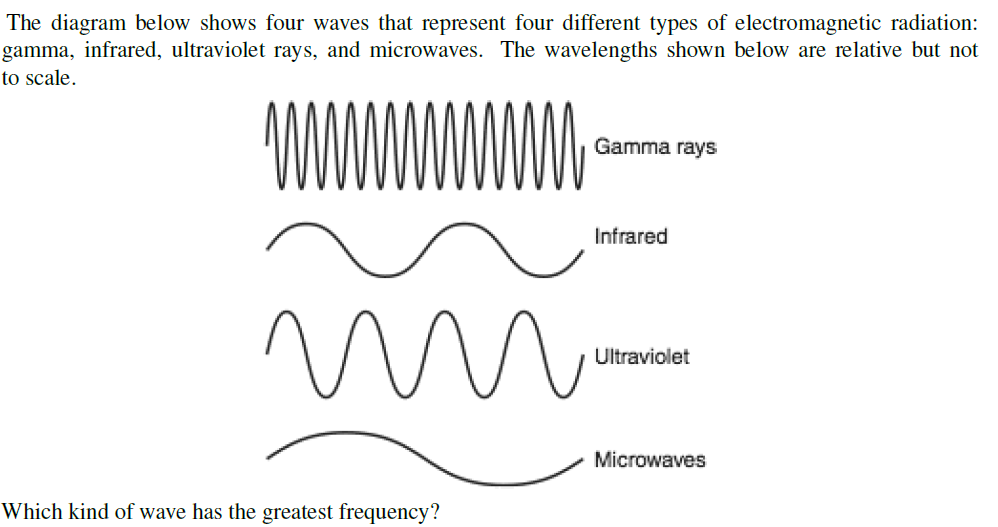
Which kind of wave has the greatest frequency?
a)
gamma rays
b)
infrared
c)
ultraviolet
d)
microwaves
34.
Which of the following will have a larger ionic radius than atomic radius?
a)
Kr
b)
S
c)
V
d)
K
35.
An anion is a negatively charged ion.
a)
True
b)
False
36.
An anion has lost electrons.
a)
True
b)
False
37.
An anion has more electrons than protons.
a)
True
b)
False
38.
A cation is a positively charged ion because it has gained electrons.
a)
True
b)
False
39.
Which of the following will lose a shell when it forms an ion?
a)
Ca
b)
P
c)
Cl
d)
Xe
40.
Why are nonmetals larger as ions than as neutral atoms?
a)
Loss of energy level
b)
Gained an extra shell
c)
More electron repulsion
d)
Nonmetals are actually smaller as ions.
41.
Which of the following will have a larger radius than Zinc?
a)
Gallium
b)
Aluminum
c)
Magnesium
d)
Strontium
42.
Which of the following will have a higher electronegativity than arsenic (As)?
a)
Carbon (C)
b)
Neon (Ne)
c)
Antimony (Sb)
d)
Germanium (Ge)
43.
Which of the following will have a lower ionization energy than Scandium (Sc)?
a)
Helium (He)
b)
Titanium (Ti)
c)
Calcium (Ca)
d)
Magnesium (Mg)
44.
Which periodic group has the smallest atomic radius?
a)
Alkali metals
b)
Halogens
c)
Noble Gases
d)
Transition metals
45.
How many inner shell electrons does Arsenic have?
a)
28
b)
18
c)
10
46.
A photon is emitted from an atom with an energy of 4.25x10^-19 J. What is the wavelength of the photon?
a)
4.67 x 10⁻⁷ m
b)
2.73 x 10⁻⁴ m
c)
1.28 x 10⁻¹⁰ m
d)
6.42 x 10¹⁴ m
47.
Which scientist characterized the "law of octaves"?
a)
Mendeleev
b)
Lavoisier
c)
Newlands
d)
Moseley
48.
Which scientist first arranged elements by atomic number?
a)
Mendeleev
b)
Lavoisier
c)
Newlands
d)
Moseley
49.
Elements Z and X are compared. Element Z is larger than Element X. Based on this you could say:
a)
Element Z is further to the left side of the periodic table
b)
Element X is closer to the top of the periodic table
c)
Element Z and X are probably in the same group
d)
A and/or B
50.
Atomic radius generally increases as we move __________.
a)
down a group and from right to left across a period
b)
up a group and from left to right across a period
c)
down a group and from left to right across a period
d)
up a group and from right to left across a period
51.
The atomic radius of main-group elements generally increases down a group because ________.
a)
effective nuclear charge increases down a group
b)
effective nuclear charge decreases down a group
c)
effective nuclear charge zigzags down a group
d)
the principal quantum number of the valence orbitals increases
52.
Which one of the following atoms has the largest radius?
a)
O
b)
F
c)
S
d)
Cl
53.
Which one of the following atoms has the largest radius?
a)
Sr
b)
Ca
c)
K
d)
Rb
54.
Which one of the following elements has the largest atomic radius?
a)
Se
b)
As
c)
S
d)
Sb
55.
Which one of the following elements has the largest atomic radius?
a)
O
b)
F
c)
Al
d)
P
56.
Which of the following correctly lists the five atoms in order of increasing size (smallest to largest)?
a)
F < K < Ge < Br < Rb
b)
F < Ge < Br < K < Rb
c)
F < K < Br < Ge < Rb
d)
F < Br < Ge < K < Rb
57.
Which of the following correctly lists the five atoms in order of increasing size (smallest to largest)?
a)
O < F < S < Mg < Ba
b)
F < O < S < Mg < Ba
c)
F < O < S < Ba < Mg
d)
O < F < S < Ba < Mg
58.
Sodium is much more apt to exist as a positive ion than is chlorine. This is because __________.
a)
chlorine is a gas and sodium is a solid
b)
chlorine has a greater electron affinity than sodium does
c)
chlorine is bigger than sodium
d)
chlorine has a greater ionization energy than sodium does
59.
The ability of an atom in a molecule to attract electrons is best quantified by the __________.
a)
paramagnetism
b)
diamagnetism
c)
electronegativity
d)
first ionization potential
60.
Put the following elements in order of decreasing ionization energy:
O, Te, Po, S.
O, Te, Po, S.
a)
O, S, Po, Te
b)
O, S, Te, Po
c)
O, Te, Po, S
d)
O, Po, Te, S
61.
The periodic table has a hidden pattern that was recognized by:
a)
John Dalton
b)
Neil DeGrasse Tyson
c)
Mendeleev
d)
Gregor Mendel
62.
Which has the LARGEST atomic radius?
a)
N
b)
N-3
c)
N-2
d)
N+5
63.
Which has the smallest atomic radius?
a)
Mg
b)
Mg+2
c)
Mg+
d)
Mg-1
100 %

