
 Worksheets
KS3 Biology Quiz 1
Total questions: 45
Worksheet time: 3hrs 48mins
Name
Class
Date
1.
a rigid supporting layer that surrounds the cells of plants and some other organisms
a)
cell membrane
b)
cell wall
c)
nucleus
d)
cytoplasm
2.
In cells a large oval organelle that contains the cells genetic material in the form of DNA and controls many of the cells activities
a)
organelle
b)
ribosome
c)
cell wall
d)
nucleus
3.
the thick fluid region of a cell located inside the cell membrane or between the cell membrane and nucleus
a)
cytoplasm
b)
cell wall
c)
organelle
d)
golgi apparatus
4.
an organelle in a cell that receives proteins and other newly formed materials from the endoplasmic retiulum packages them and distributes them to other parts of the cell
a)
vacuole
b)
chloroplast
c)
ribosome
d)
golgi apparatus
5.
a sac like organelle that stores water, food, and other matter
a)
vacuole
b)
lysosome
c)
cytoplasm
d)
cell wall
6.
a cell organelle which contains chemicals that break down large food particles into smaller ones and that can be used by the rest of the cell
a)
chloroplasts
b)
ribosomes
c)
lysosomes
d)
cell membrane
7.

a small grain shaped organelle found in the cytoplasm of a cell or on the R-ER that produced proteins
a)
cytoplasm
b)
ribosome
c)
cell membrane
d)
mitochondria
8.

What is the name of the genetic material that is inside the nucleus?
a)
ER
b)
ATP
c)
YOLO
d)
DNA
9.
The ovary, style, and the stigma make up the female part of a plant called the ?
a)
stamen
b)
petals
c)
stem
d)
carpel (pistil)
10.
Pollen grains are produced by ?
a)
the anther
b)
the stigma
c)
the flowers
d)
the leaves
11.
The seeds of apple would probably be disbursed by?
a)
animals
b)
wind
c)
water
d)
fire
12.
__________________ is a huge industry devoted to farming, ranching, food production, and many other vocations
a)
Engineering
b)
Agriculture
c)
Construction
13.

The human male reproductive system is represented below. Which structure produces cells that have the potential to become gametes?
a)
A
b)
B
c)
C
d)
D
14.

The diagrams below represent a human organ system. The major function of the system is to
a)
provide immunity essential for the survival of each individual in a population
b)
provide cells that are necessary for the survival of the species
c)
produce chemical messages that are necessary for nerve cell development
d)
control the passage of nutrients into and out of a developing fetus
15.
The primary function of the human male reproductive system is to
a)
provide a site for fertilization
b)
produce and transport gametes
c)
protect and nourish the embryo
d)
prevent urine from leaving the body
16.
The inability of sperm cells to move normally could prevent the production of offspring by interfering with
a)
meiosis
b)
fertilization
c)
mitosis
d)
differentiation
17.
Which structure is correctly paired with its function?
a)
ovary — provides milk for newborns
b)
placenta — storage of released eggs
c)
uterus — produces estrogen
d)
testis — development of sperm
18.
Testosterone directly affects the
a)
formation of a zygote
b)
changes within an ovary
c)
production of sperm cells
d)
development of a placenta
19.
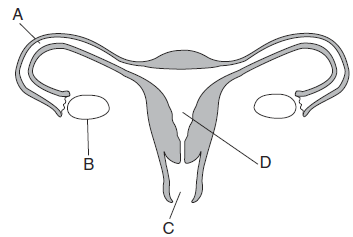
The human female reproductive system is represented below. Within which structure does the placenta normally develop?
a)
A
b)
B
c)
C
d)
D
20.

The diagram below represents one stage during the human reproductive process. A function of structure A is to
a)
remove nutrients from the fetus
b)
provide the fetus with metabolic wastes
c)
remove all toxins from the blood of the mother
d)
provide for the exchange of oxygen and carbon dioxide
21.
The structure that makes nutrients most directly available to a human embryo is the
a)
gamete
b)
ovary
c)
stomach
d)
placenta
22.
What is an advantage of internal fertilization and development over external fertilization and development?
a)
there is a greater chance for genetic variation
b)
only one sperm is needed to fertilize the egg
c)
genes can pass directly from the mother to the embryo
d)
the chance for zygote survival is increased
23.
Major organs of the digestive system
a)
Kidneys, nephrons
b)
Stomach, intestines, mouth
c)
Heart, blood vessels, blood
d)
Liver, kidneys, heart
24.
Major organs of the nervous system
a)
Kidneys, nephrons
b)
Stomach, intestines, mouth
c)
Heart, blood vessels, blood
d)
Brain, spinal cord, nerve
25.
Major organs of the skeletal system
a)
Muscles, tendons
b)
Bones, ligaments
c)
Marrow, periostium, nerves
d)
Ribs, quadriceps, femur
26.
Heart, blood vessels, blood
a)
Digestive system
b)
Excretory system
c)
Circulatory system
d)
Immune system
27.
Nose, trachea, lungs, alveoli
a)
Respiratory system
b)
Endocrine system
c)
Muscular system
d)
Skeletal system
28.
Kidneys, lungs, skin, nephrons
a)
Digestive system
b)
Excretory system
c)
Integumentary system
d)
Respiratory system
29.
Major organs of the muscular system
a)
Shoulder-blade, kneecap, triceps
b)
Muscles, tendons
c)
Bones, ligaments
d)
Heart, intestines, stomach
30.
Major organs of the immune system
a)
Kidneys, lymph nodes, nose
b)
Stomach, brain, pituitary gland
c)
Skin, stomach, breathing passages, blood
d)
Bacteria, virus, fungi
31.
Major organs of the immune system
a)
Kidneys, lymph nodes, nose
b)
Stomach, brain, pituitary gland
c)
Skin, stomach, breathing passages, blood
d)
Bacteria, virus, fungi
32.
Pituitary gland, pancreas, thyroid, adrenal gland
a)
Digestive system
b)
Integumentary system
c)
Endocrine system
d)
Immune system
33.

When you take air in through your mouth or your nose, you....
a)
exhale
b)
cough
c)
inhale
34.

Our bodies need the _________ in the air we breathe.
a)
feathers
b)
oxygen
c)
carbon dioxide
35.

When you breathe hard, your body...
a)
gets really sweaty.
b)
takes in more oxygen.
c)
sounds loud.
36.

When you exercise, your heart beats faster to...
a)
spread oxygen throughout your body more quickly.
b)
make you feel excited.
c)
let you know you're working hard.
37.
What is a way to prevent Lung Cancer?
a)
Drink Alchohol
b)
Don't smoke
c)
Eat Unhealthy
d)
Smoke
38.
What is the respiratory system?
a)
Body's food processing system
b)
Body's breathing system
c)
Body's reproduction system
d)
Body's nervous system
39.
What is the main organ in the respiratory system?
a)
Kidney
b)
Heart
c)
Lungs
d)
Diaphragm
40.
What is the main bone structure that protects the lungs
a)
Vertebrae
b)
Rib cage
c)
Skull
d)
Pelvis
41.

What is the organ "x"
a)
Heart
b)
Lungs
c)
Diaphragm
d)
Trachea
42.
Which of the following is affected by the respiratory system?
a)
Yawning
b)
Hiccups
c)
Sneezing
d)
All of these
43.

What is tube that is also known as your wind pipe?
a)
esophogus
b)
bronchi
c)
trachea
d)
alveoli
44.
EXHALE!!!
My lungs are __________________ air.
My lungs are __________________ air.
a)
taking in
b)
letting out
45.
A substance that causes cancer is generally called a/an
a)
pollutant
b)
irritant
c)
carcinogen
d)
antigen
100 %

